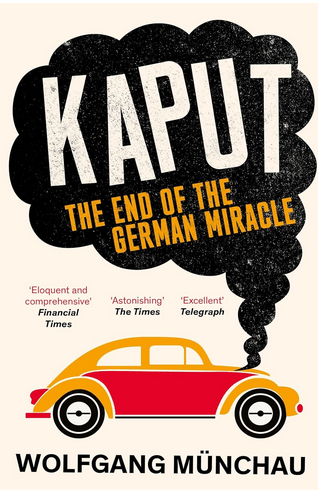
Half a century later, matters look a little different, with such warning signals as the rapid rise of the right-wing AfD, and the over-reliance on gas produced, piped into Germany and stored under the control of the state-owned Russian Gazprom. For German journalist Wolfgang Münchau, the root of the problem is Germany’s fixation with the out-dated export-driven business model of “neo-mercantilism”. In essence, Germany’s “super-cycle” has come to an end, but that, unlike for instance the Nordic countries, it is has chosen to invest its surpluses in “the same old technologies and underinvested in digitalisation”. Meanwhile, the growth of “green energy” has been hampered by excessive bureaucracy.
Münchau cites many examples of the self-serving complacency and lack of vision with which influential politicians have colluded with state banks to invest in long-established engineering rather than the riskier small innovators and in particular digital technology which would provide so much future wealth. The failure to install sufficient fibre-optic cables has resulted in very poor mobile phone reception and slow internet (as recently as 2024) – leading to the anecdote of the horse which delivered some photos over a distance of 10km faster than a computer could upload them!
At least initially, the German teachers’ association supported an academic’s view, expressed in books like “Digital Dementia”, that schools should not use computers, to avoid damaging their pupils’ concentration.
Münchau claims that, from the late 1990s, the German government was “in the pocket” of major car firms like VW and Porsche, which clung to the production of fuel-driven cars. At VW, the CEO who wished to focus on electric cars was fired, and there was the scandal of VW ironically installing software to reduce automatically emissions when being tested in a fuel-driven car.
The “modernisation partnership” with Russia which involved importing cheap gas from the latter in order to export machinery in the opposite direction has proved a miscalculation. The decision to phase out nuclear power, and limited capacity to produce green energy increased the dependence on gas. The partnership was, as it turned out naively, promoted as helping to “democratise Russia”. In fact, the sanctions imposed when Putin invaded the Crimea in 2014, meant a sharp fall in exports of machinery from Germany and increased unemployment which in turn increased support for the AfD.
Germany profited from exporting the equipment needed for the Chinese to industrialise, not foreseeing how quickly they would turn the tables and undermine the economy with cheaper manufactured imports, using “smart technology”, internet-connected machines to increase productivity. The Chinese are rapidly gaining an increasing share of the growing e-car market, developing a very efficient supply chain, copying what the Germans did for the fuel-driven car. China has taken over the German solar panel market and robotics, while Germany is dependent on China for the import of laptops, mobile phones and rare earths.
So Germany has met its match in a superpower which is also focused on export surpluses. Economic relations with China are complicated by, for instance, the need to comply with EU sanctions in response to Chinese breaches of human rights.
Although very informative and thought-provoking, at times “Kaput” seems repetitious, and peppered with the names of too many transitory politicians, business leaders and companies for a non-German reader to keep track. Barely a year after publication, some facts have been superseded and in the final two chapters Münchau seems anxious to finish, and slips into over-condensed economic theory e.g. regarding the operation of “the debt brake”.
The gist is that necessary government investment is the first casualty when spending has to be cut to comply with keeping debt relative to GDP within a certain tight limit e.g. 0.35% of GDP. Although this rule could be relaxed in the case of a national emergency, the government was found to have misspent funds meant for COVID “by funnelling them into the climate budget”.
Then there is the shortage of skilled workers, with vocational training struggling to keep up with the creation of jobs in “new” industries, and the declining number of young Germans entering the labour market. The controversial and not entirely altruistic welcoming of a million Syrian refugees may have boosted the supply of workers, but also fed the rise of the AfD.
 Antenna Reviews