This site will share with you hundreds of book and film reviews written since 2009. Also a chance to discuss these reviews together with some of my creative writing to be added.
I went to see this film with no expectations, and was pleasantly surprised. Duris plays a successful but outwardly cocky and insensitive young lawyer who harbours regrets over failing to pursue a youthful passion for photography. When he is forced to accept that his wife wants a separation, the fact that her lover is a photographer adds to his pain. An encounter with the man turns violent. As a result, the course of the "hero's" life is dramatically changed, at last he is able to pursue his art, but at a huge personal cost.
The film is well-acted, with Duris a charismatic leading man. His grief over losing contact with his children – his son is irresistibly appealing – is moving. The scenery when he hides away in Montenegro is beautiful, as is his photography, catching a ship in dock from dramatic angles, or groups of workers, half spontaneous, half wary of the camera. The plot maintains a sense of tension in which "anything could happen" and often does. I like the playing around with dream and reality, in which some dramatic scenes turn out to be imagined.
You can enjoy this story as an exciting adventure yarn – with a few implausible twists to be swallowed – or on a deeper level – an art house film as already suggested in an earlier review – as a study of man's instinct and capacity for survival, the price to be paid for one's actions, or the way that fulfilment may lie in creativity and a simple life – as exemplified by Duris's barren dwelling above a lake in a valley of incomparable beauty.
Finally, the open ending leaves you to imagine the hero's future fate as you will.
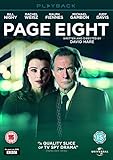
Apparently David Hare wanted to "update" a George Smiley-type M15 yarn. Bill Nighy plays an intelligence officer who has spent so many years concealing his feelings that he has become a shell, who finds it hard to give or receive real love or trust.
He is intrigued by a beautiful neighbour (Rachel Weisz) who seeks justice for her brother, killed by the Israelis during a demonstration against their destruction of Palestinian housing: Issue No. 1 on Hare's agenda, an important one, and I was keen to see this aspect developed.
Nighy's boss (Michael Gambon) has discovered that the Prime Minister (a menacing Ralph Fiennes beneath his smooth charm) has collaborated with the US government over the concealing of evidence of torture, but kept this information from his own ministers and intelligence officers, thereby seriously undermining them. It is clear that Gambon wants Nighy to take action over this undemocratic "betrayal" and Nighy feels a belated compulsion to take a moral stand. All this amounts to Issues 2 and 3: shades of Blair's collusion with the Bush regime over weapons of mass destruction, and possible British involvement in torture to get information on terrorists.
I agree that the play is witty and often amusing, a definite TV Saturday night improvement on corny whodunnits. It is slick and well-acted, as one would expect from the all-star cast, with fast-changing scenes and cryptic dialogue that sounds clever, but the issues raised are not fleshed out. The focus is on personal relationships, but these are generally brittle apart from the warm friendship with Nighy's boss. We see Nighy with his daughter, his mistress, his ex-wife, new neighbour, jealous colleague (a splendidly vicious Judy Davis) etc but all this takes up too much time to develop the rest of the plot in depth. This matters since we need to understand why Nighy is so cynical, and what is so serious that it shakes him into "cutting loose". Or is it just true love that galvanises him into using illegal means to a moral end? If so, the relationship with Rachel Weisz is not totally convincing.
Without giving too much away, Nighy compromises on one issue to resolve another. He "plays god" as to which scandal should be suppressed and which revealed, and his choice is based on personal, even self-interested considerations. This could be the intended point of the drama, but I am not sure that it is.
Although I am sure that Hare is keen to engage and enlighten us as regards topics on which he feels passionately, and I share his concerns, I was left quite unmoved by the play, without any fresh insights. The end result is all somewhat superficial and shallow, leaving me thinking "So what?"
Films of bestselling books are often a disappointment. Although I had already read and been moved by (enjoyed is an inappropriate word for a holocaust theme) the book, I think the film has a better structure, in that it does not allow the "modern" thread of the story to dominate too much or become too trite and sentimental. It is also beautifully shot and very well acted.
A film version may also serve the purpose of bringing to a wider audience the atrocity of the "Vél d'Hiv", or rounding up by the French police of Jewish women and children in Paris for transportation to Auschwitz. The horror is compounded in this story by the "twist" that the young heroine, Sarah, too young to understand the situation, manages to lock her little brother in a cupboard "for his own safety" so that he is not part of the transportation. Much of the ensuing tension in the film rests on the question of whether she will be able to escape and if she will succeed in being reunited with her brother. The drama is intercut with a modern day thread: Julia Jarmond, an American journalist, married into a well-heeled and highly respectable Parisian family, is tasked to produce an article on the Vél d'Hiv. In the process, she discovers that her father-in-law grew up in the very apartment from which Sarah's family was transported, and which her architect husband is "doing up" prior to moving there with her and their daughter Zoe. Julia's growing sense of disquiet and preoccupation with the tragic events she is uncovering begin to affect her relationship with her husband, and her attitude to life.
This is a story about issues of responsibility and guilt, and how these continue to blight – or transform positively – people's lives into future generations. The book raises the question which polarises people: is it better to draw a line on the past and move on or can one only be whole when one has confronted traumatic events, even if the price is that one is permanently changed as a result? I feel that this important aspect was somewhat blurred in the film. For instance, the wrangling between Julia's relatives and their different views on whether or not one should bury the past is largely missing from the film.
I find Julia's husband Bertrand a more convincing character than in the book, although older and less irresistibly attractive than I had pictured. Julia herself seems more likeable whereas in the book she came across as over-emotional, self-absorbed and even selfishly thoughtless in the way she acts impulsively, keeping and breaking confidences on a whim – although all this is of course necessary to the story.
In short, this comes recommended as a well-made, totally absorbing, shocking but "life-affirming" film.
This skilfully shot, well-acted and tightly scripted Danish film deserves its Oscar. It will appeal to people of all ages and nationalities. You can sit back and view it simply as a "good yarn" about a couple of barely teenage boys who slip into delinquency for moral reasons, following a warped logic which may stem from unintentional neglect by their well-meaning, hardworking middle-class parents. If you wish, you can ponder the film's messages on a deeper level, focusing on the issues which strike a chord with your own concerns. In fact, the last thing this film does is preach. Instead, it highlights the complexity of morality.
Is Anton, the idealistic, pacifist surgeon to be admired for devoting his working life to caring for people in what looks like a poverty-stricken refugee camp somewhere in Africa, or is he selfishly avoiding his guilt over his estranged wife and neglecting his two young sons back in Denmark in the process? Is he right to agree to treat the local villain when his black colleagues wish to leave the man to rot? Has he failed morally when he is eventually driven to give way to righteous anger? Is there one moral standard for a brutal, impoverished developing country and another for liberal, affluent Denmark? Is Anton hopelessly naive to insist that "violence only begats violence" to the extent that he literally "turns the other cheek" when an aggressive man punches him in front of his two sons, one of whom is Elias, with his inaptly named friend Christian a sceptical observer?
Christian's fierce sense of justice – his determination neither to be bullied, nor to let a bully go unpunished – seems more realistic, but he takes it too far. To what extent can his behaviour be condoned as a reaction against grief over his mother's death, and his father's inability to communicate honestly with him? How much more harshly would Christian and his tag-along sidekick Elias be punished for their attempts to take justice into their own hands if they were working class kids?
I agree that the ending is a little trite, and for that reason have withheld a star, perhaps unfairly since you could argue that a predictably gloomy Scandinavian ending could "turn off" more viewers than it satisfies. The plot, often shocking and sad, is saved from grimness by frequent touches of humour. After Anton's rather unwise confrontation of a bully in his workshop, to try to demonstrate to the boys how words win out over physical violence, Christian astutely observes, "But he didn't look as if he thought he's lost!" Later, when the two boys construct a potentially lethal bomb, they choose to test it out on the school project over which they have laboured for days. Their excitement over the explosion completely overrides any concerns about the waste of their work, or how they will explain its disappearance. The earnest ineffectiveness of the teachers at the boy's school is also entertaining.
There are moments of pathos, say in Anton's attempts to build bridges with the wife who loves him but cannot accept his past infidelity, or in Christian's father's halting attempts to speak of his complex emotions over the painful death of a wife to whom he may not have been faithful.
I recommend this film as a gripping and thought-provoking human drama – a popular film which stimulates you to work out your own message.
The second series of this fast-moving, dramatic Parisian police thriller with its complex "cogs spinning cogs" plot seems to me to be superior to the first, since the main plotline is more substantial, there are fewer distracting "side stories" and the end is more conclusive and less of a "damp squib".
This is very well acted, down to the smallest gesture or passing expression. The actors all seem to have distinctive faces to match them to their parts: the dedicated but often impulsive and reckless Capitaine Laure Berthaud, the suave Vice-Procurator Pierre Clement, the wily Judge Roban, the beautiful lawyer Josephine, who sells her soul for money to the corrupt senior advocate Szabo, and so on. The characters are very well-developed and convincing in their complex behaviour – the criminals often have redeeming features, while those trying to track them down are prey to ambition, hypocrisy, greed, bias or lack of self control – in short, human nature warts and all.
Although the storyline, based on drug dealing in the tight-knit Arab community, is often sordid and I hope the police methods of investigation are exaggerated, every episode is always compulsive watching throughout. The details of the French legal system are a bit hard to follow, but you can grasp the general idea. You also get a good insight into life in some of the immigrant communities in Paris.
I watched a version with French sub-titles which is good practice for an English speaker but hard going. I have certainly learned a good deal of slang I can never use on holiday in France! Since then I have watched a 2 DVD version with English subtitles – also good. but you have to read fast!




 Antenna Reviews