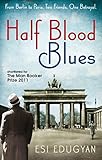
“Half Blood Blues” – Shortlisted for the Man Booker Prize 2011 by Esi Edugyan – Chandler meets Cormac McCarthy

This is my review of Half Blood Blues: Shortlisted for the Man Booker Prize 2011 by Esi Edugyan.

Since I don’t care for jazz and have little in common with hard-drinking Black American male musicians, why was I so quickly hooked on “Half Blood Blues”? At first, it was the dry, wisecracking wit, and the rhythm of the Black American speech patterns which didn’t grate as I would have expected – “he stood..leaning like a brisk wind done come up” or “Man, Sid, ain’t you ever going to clean up? You live in plain disrepair” and so on.

Then, I was struck by the spate of vivid, original similes. “He got oddly thin lips, and with the drink still glistening on them they looked like oysters”.

I realised too that there is scope for a compelling drama in a situation where a group of jazz musicians, some black, realise that the world of swing in 1930s Berlin has suddenly turned dark as the Nazis brand it “degenerate art” and begin to beat up black artists.

The author knows how to create tension. From the opening sentence, “Chip told us not to go out”, the first chapter builds up a sense of impending calamity, as the narrator Sid reluctantly accompanies Hiero, a youthful prodigy on the trumpet, in his unwise quest for a drink of milk in occupied Paris, where his high visibility as a Black German combined with a lack of the right papers place him at risk of deportation to a death camp.

Esi Edugyan takes risks in introducing the real-life Louis Armstrong to the plot, but carries it off convincingly. She also succeeds in helping me to understand the appeal of jazz music. She finds apt words to describe in detail how Hiero’s playing sounds to Sid.

“Hiero thrown out note after shimmering note, like sunshine sliding over the surface of a lake, and Armstrong was the water, all depth and thought, not one wasted note. Hiero, he just reaching out, seeking the shore; Armstrong stood there calling across to him. Their horns sounded so naked, so blunt, you felt almost guilty listening to it, like you eavesdropping.”

This is not just a tale of a jazz group under pressure, surviving violent fist fights with the brutal “boots” (Nazi soldiers) but also a subtle psychological study of the interplay between the members of a group, providing a keen insight into personal and professional jealousy. Almost until the end, we are unsure whether Sid betrayed Hiero long ago, exactly how, and if he is a reliable narrator.

Some of the minor scenes drag a little and I found a few points implausible e.g. would it really take so many weeks to make a single record, without actually completing it, would/could the seductive singer Delilah make a headscarf out of a stiff, dusty theatre curtain? Despite this, overall “Half Blood Blues” is an original, well-plotted and beautifully written work. I shall certainly look out for Edugyan’s future novels.

⭐⭐⭐⭐⭐ 5 Stars

Heritage of Folktales makes sense of War-torn Former Yugoslavia

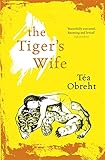
This is my review of The Tiger’s Wife by Tea Obreht.

It is easy to see why this book won the 2011 Orange Prize for Fiction. It has an unusual theme and approach, weaving together a grandfather's tall stories based on Balkan-style folktales and the experience of Natalia, a young doctor trying to cope with the aftermath of the grim war which caused the recent fracture of the former Yugoslavia, and with the death of her much-loved grandfather. Still only in her mid-twenties, the author is a gifted storyteller with an impressive command of English learned as a second language. I am not sure whether she sometimes misuses words by mistake, or is just trying to be original and poetical, but you cannot deny Tea Obreht's striking and unusual use of language.

Although I am no lover of magic realism, I was most impressed by the storytelling, in particular the tale of the "deathless man" who cannot be killed, even if shot through the head or drowned – a sceptical scientist, Natalia's grandfather is tantalised by the mounting evidence for this which flies in the face of reason. Obreht clearly loves animals, of which there are some wonderful descriptions – the tiger leaving footprints in the snow, round as dinner plates, or the elephant recaptured after its escape from the war-damaged zoo.

At first I was irritated by the lack of clarity as to exactly which country we are in – Montenegro, Croatia. Bosnia ? – which border we are close to, and so on. Then I realised that this is not the point. Obreht simply wants to create a sense of the superstition and prejudice, the deep-seated and irrational hatred between Christians and Moslems, the brutality and unthinking futility of war, and the residue of damage for the survivors. Then there is of course the simple expression of grief over the death of a close relative, regardless of whether there is peace or war.

I found the descriptions of Natalia's work the least satisfying, too many minor scenes of little interest, and in need of editing. Some of the later tales told to Natalia by her grandfather become rather tedious and rambling, getting bogged down in excessive back story about the early lives of Luka the sadistic butcher, Darisa the bear hunter and the village apothecary.

From the outset, Obreht skilfully manages to arouse the reader's interest by covering events through a series of separate scenes which move back and forth in time. Natalia's attempt to find out more about her grandfather's death and to obtain his belongings has a touch of the detective novel. Towards the end, the plot loses structure and pace. Again perhaps deliberately, it becomes even more fragmented and further parts company with reality, proving a little too fey and nebulous for my taste, although there is a persistent rather odd attempt to provide rational explanations for implausible events.

⭐⭐⭐ 3 Stars

Did Garibaldi do Italy a Great Disservice?

This is my review of The Pursuit of Italy: A History of a Land, its Regions and their Peoples by David Gilmour.

"Italy," complained Napoleon,"is too long." It is hard not to warm to a book that begins in this vein. I think that Gilmour's aim is to show not only how Italy came into existence as a single nation state, but why it has proved so difficult both to achieve and sustain unification. Even now, the economic and social divide between north and south remains far stronger and more bitter than that of England.

The author uses his obvious knowledge and enthusiasm for Italy to create a popular history in which each chapter is like a self-contained essay, drawing not only on key events but also on the diverse geography, different regions, peoples and cultures of Italy. For instance, after World War 2, five peripheral regions had to be given special status, including a good deal of autonomy to stem strong separatist demands based on physical separation, as for Sicily and Sardinia, or different languages, as in northern areas speaking mainly French, Italian or Slovene. There are some useful maps to help identify the various regions.

I appreciate why Gilmour felt that a full analysis required him to go back in time to the Bronze Age traders travelling through Alpine passes. After an initial chapter to spell out the physical and social diversity of Italy, he moves systematically forward in time, with a unifying theme for each chapter e.g. the various empires which dominated Italy, starting with the Romans; the growth of city states from the Middle Ages or the period from C15 when Italy was a battleground for foreign warring armies.

Some chapters e.g. 5 on "Disputed Italies" proved hard to follow without a level of background knowledge which would have made it unnecessary to read the book in the first place! I can see that Gilmour wanted to avoid getting bogged down in facts, but perhaps needed to think himself more into the position of a willing reader who may not know enough about the history of say, the Hapsburgs in Austria and Spain versus the French dynasties to understand their complex activities, warring and installing puppets on Italian soil, from 1494 to the early 1800s.

I resorted to reading the chapters in reverse order. Perhaps because they interest him most, Gilmour seems to write best about more recent events such as the modern resurgence of "centrifugal Italy" and the rapid rise of the racist and divisive Northern League under Bossi. Once I had absorbed all the fascinating events from say, Garibaldi through Mussolini to Berlusconi, I had the motivation to go back further in time and make the effort to understand the more distant, important yet often less engaging detail which underpins the current situation.

Overall, this is quite an ambitious work, which might benefit from a slightly clearer stated aim, and sometimes becomes too fragmented in its attempts to provide a synthesis, but on balance it is for the most part informative and readable.

It ends on a provocative note. Despite creating "much of the world's greatest art, architecture and music and…one of its finest cuisines" and possessing "some of its most beautiful landscapes and many of its most stylish manufactures", united Italy has never lived up to its founders hopes, "predestined" by its history and geography "to be a disappointment….never as good as the sum of its people".

⭐⭐⭐⭐ 4 Stars

Slight of Hand

This is my review of The Prestige by Christopher Priest.

The term "prestige" refers to the product of a magic trick – the rabbit pulled out of a hat.

"The Prestige" is the tale of a feud between two rival magicians in the late Victorian age, the working class Borden who makes good use of his skills as a cabinetmaker to conceal people during tricks, and the aristocratic Angier, forced by the poverty of being a younger son to make a living out of a hobby. Told largely through extracts from their journals, starting with Borden's viewpoint, this makes for a clunkily plotted read. Many incidents are reported, which detracts from the drama, and the tone is often stilted, although this may be an attempt to adopt a suitably Victorian style. At any rate, the characters come across as rather wooden.

Borden's prize act is "The Transported Man", for which the obsessive desire to work out an explanation drives Angier to distraction. The only possible solution seems to be that Borden has a double, but there is no evidence for this. In his desire to outdo Borden, Angier is driven to devise a transportation trick of his own, making use of the new power of electricity to move himself instantly from one place to another, although the process gives rise to a certain persistent problem… I was interested to learn that the electrical engineer Tesla really existed and had a laboratory at Colorado Springs, with a contraption called a "magnifying transmitter" which emitted arcs of electricity 7 metres in length. However, I share the disappointment of readers who prefer a story of magic where the suspense lies in working out how it is done, rather than one which relies on science fiction to create effects. This raises a real problem in reviewing the book fairly, since scifi is by its nature generally implausible. You just have to like it (which I don't) or judge it for its originality. On this count, the book scores quite highly, but it would have worked better with more skilful development of the plot.

I agree with those who think that the modern storyline of the magicians' descendants, wrapped round the basic plot, proves to be a further twist too far. This may be why it has been dropped totally in the film version of the book, which I happened to see a few years ago before reading "The Prestige" for a book group. I also think the film version works better because the visual recreation of the various tricks and acts of sabotage is obviously more entertaining than a series of descriptions. Interestingly, I enjoyed the film right up to the end when the multiple cloning of men and black cats by electrical transmission seems too ludicrous. This particular twist is not in the book.

Although I would say that the story works better as a film, you could argue that the book version of "The Prestige" has two advantages. It includes analyses of what motivates magicians and of the nature of magic, and insights on the relationships between the main characters which are lacking in the film. These combine to make it more thought-provoking, yet this quality sits uneasily with an ending which could be said to "go off the rails".

⭐⭐⭐ 3 Stars

Why is this disappointing?

This is my review of Solace by Belinda McKeon.

The following is an attempt to analyse why a book which has been well reviewed so far disappointed me.

This slow-paced novel commences with descriptions of places – the Irish countryside – and small incidents – buying a ball of twine. The reader is left to work out who the main protagonists are, what the characters are like and what is going on, and that is fine. We meet Tom the farmer, his son Mark who has returned to assist him, with an infant daughter Aoife in tow. Where is the child's mother? Is Mark's excessive anger over his father taking the child with him to buy twine without telling him a cover for some deeper-seated resentment? There are all the ingredients for the unwinding of some moving Irish tale and my expectations are suitably kindled, but nothing much happens over and above what is given away on the flyleaf.

As the book progresses, I find it hard to engage with any of the characters. I think this is because the differences in their personalities are not very clearly drawn and sustained. The most dramatic incidents seem strangely muted. The description of someone discovering she is pregnant, another of someone dying in an accident – the events and people's reactions, none of this moves me as it should. Likewise the old grievance between the fathers of Mark and Joanne does not strike me with sufficient force, given the flyleaf's reference to "spectacular…wrongs" and "betrayal". I think part of the problem is that, once the book gets under way, there is too much "telling" rather than "showing". Also, events seem too disjointed.

Pehaps the plot is too slight to sustain a book of this length in the absence of a strong narrative drive. I feel that I am reading the words of someone with an ambition to write, who loves putting words down on paper or the keyboard but does not as yet have much to say.

Yes, the simplicity is to be admired, but needs to provide new insights or find ways of expressing truths that we cannot produce for ourselves.

For examples of "less is more" I cite the work of the late Brian Moore and also William Trevor.

⭐⭐ 2 Stars

Another Case of Truth more Dramatic than Fiction

This is my review of The Sinking of the Laconia and the U-Boat War: Disaster in the Mid-Atlantic by James Duffy.

A recent television drama on the sinking of the Laconia during WW2 prompted me to obtain this book. With the aim of putting the already well-documented Laconia incident in context, it provides plenty of examples to show that Hartenstein, Captain of the U-boat U-156 which torpedoed the Laconia, was not alone in putting himself out in the attempt to rescure survivors once they had ceased any attempt to retaliate. German U-boat crews regularly pulled people out of the water, helped them into lifeboats or even on board the submarine, provided food, blankets, medical aid when needed and gave directions to the nearest coast, helped to repair lifeboats, even towed them to passing ships that would take them to safety.

What has made the Laconia incident so striking is the sheer number of survivors, meaning that Hartenstein did not have the capacity and enough supplies to meet their needs without calling for help. As photographs bear out, at one point the entire deck of the sub was crowded with some 200 survivors. There is also the issue of their composition: the Laconia was found to be carrying up to 1800 Italian prisoners of war. The fact that many were trapped below decks as the Laconia sunk was likely to cause diplomatic tension between the Germans and their Italian allies, so Hartenstein was under pressure to do what he could to save the rest.

If Hartenstein had been able to carry out his plan of calling on available U-boats and enemy "Allied" craft to relieve him of his human burden, virtually all those surviving the inital onslaught would have been saved. Sadly, an American bomber on the mid-Atlantic refuelling base of Ascension Island was given by officers who were probably not in full possession of the facts the terse and fateful order "Sink sub at once". Hartenstein had no option but to order the survivors to jump overboard, cut loose the lifeboats, and make a rapid dive for his own crew's survival.

Although the level of detail is sometimes too much for a general reader to take, this book is full of fascinating information. To reduce the risk of attack, ships used to follow a zigzag course, very wasteful of fuel. Only on moonless nights could they risk travel in a straight line, with all lights blacked out. The subs used diesel fuel at the surface but battery power under water. They faced risks on a daily basis when it was necessary to rise to the surface to use diesel power to recharge these batteries.

After the Laconia incident, Admiral Donitz was obliged to issue the infamous "Laconia Order" forbidding U-boats from taking enemy survivors on board. For this he suffered opprobrium, and was imprisoned after the war for his aggressive attacks on Allied shipping. However, Donitz probably refused in the sense of managing not to obey Hitler's order for U-boat commanders to kill the crews of sunken ships, even if they were on lifeboats.

This book leaves it to us to debate the morality of launching a torpedo with the aim of killing as many people as possible, but then risking one's own life to save the survivors of this action. Hartenstein, a brave and humane man with the misfortune to live under the authority of a crazy dictator lost his own life when the U-156 was blown up a few months later.

⭐⭐⭐⭐ 4 Stars

Striking if Overblown Insight on Life in Trinidad

This is my review of The White Woman on the Green Bicycle by Monique Roffey.

My view of this book see-sawed violently as I read it. Starting with the over-used ploy of the description of a shocking event, in this case the beating of a young boy by corrupt policemen, the novel launches into a study of Englishman George Harwood and his French wife Sabine, who have lived on Trinidad for fifty years. It dissects their rum-fuelled love-hate relationship with each other and the island.

For many pages I read without feeling absorbed, noticing the stilted, banal scenes, characters who did not quite ring true. I was interested to realise that George's interviews for the " Trinidad Guardian" are with real people still living at the time of writing, and wondered if one of them , the famous calypso singer "The Mighty Sparrow" takes exception to being described as the suspected father of a poor, illegitimate Trinidadian boy.

Gradually, I found myself impressed by some of the vivid descriptions, say of the colourful island vegetation, which I found to be very apt when I googled their images. For instance, we see George's favourite month of May described in language which implies his casual promiscuity.

Sabine's habit of talking to the surrounding green hills which she sees as a voluptuous reclining woman seducing George and her appreciation of Trinidad's beauty, contrast with her hatred of the country's corruption and its failure to progress once free from white domination, and the way it makes her feel an outsider.

She hates George too at times for choosing to ignore all this, so that he can exploit the situation, indulge in the free way of life, the scope to grow rich through land purchase, enjoy "the sounds and smells….smiles and shapes", the "bewitching" local women and booze, in a way that would never have been possible in England.

The first part of the book proves to be a novella set in 2006, building up to a dramatic conclusion which I felt for a time should be the end of the whole book. Since the next section moves back in time, to the Harwood's innocent arrival on Trinidad in 1956, I had to force myself to continue because of the numerous hints already provided as to what had happened in the past.

I remain unsure as to whether a structure that moves back in time is a good idea. The reader may gain a sense of "one-upmanship" through knowing more than the characters, but on balance this does not compensate for the loss of suspense.

However, once the narration becomes first person, Sabine's viewpoint from part 2 onwards, it seems to come more alive, grow more moving, and the quality of the writing also improves.

I remain unconvinced by the idea of Sabine loving the unsuccessful leader Eric Williams, the first black leader of an independent Trinidad who promises the people progress, but fails to deliver. I also think the story is not just about the exploitation of Trinidadians first by whites, then by their own leaders. It is also about issues of feminism – the way some women are attracted by powerful men, and allow themselves to be dominated by men, as well as the sense of regret many women have over failing to achieve much in their lives.

The book "goes on too long" and the attempt to create a resounding finale in 1970, after moving back from 2006 to 1956, then forward again, makes for a final chapter with some of the overblown or ludicrous paragraphs which mar an otherwise striking novel.

⭐⭐⭐⭐ 4 Stars

Impressive Courage or Ignorance is Bliss

This is my review of Wagons West: The Epic Story of America’s Overland Trails by Frank McLynn.

I was inspired to read this after watching the recent film about "Meek's Cutoff" in which a small number of pioneers hire an unreliable guide to show them a short cut on the Oregon Trail. The true story proves to have been much more dramatic, involving more than 1000 people and perhaps 300 wagons. Soon clearly lost, the party ran dangerously low on food and fresh water at times, or found more than they bargained for in the form of torrential rivers which could only be crossed by dismantling their wagons piece by piece. Resentment against Meek rose so high at one point that he came close to being hanged from a gibbet made from raising up the tongues of three wagons and tying them together in the kind of summary justice often practised in a society which had to maintain its own system of law and order. In fact, the travellers were often remarkably lenient. The punishment for killing a man in angry self defence might be expulsion from the group, perhaps to be readmitted fairly quickly.

"Wagon's West" provides a useful history of the background to the great pioneer movement which began in earnest in the 1840s. The young nation of the United States did not yet clearly control the western part of the continent: Oregon was still effectively a British province, and California part of the decayed Mexican Empire. The first pioneers were neither religious refugees – apart from the Mormon trek of 1847 to establish Salt Lake City – nor were they the poorest elements of society. It took moderate means to assemble a wagon and provisions for the trek along the Oregon Trail, or to branch off it at the staging post of Fort Hall to reach California.

I agree that the "blow by blow" account of the first great treks from 1841 is repetitive at times, and includes far too many characters for one to absorb. Clearer, better positioned maps would be helpful, together with a few more photographs, although Google images provide a fascinating accompaniment to descriptions of landmarks like Chimney Rock, or the many rivers, mountains and forts described en route.

McLynn conveys well the courage and resilience of people who would set out with only sketchy knowledge of a route which would cover hundreds of miles and take weeks. It helps one to understand why so many modern-day Americans are so opposed to the idea of relying on state aid. Of course, the travellers were mostly farmers or skilled craftsmen like blacksmiths, and used to living off the land. Descriptions of encounters with vast herds of buffaloes, using their droppings as fuel in the absence of timber for firewood, rattlesnakes bunking with prairie dogs, Indians who wanted some compensation for encroachment on their territory, stole horses or shot at oxen so they would be abandoned to provide them with food, the petty bickering triggered by the sheer boredom of travelling mile upon mile, or the hardship of running short of vital supplies, the crazy jockeying for position to take the lead, rather like the road rage of car drivers today – all this makes for a fascinating read.

Just when you feel that you have had enough, McLynn changes tack slightly, with a chapter on the infamous "Donner Party" who became stranded in snow on a treacherous cut-off, and may have resorted to cannibalism: other sources now dispute this horrific twist which McLynn presents as Gospel. The chapter on the Mormon Trek is particularly interesting, showing how an autocratic, manipulative leader, Brigham Young, maintained discipline to provide an impressive example of rapid colonisation. The Epilogue ends with the Gold Rush of 1848, which disrupted the former relatively orderly pattern of migration. McLynn describes how, in the craze to get to the riches first, people set out with too many goods and abandoned them after only a few miles, littering the landscape, so that the traders who had sold them could easily collect them up again for resale. The Westerns with which we are so familiar do not appear at all far-fetched.

⭐⭐⭐⭐ 4 Stars

An Islamic Morality Tale

This is my review of Les hirondelles de Kaboul: Roman by Yasmina Khadra.

Although I read this in French – and it is excellent practice for improving one's French – I thought it best to post a review in my native English.

The swallows are the veiled women of Kabul, who flit through the ruined alleys like fugitives in a perpetual "half-life" of oppression.

It is ironical that all the reviews to date have been written on the English translation. The original French version of this tale – which I am sure must be "better" for those who can access it – uses vivid, striking language to capture the atmosphere of a war-torn city under the bigoted rule of the Taliban, which gives free rein to bullies and fanatics: people survive by keeping their heads down.

We see constant examples of casual brutality and sexism which shock our sanitised western sensibilities.

When a man admits to his worries over his sick wife, a friend condemns him for such a display of his own weakness. The remedy is obvious: he should cast his wife aside for a younger model!

A sensitive young man is aroused by the madness of a crowd to join in the stoning of a woman he does not even know, a momentary lapse on his part which costs him the love of his would-be emancipated wife.

As a final irony, men who feel "dishonoured" when a lunatic tears aside their wives' veils trample on the women in their haste to get at him.

This short, simple tale of cause and effect reminds me of a medieval morality play, as the lives of the various characters begin to impinge on each other and events build to a plausible but inevitably tragic climax.

I have no idea as to the authenticity of this story written by an Algerian army officer under a female pseudonym to avoid censorship at the time. Despite its bleak theme, and at times somewhat overblown prose (which somehow seems acceptable in French), the story of the chain reaction of damage wrought by fanatical repression remains in one's memory.

⭐⭐⭐⭐ 4 Stars

The Rites of Ming

This is my review of China: A History by John Keay.

This thorough, systematic history provides an informative and readable textbook.

I like the introduction which challenges the myths which have arisen over The Great Wall, the Grand Canal, the Long March and even the Giant Panda. Although I appreciate the author's point that a history of China calls for a focus on the distant past because its culture is so "historically conscious" that "the remote is often more relevant", I am not sure that the author actually identifies this relevance very often! Yet it is salutary to realise how relatively advanced the Chinese have been for so long, compared to the west.

However, taking 300 pages to cover the first two thousand years without quite reaching the date of the Norman Conquest of England proved too much detail for me to absorb. My solution as a "general interest reader" was to move to Chapter 14 on "The Rites of Ming", the time span 1405-1620, i.e. contemporaneous with the late Renaissance in Europe. Although the characters do not come alive as individuals like, say, the Tudors, it is interesting to read about the size and scale of the Chinese voyages of the famous eunuch Zheng He with up to 300 ships, the largest over 130 metres long compared with the pioneering voyage of Columbus with only three ships, none longer than 20 metres. Yet, rather than dominate the seas, the Chinese fleets were laid by to rot, after the emperor's decision (or was it that of the scholar-bureaucrat mandarins?) to turn his back on overseas enterprise. The conflicts between the emperor, who despite his "heavenly power" could only "dispose", and the mandarins who "proposed" his actions are also intriguing.

It is hard to keep track of the various states, so that more small maps at relevant points would have been useful.

I recommend this book as a useful text to have on one's shelf for reference, although I am personally more interested in the last couple of centuries of Chinese history i.e. its contact with the west.

⭐⭐⭐⭐ 4 Stars