L’Absolue Perfection du crime by Tanguy Viel, annotated as study guide by Johan Faerber – L’absolue étouffement de la pensée individuelle?

This is my review of L’Absolue Perfection du crime by Tanguy Viel,Johan Faerber.

I purchased this by mistake, thinking it was an annotated copy of the novel itself. In fact, it is a very detailed “study guide” of the type used to help students pass exams. Perhaps the brevity and clarity of Tanguy Viel’s writing lends itself to being selected for “set texts”.

The novel, which you need to purchase separately, possibly from Amazon.fr, is an account of an attempted “perfect crime”, the robbery of a casino by a small gang in a French seaside town. You know from the outset that matters will not go according to plan. Much of the interest lies in enjoying the author’s distinctive, deliberately repetitive and often rhythmic style, and his playing with time e.g. building up to a dramatic climax which is then described as if “after the event”.

The guide focuses on the rivalry, reminiscent of Cain and Abel, between the “faux frères”, the enigmatic and brutal man of action Marin, and the more passive and introspective narrator, whose name appears to be Pierre although I missed this on my first reading. Pierre strikes me as altogether too articulate and insightful to be a member of a mafia-style gang, but this point is not explored.

The guide rams its points home with an almost hypnotic repetition, so that I would advise reading it after tackling the real thing. I did not appreciate when doing so that each chapter is based on a specific Hollywood noir thriller from the 1950s, so it is useful to discover what these are, although I think that this device gives the novel a somewhat mechanical and contrived quality. Various metaphors are highlighted, such as the frequent references to the rearview mirror of Marin’s car, as a way of indicating a tendency to be backward-looking.

In a very thorough analysis of the book from every aspect, the guide is useful in explaining Viel’s fascination bordering on obsession with the cinema – although this has in fact recently declined. His belief that it is hard to create anything new in writing has led to his continual reference to existing cinematic films in order to construct “remakes” using the written word, a reversal of the usual process, although I would argue that Viel’s more recent “Paris-Brest” is in fact quite original. Perhaps his previous approach has fed this new creativity.

My main criticism of the guide is that it tends to overdo telling us what we should think, and does not leave space for personal speculation and interpretation.

⭐⭐⭐⭐ 4 Stars

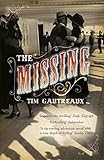
“The Missing” by Tim Gautreaux – For the love of children and steamboats

This is my review of The Missing by Tim Gautreaux.

Not to be confused with other stories bearing this title, “The Missing” refers not only to the abduction of a small girl called Lily, but also the psychological effects of family loss both on her and on Sam Simoneaux, the young French-speaking American who dedicates himself to finding her. Nicknamed “Lucky” for having landed in France off a US troopship just after the armistice which brought World War 1 to an end, Sam’s good fortune runs out when he loses his cushy job as a Louisiana department store “floor-walker” because of his failure to prevent the kidnappers from escaping with their prize. His attempts to find Lily, and to come to terms with his own past, form the core of this novel.

“The Missing” is a good “old-fashioned” yarn, in that it has a strong, straightforward plot with plenty of twists and tense or moving moments. It stands out for the quality of the writing: “…the train was pulled off the lurching ferry…., handed over to a greasy road locomotive, and proceeded west through poor, water-soaked farms into a reptile-laced swamp where virgin cypresses held up a cloud-dimmed sky……from one of the new aeroplanes the railroad would look like a flaw in a vast green carpet”.

Apart from creating this vivid sense of place, Tim Gautreaux is good on the development of Sam’s character, as he gains insights into dealing with both grief and revenge. The author must also have undertaken a phenomenal amount of research to produce the detailed descriptions of life in the 1920s on Mississippi paddlesteamer leisure cruises, where skilled black jazz musicians won over their local audiences, often cracking deep southern prejudice in the process.

If forced to criticise this impressive and absorbing novel, I would say that it is probably too long, insufficiently ruthless in rooting out superfluous, more mundane details, whilst omitting some areas of interest to the reader such as how Sam came to marry his long-suffering wife, Linda, or what befell some of the villains of the piece. I was in fact unconvinced that a strong, capable man like Sam would have found it so hard to gain employment other than working on the paddlesteamer, or that Linda would have accepted with so little complaint Sam’s long absences, in particular when he could no longer claim that they were necessary to find Lily. Some events are “told” rather than “shown” as in the case of the personalities and motivations of Lily’s captors. Also, despite some grim events, the story lapses at times into American-style corniness and slapstick punch-ups, but manages to take an unusually sophisticated approach to the issue of “revenge”. I now plan to read “The Clearing”…….

⭐⭐⭐⭐ 4 Stars

Sins of the fathers

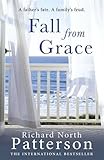
This is my review of Fall from Grace by Richard North Patterson.

Adam Blaine returns from Afghanistan for the funeral of best-selling novelist Ben, the charismatic, but cruelly manipulative father who a decade earlier drove him to leave his home in Martha's Vineyard and abandon his law studies for reasons which are not revealed until the end of this twisting yarn. In a final abuse of power, Ben has made his estranged son executor of the will which disinherits his wife Clarice and Adam's brother Teddie, leaving his estate to the beautiful former actress Carla.

The author creates an intriguing situation and a range of interesting characters, although his world of predominantly rich, gifted, boozy, somewhat two-dimensional people with a common style of speech, by turns corny or brittle, palls at times. The plot proves somewhat skimpy, and I was aware of the frequent repetition of key points, which I suppose helps to drum them in. This may be a result of North Patterson's preoccupation with legal arguments, which are in fact his strongest point. I could not help noticing sentences which are occasionally slipshod or tending towards inflamed purple prose. Despite these reservations, I found this for the most part "a good read" of the kind that gives you a guilty pleasure.

"Fall from Grace" is the second part of a trilogy about the Blaine family, although I believe it was published first. I started with "Loss of Innocence" , which portrays Ben as a talented but poor and embittered young man drawn albeit with cynicism to Clarice's world of privilege and power. I would recommend reading the series in this chronological order.

"Fall from Grace" may not be great literature, but North Patterson does this kind of dysfunctional family thriller well. I shall read the final part of the trilogy.

⭐⭐⭐⭐ 4 Stars

“Replacing an identitarian object with a real presentation of generic power”

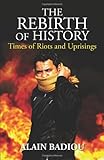
This is my review of The Rebirth of History: Times of Riots and Uprisings by Alain Badiou.

Attracted by the apparent brevity of "The rebirth of history" (119 pages), I was interested in reading an analysis of recent uprisings such as the Arab Spring by the famous French political philosopher Badiou. I understand his desire to adopt an academic approach, and was prepared to rise to the intellectual challenge of grasping his ideas. This was made harder by what I found to be a very tortuous style, although this may have suffered in translation.

Badiou cannot be blamed for wishing to be one of the first in the field to comment on the Egyptian uprising which triggered such optimism in the early days of Tahrir Square and the fall of Mubarak. His conviction that this is a clear example of the rebirth of history has suffered a setback from the re-establishment of a repressive military regime, but it is still too early to judge the longer term outcome of the Arab Spring. However, I came to the conclusion that the essence of Badiou's thoughts on riots as such could have been summarised in an essay. He also complicates his case by straying into the vast and complex topics of nation states, communism and liberalism, citing the books he has already written on these.

He makes some interesting observations, such as that contemporary capitalism has all the features of traditional capitalism as described by Marx although he did not live to see it: concentration of capital in the hands of the global "gangsters of finance"; government leaders of all persuasions reduced to the role of "capital executives". Another example is Badiou's definition of "intervallic periods" following the collapse of a significant new "Idea" e.g. 1980-2011 when classic capitalism revived because communism had failed which he compares with 1815-50 when dissatisfaction with the French Revolution led to a revival of monarchism.

In essence, I understood him to say is that a mass uprising of a diverse group of people, although they may only be a numerical minority, occupying a clear site, may generate the enthusiasm and energy necessary to force change, improving the lot of those neglected or oppressed by the state. He remains an idealist, arguing that, in such a riot, it is enough "to want to want" subordinating "the results of action to the value of the intellectual activity itself".

My basic problem with Badiou is that I find him over-theoretical and unrealistic. He enabled me to understand better what is meant by "the withering of the state" and the rejection of representative democracy as a form of exploitation. However, his thesis that a viable, peaceful society could emerge through the power of the "Idea" taking root – his language is quasi-religious at times – seems woolly and Utopian, a luxury for an academic in his Parisian ivory tower.

⭐⭐⭐ 3 Stars

Soon to be neither national nor healthy?

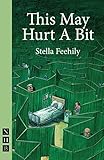
This is my review of This May Hurt A Bit (NHB Modern Plays) by Stella Feehily.

This very topical play is a savage indictment of the UK Coalition’s reorganisation of the NHS. To regular followers of the media, the main attacks will come as no surprise: costly, top-down, cynical sell-off of services without a mandate from voters, handing over to profiteering private, often foreign companies, failing to ensure that provision is adequate and worst of all, sacrificing the post-war vision of a free service based on need, unique and revolutionary in its day.

The drama pricks our consciences with an opening polemic from Nye Bevan, then moves on to a kind of “Yes Minister” scene, in which a Sir Humphry clone gives David Cameron the form of words to fob of criticism of the proposed Act.

It is soon clear that this play is a series of sketches, with surreal touches as when Nye Bevan and Churchill gatecrash a family reunion to argue over how best to manage a health service collapsing beneath the unforeseen demands of a rapidy ageing population, or when a budgie called “Maggie” begins to talk like Margaret Thatcher.

Requiring a high level of performance, this play is by turns funny and poignant, but the polemical stance is often heavy-handed. The criticism of PFIs is devastating, but in the main the assault is too earnest and didactic, rather than subtly dramatic. Despite the inclusion of a pro-reform consultant, and stereotyped Republican American medic and his English wife who only see the faults in the NHS, there is insufficient coverage of alternative points of view with arguments to counter them effectively.

The work seems likely to date quite fast.

⭐⭐⭐ 3 Stars

Automatic assumptions

This is my review of The Expendable Man by Dorothy B. Hughes.

Hugh Densmore, a young American doctor on his way to his niece's wedding in Phoenix feels obliged, against his better judgement, to pick up a teenage hitchhiker. Who knows what will befall her if he does not? She proves both an unpleasant liar and a pathetic object of pity. When local newspapers report the discovery of a young girl's body in a canal, Hugh is convinced it belongs to the hitchhiker, and that the police will soon be knocking on his door. He is fatalistic, yet also determined not to spoil the wedding and to prove his innocence.

It is not until more than fifty pages in that the author delivers a master stroke by revealing a piece of information that stopped me in my tracks. Not only does it explain Hugh's previous almost paranoid fears, but completely alters the reader's perception of the situation. I was forced to look back to see if I had misread some details, but it was clear that I had made certain assumptions and was potentially as guilty of misjudgements as some of the characters in the book.

This book is partly a psychological crime thriller in which every step is developed in forensic detail. It is also a study of life in the western states of America in the early 1960s – the baking afternoon heat and traffic jams of Phoenix, the "startling growth" of the suburbs, the abrupt change from surfaced roads to rough tracks through the semi-desert landscape of "troglodyte rocks and spire cacti". Although Dorothy Hughes can be a little shaky on the flowering of romance, she is excellent on landscapes, cold starry nights and the burgeoning fast food culture as well as deeper issues in a world of racial prejudice and criminalisation of abortion.

The sustained sense of menace and very evident risk of Densmore being unjustly ruined, combined with occasional suspicions that he may go free at the end yet turn out to be a villain after all, make this a page turner. With so much suspense, it is perhaps inevitable that the final climax is a somewhat underwhelming, but overall this gripping tale deserves its recent revival. It stands the test of time as one of the best crime novels which everyone who enjoys this genre should read.

⭐⭐⭐⭐ 4 Stars

Too far out and not drowning

This is my review of Loss of Innocence by Davi Patterson,Richard North Patterson.

In a break from his tense courtroom scenes and alpha male political dramas, the author makes an effective stab at writing from the female viewpoint, even if his women in the America of 1968 are still under the influence of a benign but controlling WASP patriarch.

A bright young graduate, Whitney Dane chooses too lightly the conventional path of devoting herself to husband and children. Only muted warning bells suggest to her that fiancé Peter is a little too compliant, accepting from her father Charles a job in high finance that does not really suit him, acquiescing to string-pulling, again by Charles, to avoid the Vietnam draft. Charles even gives the couple an upmarket flat in New York as their future home, stifling any desire to find their own place. In sharp contrast to all this, the assassination of Bobbie Kennedy, following so soon on that of JFK and Martin Luther King, shocks Whitney into a more questioning line of thought. She is therefore ripe to fall under the influence of Ben Blaine, an unconventional young man from a different class who encourages her to think for herself.

This book will resonate with those old enough to remember 1968, but non-Americans and those under sixty-five would probably appreciate an appendix or two to explain the background politics, in particular of the Democrats divided over Vietnam.

It grated on me a little that all the main characters seem to be born wealthy and privileged or achieve these attributes in due course. Perhaps this is because the successful and well-connected author simply does not know about ordinary people.

Another slight weakness for me is the device of book-ending the main story between scenes of "I want to tell you a story" and "So this is how it worked out afterwards". In this case, we see Whitney in her sixties, encountering a younger woman who was Ben's last lover. I found the opening section rather trite, and the conclusion dotted i's and crossed t's too explicitly, leaving little to the imagination. This approach may have been used because the novel is a prequel (to a book I have not read) and is intended as part of a trilogy which effectively makes the whole into a kind of soap opera.

North Patterson is a seasoned producer of bestsellers. He knows how to write a page-turner with a strong, pacy plot, a well-judged ending (of the main story), engaging dialogues and sharp insights. The descriptions of sailing and of Martha's Vineyard are very vivid, although I know nothing about either. Yet, some passages cry out for rigorous editing to give a leaner and more edgy style rather than one that too often seems stilted or overblown.

⭐⭐⭐⭐ 4 Stars

Automatic assumptions

This is my review of The Expendable Man (New York Review Books Classics) by Dorothy B Hughes.

Hugh Densmore, a young American doctor on his way to his niece's wedding in Phoenix feels obliged, against his better judgement, to pick up a teenage hitchhiker. Who knows what will befall her if he does not? She proves to be both an unpleasant liar and a pathetic object of pity. When local newspapers report the discovery of a young girl's body in a canal, Hugh is convinced it belongs to the hitchhiker, and that the police will soon be knocking on his door. He is fatalistic, yet also determined not to spoil the wedding and to prove his innocence.

It is not until more than fifty pages in that the author delivers a master stroke by revealing a piece of information that stopped me in my tracks. Not only does it explain Hugh's previous almost paranoid fears, but completely alters the reader's perception of the situation. I was forced to look back to see if I had misread some details, but it was clear that I had made certain assumptions and was potentially as guilty of misjudgements as some of the characters in the book.

This book is partly a psychological crime thriller in which every step is developed in forensic detail. It is also a study of life in the western states of America in the early 1960s – the baking afternoon heat and traffic jams of Phoenix, the "startling growth" of the suburbs, the abrupt change from surfaced roads to rough tracks through the semi-desert landscape of "troglodyte rocks and spire cacti". Although Dorothy Hughes can be a little shaky on the flowering of romance, she is excellent on landscapes, cold starry nights and the burgeoning fast food culture as well as deeper issues in a world of racial prejudice and criminalisation of abortion.

The sustained sense of menace and very evident risk of Densmore being unjustly ruined, combined with occasional suspicions that he may go free at the end yet turn out to be a villain after all, make this a page turner. With so much suspense, it is perhaps inevitable that the final climax is a somewhat underwhelming, but overall this gripping tale deserves its recent revival. It stands the test of time as one of the best crime novels which everyone who enjoys this genre should read.

⭐⭐⭐⭐ 4 Stars

Light shed

This is my review of Zennor in Darkness by Helen Dunmore.

Having read Helen Dunmore's spare and brilliant novel "Lies" focused on a shell-shocked young Cornishman in the aftermath of World War 1, I was interested in comparing it with her début novel published twenty years earlier, "Zennor in Darkness". Set in 1917, this describes how the tentacles of war have reached into rural Cornwall, with teenage boys conscripted from remote farmhouses, and cottage windows darkened with blackout curtains to deflect the German U-boats venturing near the coast to prey on British supply ships.

Since the author is also a poet, it is perhaps not surprising that "Zennor in Darkness" has a touch of Under Milk Wood with its array of local characters. The two who emerge most sharply in the foreground are at least to some extent outsiders: young would-be artist Clare Coyne, whose genteel Catholic father stayed on in Zennor after his wife's premature death, and the author D.H.Lawrence, who hoped in vain to find a refuge in Cornwall from the public outrage over his attacks on the war, and his marriage to Frieda, a German who had abandoned her husband and children to be with him.

The present tense which seems to have annoyed some reviewers did not trouble me at all. I hardly noticed it, and think that in fact it creates an increased sense of immediacy, and awareness of what each character is observing and feeling. However, the novel is clearly less taut and polished than "Lies". Several scenes, such as the opening chapter with three girls sunbathing on the beach is too rambling, with a confusion at times as to who is talking or who the identity of the main character – I thought at first it was Clare's cousin Hannah. There also seemed to be a bewildering excess of names to cope with at first. The writing sometimes seems over-intense.

This is a slow burning novel, a stream of impressions and thoughts. It conveys as far as I can tell a powerful and evocative sense of the Cornish landscape and the ambiance of a tightknit, closed community. Dunmore is also good at portraying relationships between people, their shifting emotions, misunderstandings and mutual criticism despite strong empathy, even love. Although in the main uneventful, requiring the reader to take time and savour the originality and beauty of Dunmore's prose, the novel shifts into a higher gear for the final third to reach a convincing conclusion.

⭐⭐⭐⭐ 4 Stars

When doing harm is unavoidable

This is my review of Do No Harm: Stories of Life, Death and Brain Surgery by Henry Marsh.

"The idea that emotions and reason, that memories, dreams and reflections should consist of jelly is simply too strange to understand… Yet..if I stray into what neurosurgeons call eloquent brain, I will be faced with a damaged and disabled patient."

It is this kind of honesty that makes Henry Marsh's memoirs so compelling, overriding the initial concern that I might be reading the book solely out of a kind of ghoulish voyeurism. Henry Marsh was clearly drawn to this field by the challenge and element of danger, akin to what drives people to climb mountains. He describes with great clarity and insight the sense of shame when what should be a straightforward operation goes wrong, perhaps through a moment of hubris or distraction, but it could also be because one has given a more junior colleague the practice he needs in order to improve, or just bad luck, a sudden haemorrhage for no obvious reason. On the other hand, inexperience – or memories of a recent disaster- may make a surgeon over-cautious as regards something as simple as trying to adjust the clip on an aneurism.

Marsh patiently explains various medical conditions, mainly tumours, in terms a layman can grasp. I found it hard to read more than about three chapters at a time, not because the book is depressing – Marsh manages to weave in a surprising amount of humour – but because the experiences of many of his patients seemed to demand a certain amount of respectful reflection before rushing on to the next trauma.

Marsh reserves his bile for hospital management and government targets or cuts. He may be a bit of a dinosaur in some respects, but makes his case very convincingly. The 48 hour Working Time Directive causes more frequent shift changes so that staff often do not know the condition of patients they are treating as well as they used to. Bureaucratic rules enforced by junior staff no longer so in awe of consultants and senior surgeons often mean that patients have to wait longer for operations, and suffer more often the stress of last minute postponements. He condemns Private Finance Initiative (PFI) schemes as a "very expensive way of building second rate public buildings" which "some would consider to be an economic crime, although nobody is to be held responsible for it."

If anything, this book has eroded my confidence in the NHS as a whole, but has made me more understanding of the surgeon's dilemma. Often, he really does not know whether on balance it is better to operate or not. As regards patient consent, the percentage risk of death from the operation may equal that of eventually dying from a tumour, but if one survives the former, there is the incalculable benefit of peace of mind. Even such an eminent surgeon as Marsh may have to face charges of indefensible error, say for delay in diagnosing an infection: "it was painfully clear, as I had always known – that the case could not be defended… The final bill…was for six million" to settle it. One is left thankful that there are people with the courage and motivation to persevere in this complex medical field.

⭐⭐⭐⭐⭐ 5 Stars