Santa Claus with odd socks

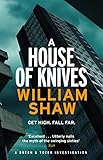
This is my review of A House of Knives: Breen & Tozer 2 (Breen and Tozer) by William Shaw.

This picks up the plot straight from end of "A Song from Dead Lips" (also titled "She's leaving home") with a limited recap to help those who have not previously read the first book in the trilogy featuring DS Breen, which I would recommend to get the most out of this story.

The discovery of a corpse following a domestic gas explosion reminds Breen of an unresolved case which haunted him in the previous novel. As before, this is tightly plotted, alternating fast-paced action with a sense of the frustration, even tedium, of criminal investigations. Breen is developing as a character, moving beyond being stereotypically dysfunctional to proving himself a methodical and tenacious operator, a decent, thoughtful even sensitive man – so that it is hard to understand how he tolerates the corruption and crassness of his work colleagues.

What marks this series out is the portrayal of the late sixties. It is fascinating to be reminded of or perhaps discover for the first time what this period was like – the now jaw-dropping lack of any awareness of equality, the smoke-ridden offices, the gulf between the old and young, as free love, hippiedom and drugs took hold, the embrace of modern art by a wealthy few, perhaps only to prove themselves followers of fashion, the brew of idealism, brutalism and corruption in the form of concrete flyovers and tower blocks, heralded as solutions for congestion and slum clearance without anyone fully considering the adverse effects. William Shaw makes some interesting points, such as that the legal change preventing drug addicts from obtaining drugs like heroin from their GPs merely pushed them into the hands of dealers, often selling far less pure and so more deadly substances.

Shaw's style is deceptively simple and direct. I like his often funny Pinterish dialogues in which several conversations are being carried on at once. He is good at poignancy, wry humour and unexpected twists, but some of the potentially most dramatic moments lack a certain tension and are not quite convincing, like the final denouement which serves mainly as an opportunity to provide the reader with details which should mostly have been grasped already. This comment sets the bar high for an otherwise very talented writer. I accept that some very dangerous situations may feel oddly banal at times, which may be what he wishes to convey. Very occasionally there seems to be a small glitch suggesting a lack of thorough editing, and the title is clearly aimed at ghoulish attraction of readers rather than relevance to the story. Although these books lend themselves to film adaptations, one of the strongest aspects will be lost in the process, namely Breen's chains of thought, his reactions and sensitive introspection.

Overall, I recommend this series and will make a point of reading the last of the trilogy – which may not be the end of Breen and his unconventional sidekick Tozer.

⭐⭐⭐⭐ 4 Stars

Where fancy is bred

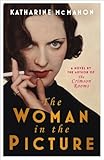
This is my review of The Woman in the Picture by Katharine McMahon.

In this sequel to "The Crimson Rooms", we encounter again Evelyn, the determined young woman who flouted convention after the First World War to train as a solicitor in London. Set against the background of the 1926 General Strike, a damp squib of an event which may account for its somewhat wooden treatment here, the book's compelling quality comes from the author's ability to create a sense of period and place and develop the main characters as Evelyn is caught up in a couple of cases which illustrate the abuse of two women at very different levels in society. In particular, we understand Evelyn's changing moods, the poignancy of the continual reminders of the brother killed in the war, to whom she was deeply attached, and her dilemma as to whether, learning from her grandmother's experience, she should be ruled by her passionate heart or her pragmatic head, by physical attraction or a sense of trust and respect when it comes to choosing a partner. It seems too much of a coincidence that Evelyn's former lover Nicholas appears on the scene only to become involved in the two main cases on which Evelyn is working, but this is of course necessary for the plot.

This story treads a fine line between romantic and literary fiction, which may leave dissatisfied both categories of mostly likely female reader. It is well-written with a sound structure, but I have a few reservations. Although the exchanges in court are gripping, I was surprised by the conversational way prosecution and defence are allowed to interrupt each other. Even more so, whether in a paternity case held in camera or during interviews with Evelyn, the main parties seem remarkably willing to speak frankly about intimate matters without the kind of embarrassed prevarication one would expect. Regardless of social position, gender or personality, the characters tend to speak with the same voice. The way so many strangers seem to know about Evelyn's aborted love affair with Nicholas and feel free to comment on it also seems unlikely. Evelyn's nervous and demanding mother undergoes a rather rapid personality change.

I may have missed something but realise that I do not understand the choice of title. The current front cover of a 1920s vamp with come-hither blue eyes, whose cigarette should surely be in a holder, also gives a false and trivialising impression of the book.

Despite these points, I recommend this as a "good read" with an ending sufficiently open to pave the way for yet another novel on Evelyn, part blue-stocking, part unconscious femme fatale.

⭐⭐⭐⭐ 4 Stars

A saga of crocodiles animal and human

This is my review of Les Yeux jaunes des crocodiles (LITT.GENERALE) (French Edition) by Katherine Pancol.

Lacking in self-esteem, overweight, frumpy and only happy when immersed in research of her beloved C12 history, Josephine musters the anger to send packing her charming but philandering and unemployed dreamer of a husband Antoine. Desperate for money to pay the bills, she agrees to a piece of deception to feed the vanity of her beautiful, wealthy but bored elder sister Iris who has pretended to an admiring editor that she is writing a book. Josephine will produce a novel set, of course, in the C12 and Iris will claim authorship and market it.

This French soap opera is often too tongue in cheek or over-the-top to be taken very seriously, particularly when, at the time of writing this, truth is more ludicrous than fiction in the form of a scorned former First Lady's revenge kiss-and-tell book on a serving President Hollande. The strongest passages are Josephine's relations with her sister and her two daughers, in particular the adolescent Hortense: beautiful, immature and manipulative as her Aunt Iris yet also chilling in her precocious insights. Antoine's attempt to make a living managing a crocodile farm (hence the title) in Africa is a quirky thread which could have been developed more.

The book is too long. Some threads are quite tedious, such as the content of Josephine's novel, which would surely never have been such a resounding success judging by the descriptions. Some of the male love interest is unconvincing – the women are in general made of sterner stuff than the men. A plot-line involving the mystery in the life of Josephine's friend Shirley proves to be utterly implausible and crass. Despite these flaws, and against my better judgement, I found much of the story entertaining, often funny yet sufficiently poignant to make one care about the fate of the main characters, apart from the shamelessly stereotyped villains like Josephine's appalling mother, nicknamed "Toothpick" by her put-upon husband's tart-with-a-heart mistress, Josiane. The final scene is effective, paving the way for future novels.

This is worth reading for the French idioms and current slang, although I believe that the English translation is full of Americanisms likely to detract from the authentic French flavour which adds to the book's appeal.

⭐⭐⭐⭐ 4 Stars

A half-forgotten classic well worth reading

This is my review of Anna of the Five Towns by Arnold Bennett.

At first, this seemed wooden and dated, a pale imitation of Trollope or Eliot, who had been writing in a similar vein two generations earlier. Initially, I found the main source of interest in the detailed descriptions of the industrial landscape of "The Five Towns", a kind of verbal Lowry, if the latter had painted the Potteries rather than Manchester.

Then, I became hooked by Bennett's portrayal of the main characters, which in time seemed to me more realistic and telling than his more celebrated Victorian forerunners. We know that Anna's relationship with the suave and capable Mynors will not follow a simple and happy path, since the author begins to hint at future tragedy, but will this be dramatic or subtly understated?

Competent, self-contained but inexperienced, Anna has been understandably dominated by her miserly tyrant of a father who has been punctilious in growing the fortune left her by her deceased mother, but cannot bring himself to give her free access to the money, only arbitrary duties such as his brutal insistence that she pursues rent arrears on one of her properties. Denied a normal, loving upbringing, it is hardly surprising that Anna find it difficult to establish a spontaneous romantic relationship with Mynors. She admires him, even imagines him in her bed, but it is only a matter of time before she comprehends that life with him means exchanging one tyrant for another, admittedly more benevolent than her father. It is easier for her to extend the maternal love she feels for her young sister to a weak, inept man who needs her support.

Bennett also proves clear-eyed over the materialism and hyprocrisy of some of the pillars of the local Methodist community, which exerts as great a domination on poor Anna as does her father. He describes with wry insight how the community deals with the suicide of a leading church member , "an abject yet heroic surrender of all those pretences by which society contrives to tolerate itself. Here was a man whom no one respected, but everyone pretended to respect – who knew he was respected by none, but pretended that he was respected by all….. If any man could have been trusted to continue the decent sham to the end and so preserve the general self-esteem, surely it was this man. But no! Suddenly abandoning all imposture, he transgresses openly….snatching a piece of hemp cries, `Behold me; this is real human nature. This is the truth; the rest was lies. I lied;you lied. I confess it, and you shall confess it.'"

⭐⭐⭐⭐ 4 Stars

A Half-forgotten Classic worth reading

This is my review of Anna of the Five Towns by Arnold Bennett.

At first, this seemed wooden and dated, a pale imitation of Trollope or Eliot, who had been writing in a similar vein two generations earlier. Initially, I found the main source of interest in the detailed descriptions of the industrial landscape of "The Five Towns", a kind of verbal Lowry, if the latter had painted the Potteries rather than Manchester.

Then, I became hooked by Bennett's portrayal of the main characters, which in time seemed to me more realistic and telling than his more celebrated Victorian forerunners. We know that Anna's relationship with the suave and capable Mynors will not follow a simple and happy path, since the author begins to hint at future tragedy, but will this be dramatic or subtly understated?

Competent, self-contained but inexperienced, Anna has been understandably dominated by her miserly tyrant of a father who has been punctilious in growing the fortune left her by her deceased mother, but cannot bring himself to give her free access to the money, only arbitrary duties such as his brutal insistence that she pursues rent arrears on one of her properties. Denied a normal, loving upbringing, it is hardly surprising that Anna find it difficult to establish a spontaneous romantic relationship with Mynors. She admires him, even imagines him in her bed, but it is only a matter of time before she comprehends that life with him means exchanging one tyrant for another, admittedly more benevolent than her father. It is easier for her to extend the maternal love she feels for her young sister to a weak, inept man who needs her support.

Bennett also proves clear-eyed over the materialism and hyprocrisy of some of the pillars of the local Methodist community, which exerts as great a domination on poor Anna as does her father. He describes with wry insight how the community deals with the suicide of a leading church member , "an abject yet heroic surrender of all those pretences by which society contrives to tolerate itself. Here was a man whom no one respected, but everyone pretended to respect – who knew he was respected by none, but pretended that he was respected by all….. If any man could have been trusted to continue the decent sham to the end and so preserve the general self-esteem, surely it was this man. But no! Suddenly abandoning all imposture, he transgresses openly….snatching a piece of hemp cries, `Behold me; this is real human nature. This is the truth; the rest was lies. I lied;you lied. I confess it, and you shall confess it.'"

⭐⭐⭐⭐ 4 Stars

The way it was

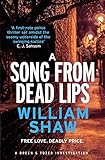
This is my review of A Song from Dead Lips: Breen & Tozer 1 (Breen and Tozer) by William Shaw.

One of the latest in the seemingly inexhaustible series of dysfunctional detectives, Breen has more reason to be so than most – he is recovering from the recent death of his father for whom he has cared during a long decline. Is this sufficient excuse for running from the scene of a robbery on seeing his work colleague Prosser held at knife-point? Breen understandably has to face a good deal of flack from the rest of the team for this, but perhaps less convincingly no formal disciplining. Yet we can see he is an above-average officer from the painstaking attempt to interpret evidence on the murder case of a young woman and his tolerant attitude towards Tozer, the often out-of-line female officer foisted on him in an otherwise solidly male team.

Set in 1968 around Abbey Road at the time of Beatlemania, this story will strike several chords with those who can remember the period. Others may find it hard to credit the sexism, casual racism, ubiquitous chain-smoking, unchallenged bullying at work – in short, general political incorrectness, and it is unsettling to realise how unthinkingly one accepted it at the time.

Beneath a fairly conventional police detective drama there lie some serious issues such as police corruption in the 1960s and the cynical British reaction to the Biafran war, of which I was to my present shame then completely unaware. There is also some quite strong character development behind the stereotyped attitudes of the police officers, and the crude workplace humour and rivalries. After building up to a dramatic climax, the author clearly leaves the ending open for a sequel or two. Apart from a feeling that the subplot relating to Prosser is handled in a rather rushed way, and the quality of the writing, generally good, occasionally slips, I recommend this novel and intend to read the sequel, "A House of Knives".

⭐⭐⭐⭐ 4 Stars

Crueler than their circumstance

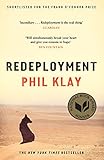
This is my review of Redeployment by Phil Klay.

A dozen often bleak and brutal stories carry an authentic ring based on the author’s first-hand experience as a marine in Iraq. Although it is deliberate in the case of “OIF”, some are too cluttered with military acronyms, either meaningless or distracting if you pause to work them out or look them up. Others which focus on the fighting have nowhere to go after ramming home the way young soldiers are trained as unquestioning killing machines, kept in this state by psychopathic officers, then swear, take drugs and get drunk to blunt their fear, guilt and confusion.

What held me more were the issues raised by the “redeployment” of the title : how these men might deal with the return to “normal” life and communicate with non-combatants.

The brilliant opening story, “Redeployment”, describes with great clarity and insight a young man’s sensations on returning home from a seven month stint in Iraq. Having been trained to function at an “orange” level of alert all the time, he cannot adjust at first to a world of people “who’ve spent their whole lives on white”. He cannot cope with walking down the high street alone, rather than in a line of men, each detailed to scan ahead at a different level: tops of buildings, lower windows or at street level. “You startle ten times checking” for the gun that is no longer there. By the end of the trip, the man is too “amped up” to drive. “I would have gone at a hundred miles an hour.”

In “War Stories”, a young man whose face has been hideously scarred agrees to be interviewed by a chilly young actress “with a splinter of ice in her heart” who wants to use his experiences for a play. She is only interested in the drama of his injury, so never discovers his pragmatic decision, being unlikely to “pull” a girl like her, to give his undamaged sperm to a bank, so that his genes can be passed on in a new life. “I’ll have some baby out there. Some little Jenks. Won’t be called Jenks, but I can't have everything, can I?”

I also recommend “Prayer in a Furnace” where a sensitive and well-intentioned chaplain’s faith is unequal to dealing with the horror which a cynical young soldier confesses to him, and “Psychological Operations” which explores the complex emotions of an American of Coptic Egyptian origins who, because of his assumed knowledge of Arabic, is sent to deliver propaganda which involves insulting Iraqi extremists to goad them into coming out to die under fire.

Less harrowing than the other stories, but chilling beneath its humour is, “Money as a weapons system” in which an idealistic man sent out on a “Provincial Reconstruction Team” learns painful lessons over the extent of corruption, tribal division and American ignorance which bedevil any serious attempt to rebuild the country.

I don’t know how cathartic is was for Phil Klay to write this, but it would be a mistake to “write these stories off” as the scripts for yet another violent war film – into which they could well be twisted. Most of them provide salutary lessons on the folly of ill-prepared engagement in Iraq.

⭐⭐⭐⭐ 4 Stars

Every picture tells a story.

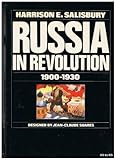
This is my review of Russia in Revolution, 1900-30 by Harrison E. Salisbury.

This provides an engrossing photographic record of the period from the disintegration of the last Tsar Nicholas ll's rule, through the often farcical chaos of revolution, and Lenin's inability to practise what he had preached, to Stalin's ruthless establishment of dictatorship and the collectivisation of agriculture on a huge scale. The mainly black-and-white prints, many still of great clarity show not merely the leading political players and artists but the life of the peasants, and a sense of the gulf between the wealth of the few and the muddy vastness of the countryside. We see the range from Rasputin posing with a prince and a colonel, to an unnervingly handsome and harmless-looking youthful Stalin. The faces are often startling in their modernity: members of the revolutionary "Women's Battalion" with heads shaved as stark protection against lice, an impassive-faced commissar noting details of dealers in human flesh during the famines of the 1920s (this is not really explained in the text), Russian woman doctor conducting stress and fatigue studies on a resigned young female worker.

At first, I found the supporting text very informative, including one of the most concise and effective explanations I have read of the various political parties in 1905: the uncompromisng Socialist Revolutionaries who saw violent terror in support of the peasants as the only path, the Marxist Social Democrats split in three groups with Lenin's Bolsheviks forming the largest party, the idealistic if impractical Anarchists and Constitutional Democrats or Kadets. Although there is only enough space for a fairly superficial coverage, the tragic if understandable confusion and ineptitude of the revolutionaries in their efforts to achieve a daunting radical change are made very clear – including the irony that after only four years Lenin was practising the kind of repressive rule which had led him to call for the Tsar's removal.

Apart from many telling quotations from letters and the comments of observers, the author also finds space for the role of art: Malevich's Futurist painting "The Knifegrinder" and the widespread application of "constructivist", machine-like art to propaganda posters like "Beat the Whites with the Red Wedge", the latter depicted piercing a white cirle, labelled "red" and "white" respectively. It was even applied to plain, angular clothing displayed in the 1920s.

The lack of an index is frustrating at times, the point being perhaps that most of the pictures defy classification in what they reveal. Poring over these photographs gives more insight than many a text on this fascinating if depressing period of history.

⭐⭐⭐⭐⭐ 5 Stars

Vandal rock moon in the filthy mirror of a puddle

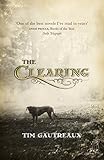
This is my review of The Clearing by Tim Gautreaux.

Dutiful younger son Randolph Aldridge agrees to work as manager as Nimbus, the mismanaged but potentially profitable sawmill his wealthy father has just purchased in the remoteness of the Louisiana swamps. His perhaps unlikely motivation is to bring back to the fold his elder son Byron who has been located working as a "lawman", or security guard, at the site. He has returned from the First World War in a shell-shocked state that leaves him by turns aggressive and depressed, certain only that he no longer wishes to take over his father's business. Byron's resolve to restrict the opening hours of the local casino-bar embroils him in a bitter feud with the Sicilian mafia boss Buzetti who runs the gambling, and Randolph also becomes involved in the conflict.

After a slow start, the plot gathers pace, veering between violent barroom brawls and minute descriptions of river steamboats, trains and various aspects of sawmill production, all of which Gautreaux must have researched in great deal and seems to find fascinating, although I often felt frustrated by the lack of a diagram to explain his descriptions. The book has something of a Wild West quality, except that the landscape is of course bayou and swamp in periods of muggy heat and rain, rather than arid desert, and intense manual labour replaces rounding up cattle on the plains.

My admiration for Gautreaux's "The Missing", with its often original poetic language and vivid sense of place, led me to seek out this book, which has the same qualities. Beneath the at times wearisome swashbuckling, there is a thought-provoking portrayal of how "a whole forest" of cypress trees is turned into "window frames and water tanks". When Randolph seek out a livery stable to ride twenty miles to his new job, he is advised with brusque humour, "you better get a fat horse that'll float. if you don't break off his legs, you'll have to row him through some low spots". Whereas Randolph comes out of it all with a fat bank account and prosperous life-style, he is honest enough to realise that the mill workers end up with "only the same belongings they'd owned when they signed on". On night-shifts, some men carry pistols and scan "the borders of light for the luminescent eyeballs of alligators" and water moccasins lurk in puddles to bite the unwary by day. When it floods, Randolph can hear "the backs of turtles bumping against the floorboards". Yet, the menace of the natural world is as nothing compared to the threat from the determined criminals who seem immune from justice, since the Sheriff cannot be persuaded to take action against them: "I can't hardly enjoy being famous if I'm worried about some honky-tonk dago burning my house down".

As is often the case, the story carries an essential flaw, since Buzetti could easily have contrived the murder of Byron and Randolph in the first few chapters. Byron often seems too "together" in moments of stress to be truly shell-shocked. His wife Ella is a little too much of a cipher. In fact, in this male-dominated world, the men's characters are developed in much more depth than the women's.

Although I had reservations at first, and found the reading of this quite heavy-going at times, with a distinct need for editing out of some wordy detail, the enclosed world of "the clearing" was certainly well-embedded in my mind, I felt concern for the fate of the main characters, and by the end it seemed worth the effort. I can also imagine it as a film.

⭐⭐⭐⭐ 4 Stars

Stranger things have happened

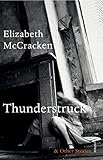
This is my review of Thunderstruck & Other Stories by Elizabeth McCracken.

My four stars are for the best stories in what struck me as a "mixed bag" much as I wanted to admire the quality of the writing and risk-taking originality.

McCracken reminds me of Alice Munro: the unusual take on situations, the continual drift to unpredictable outcomes, the concern with observation rather than plot, the sharp, self-possessed prose stripped of emotion even in the most moving situations, the flashes of humour to alleviate the pain or even horror. However, I find her writing a little more contrived and less empathetic than Munro's.

The stories seem very variable in their effectiveness. I was hooked by the opening "Something Amazing" in which teenage Gerry comes home to find that his grief-deranged mother, unable to get over the death of her small daughter, has kidnapped a neighbour's child. "He wonders how to sneak him back home. He wonders how to keep him forever".

The plight of a couple trying to deal with an accident which has befallen their wayward adolescent daughter in the title story "Thunderstruck" comes closer to moving than most of the rest. Sustained by false optimism, the father "looked at his wife, whom he loved, and whom he looked forward to convincing, and felt as though he were diving headfirst into happiness. It was a circus act, a perilous one. Happiness was a narrow tank. You had to make sure you cleared the lip".

"Peter Elroy; A Documentary by Ian Casey" is very original, showing how a longstanding friendship has been destroyed by film-maker Ian's early masterpiece in which he interviewed Peter, but only recorded his responses, thereby both deceiving him and showing him in a dreadful light.

McCracken is good at portraying earnest young children, and some of her quirky descriptions have a childlike quality: "A lawnmower skulks up to its alligatorish eyebrows in the yard". A family anxious to comfort a daughter "bundled" her up "in their eight bare arms, the devoted family octopus". I also enjoyed her revealing but oblique Pinteresque dialogues.

Although some stories improved on a second reading, perhaps I was getting used to her style, about half like "Property","The Lost and Found Department of Greater Boston", "Juliet" or "Some Terpsichore" failed to engage me. Although the technical quality is high, and she is often original and very imaginative in both her descriptions and ideas, many of her characters seem unconvincing. At times, situations slip into unrelieved black farce which tends to distance the reader: you may be intrigued and fascinated by the writing, but you do not care enough about the characters and need to take a break at the end of each piece to escape the bleakness.

⭐⭐⭐⭐ 4 Stars