Cause and effect

This is my review of I Saw A Man by Owen Sheers.

Having recently moved to a road overlooking Hampstead Heath, Michael calls on his neighbour Josh to reclaim a tool he has lent him. Surprised to find that the house is empty but the back door left ajar, he enters it on an impulse. This small, chance act triggers an unpredictable but initially devastating chain of events with life-changing consequences.

The cleverly titled, "I saw a man", although it takes a while to understand the significance of this, is a slow-paced psychological thriller by a serious-minded writer interested in exploring the role of cause and effect in our lives, the strength of the will to survive, and how we handle guilt. From the outset, there is a sense of tension and of the need to take note of every mundane detail because it might prove important. Suspense is heightened by the device of switching in alternate chapters between Michael, an intruder in his friends' house, and flashbacks to explain his past life: a few minutes spent in the house therefore expand to an eternity.

What could be a taut structure is slackened by the author's desire to weave in his views on a variety of issues such as the recent banking crisis, the Iraq War and creative writing, including the idea that it is a manipulative process: observing others, "blending in" to gain confidences and exploiting friendships in order use people as models for the putty to be moulded into novels.

In the first chapter I was struck by the occasional poetic phrase – the "nun's head" of a mother coot – in the otherwise plain prose, which led me to discover that the author is also a poet. The narrative is very strong on descriptive detail, as if the work of a scriptwriter, causing me to wonder if Owen Sheers had a film in mind from the outset. There are some powerful passages, but the style often jarred on me. The frequent use of reported events makes for too much "condensed telling". Some metaphors seem inapt, words misused, although this may be intentional, all these factors combining to seem surprising from a Professor of Creative Writing.

I think this book will be popular, and could be adapted as an entertaining TV series or film. It is a page-turner, but marred for me by avoidable lapses into clunky prose and some plot digressions which either detract from the narrative drive, because they lead nowhere, or which seem like missed opportunities for further plot twists, such as the aftermath of Michael's liaison with the young New York hoodlums, Nico and Raoul.

⭐⭐⭐⭐ 4 Stars

Nora Webster by Colm Tóibín: “Life goes on”

This is my review of Nora Webster by Colm Tóibín.

This is the detailed and dispassionate portrait of Nora Webster, widowed suddenly in her forties with two young sons to bring up, plus two older daughters who still need a mother’s support although they are living away from home at school or university. The story is set in close-knit, convention-bound, small-town coastal Ireland around 1970 where sexual equality was an alien concept, and the troubles brewing over the border in Belfast cast gathering background shadows. An intelligent woman who was prevented by her father’s early death from obtaining the college education of which she is capable, Norma is on the surface a dutiful wife and mother, unaccustomed to pleasing herself, but she is capable of sudden decisions which may seem out of character or even a little extreme, perhaps a result of the shock of grief.

Tóibín’s plain prose creates scenes and inner thoughts of acute realism which are saved from tedium for me – if not for many other readers – by his skill in the gradual revelation of details. What caused the death of Nora’s husband Maurice? What did he do for a living? How will Nora manage for money? How will she cope with a tyrannical office manager who bears a long-held grudge against her? Why does her son Donal begin to behave “out of character” at school? We see how, although superficially “carrying on as usual” all her four children have been affected by their father’s death in different ways. Nora herself, although for the most part continuing to fulfil her duties as a parent, and trying to build a new work and social life, often feels that the world around her is unreal, nothing has any meaning and she is adrift, only at ease when avoiding other in the refuge of her own house, or in sleep.

Throughout the book, Tóibín continually primes what seems like the trigger for some dramatic event, only for the tension to drift away, as is often the case in daily life. This may prove disappointing until one accepts that this novel is largely a study of grief, it would seem inspired by the author’s own experience of losing his father at an early age. It is also a detailed portrayal of the dynamics and relationships of family life, in which Nora seems always to have been an outsider, her natural self-containment now sharpened by the pain of her loss, although at times she displays great empathy, insight and sardonic humour. Another intriguing aspect is the power of the local gossip grapevine which sometimes reaches the level of farce. Everyone knows Nora’s business, or some distorted version of it, culminating in an interfering, it would seem at times telepathic, local nun: it occurred to Norma “that in any other century, Sister Thomas would have been burned as a witch”.

Hearing the author give a talk on this book also made me appreciate how much of his work is based on the part of Ireland (round Enniscorthy) where he grew up, a result of his belief that one can only write with authenticity about what one knows, and his fascination with places which people who have never met may experience differently but which all recognise, even long after they have changed.

This is not a depressing book, for it reinforces the essential truth that “time eases pain” although it may not really “heal” , and “life goes on”.

⭐⭐⭐⭐ 4 Stars

Burial Rites by Agnes Kent : Awaiting execution

This is my review of Burial Rites by Hannah Kent.

On a visit to Iceland, Australian teenager Hannah Kent became fascinated by the story of Agnes Magnúsdóttir, the last woman to be executed there in 1829. Agnes was convicted with two accomplices of involvement in the brutal double murder of herbalist Natan Kedilsson and his visitor Pétur Jónsson, setting fire to his house in an attempt to conceal the crime. Keen to explore the ambiguity of her guilt, what had shaped Agnes as a person who might commit such a crime yet retain some humanity and evoke sympathy, Hannah Kent went on to research the case in depth for a PhD which included a creative novel on the subject, leading to the publication of this bestseller, “Burial Rites”. I liked the way in which imagined scenes are interspersed with documentary evidence.

My first attempt to read this book failed as I found many of the characters somewhat two-dimensional and written too much in the same “voice”, the dialogue stilted, the prose often overblown. Much of the book is quite slow-paced and repetitive, continually reinforcing the bleak detail. Forcing myself to finish it for a book group, my main reservation became that too many events are told statically, rather than shown dramatically, through the device of Agnes relating them to a third party. I accept that this could reflect the oral tradition of relating Icelandic sagas over interminable dark winter evenings. It also raises the intriguing question as to her reliability as a witness. However, the storyline, which is quite well-developed as regards Agnes’s relationship with the ailing wife and two contrasting sisters at the farm to which she is sent pending her final sentence and execution, becomes fragmented and confusing as regards the events leading up to the final crime. Again, this could be intentional as regards suggesting ambiguity.

My conclusion is that Hannah Kent is an enthusiastic researcher rather than a talented writer, so that the main interest lies in the detailed portrayal of the harsh life in northern Iceland and social customs of the day. Whereas we now think of Iceland as a sexually liberated country, in the early C19, women farm workers had a raw deal, forced to choose between accepting the advances of their employers or being thrown out to possibly certain death in the bitter weather, at the same time risking the consequences of bastard children or the anger of a farmer’s wife.

⭐⭐⭐ 3 Stars

“Putin Mystique Inside Russia’s Power Cult” by Anna Arutunyan” – “A leader only as corrupt as the system that produces him”?

This is my review of Putin Mystique Inside Russia’s Power Cult by Anna Arutunyan.

A Moscow-based Russian-born journalist who was raised and educated in the States, Anna Arutunyan seems unusually well-placed to interpret Putin’s mystique in a way that Western readers can readily grasp. Although this book contains some fascinating information if you are prepared to make the effort to glean it, I was disappointed to find that the disjointed journalese makes for an often confusing and laborious read.

We are familiar with photographs of a macho Putin displaying his muscular torso as he rides on horseback through the wilderness, or wades in a river to catch salmon, of him diving in the Black Sea to retrieve ancient Greek urns in what proved to be a staged stunt, or co-piloting a plane to dump gallons of water to extinguish a forest fire. This personality cult which began in around 2001 is partly a top down process of which Anna Arutanin provides further examples: Kremlin ideologist Surkov’s organised demonstrations of support by the activist youth group “Nashi” whose members were rewarded with payment or career opportunities; the elaborate charade in which Putin showed his concern for alumina factory workers demanding their pay by berating on film the oligarch Deripaska who had halted production at their workplace. This included forcing him to sign a probably fake contract and even throwing a pen at him, for which humiliation Deripaska was compensated by some massive monetary bail-outs. The author also identifies more spontaneous actions with commerce in mind, such as the “pin-up” calendar showing the twelve moods of Putin or the erotic calendar of obligingly posed girls presented to him for his birthday. Having been groomed by the oligarch Berezovsky to take over as a President who would provide some stability and order after the chaos of Yeltsin’s regime, Putin adapted readily to mirror the kind leader many Russians wanted to look up to.

The Russians have a history of developing a cult round their leaders as a means of keeping control in a vast, often harsh land of scattered and ethnically diverse people. “Russia may never have had the close-knit communities that foster democracy and legal institutions”. So, we see the persistence of a “patrimonial” rather than a legal-rational state. The Tsars were often venerated like gods, with their subjects literally prostrating themselves in their presence; the Stalinist cult was developed by his inner Bolshevik circle before “spilling out” in a nationwide adulation which in a form of “doublethink” was not incompatible with viewing him as a “bloody tyrant”.

This book was published too late to cover the shocking murder of the charismatic Boris Nemtsov, but the failure to analyse the recent annexation of the Crimea and the issues raised by the poisoning of Litvinenko, along with the murder of a number of investigative journalists critical of the regime, are glaring omissions. Perhaps there are boundaries the author prefers not to cross: although her portrayal of Putin is negative, precise accusations of a serious nature are avoided and charges often veiled. It is suggested, for instance, that widespread financial corruption and human rights’ violations are often beyond Putin’s control, despite the “myth of his omnipotence”, because they are conducted by people on whom he depends to keep order – as in the case of the Chechnyan strongman Ramzan Kadyrov. In reporting recent middle-class protests against Putin’s “corrupt, authoritarian and self-serving regime”, the author suggests that Putin’s opponent, rising star Navalny has himself shown signs of developing a personality cult, including an aggressive stance and the favouring of questions from supporters, as if this somehow weakens criticisms of “the Putin mystique”.

One of Putin’s reactions to the recent backlash has been to align himself more closely with the Church, a respected institution since its recent revival. This may explain the harsh crackdown on “Pussy Riot”, the girl band who performed their blasphemous anti-Putin ditty in a Moscow Cathedral.

⭐⭐⭐ 3 Stars

“Think of a kitchen table then when you’re not there.”

This is my review of To the Lighthouse (Wordsworth Classics) by Virginia Woolf.

Rereading this novel after many years, I have grasped for the first time the brilliance of Virginia Woolf’s work. One of the pioneers of “stream of consciousness” writing in the 1920s, she conveys various characters “interior monologues” with great technical skill and poetic beauty streaked with acerbic wit, weaving together the rapid fleeting impressions of their surroundings, appreciation of objects, fragments of memories, shifting perceptions of other people, the tendency to think one thing but say something else. For this reason, a novel which might seem dated retains relevance and the power to move us almost a century later. It reveals in an original way aspects of the relations between men and women, even the meaning of life.

The plot which could be written on the back of a postcard is immaterial, except that the narrative covering two separate days set ten years apart is cut in two by the impact of the First World War, subtly conveyed by the decay of a house on the Isle of Skye, left unvisited for several summers by the Ramsays. They are a cultured Edwardian family, casually taking for granted their privileged place in the world and unaware of how much things are about to change. There are clear autobiographical elements in the story – certainly, the author’s sister Vanessa thought that Mrs Ramsay bore an uncanny resemblance to their mother. Still beautiful despite being fifty and the mother of eight, Mrs Ramsay exhausts herself in supervising the servants who do the actual hard labour, in ensuring the comfort of her guests, perhaps with a little match-making thrown in, but most of all in trying always partly in vain to meet the demands of her egotistical, insecure philosopher husband, who continually seeks attention and reassurance that, having reached “Q” he may attain “R” – “What is R?” – and that his work may be remembered. Although also at times troubled by a sense of unfulfilled potential, “But what have I done with my life?”, Mrs Ramsay seems to enjoy her lynchpin role, in which she is both admired and resented by others.

A constant factor is the lighthouse (inspired by Godrevy Lighthouse near Talland House in St. Ives, rented by the author’s father for his family) which casts its regular, impersonal beam over the bedrooms at night. James Ramsay will probably always remember the disappointment of being unable to visit the lighthouse as a six-year-old when his father’s dismissive “It will not be fine” harshly shattered the dreams which his gentle mother had encouraged. Ironically forced by his father to sail to the lighthouse a decade later, the journey has a very different significance.

The narrative flows in a twisted thread which requires total concentration. This is the kind of book to reread for the sheer quality of the prose, and to note how the author moulds language to fit moods and impressions, rather as an artist uses paint – one of the characters being Lily Briscoe who agonises over her pictures much as Virginia Woolf must have done, perhaps also over the written word.

How much more might Virginia Woolf have achieved if manic-depression had not caused her to take her own life at the age of 59? Yet, had they been available, modern medications could have dulled the capacity to achieve her unique streams of consciousness.

⭐⭐⭐⭐⭐ 5 Stars

“The Impossible Exile” by George Prochnik – A world in which Stefan Zweig cannot live

This is my review of The Impossible Exile: Stefan Zweig at the End of the World by George Prochnik.

The subject of a recent revival of interest, for instance as author of the short story on which the Oscar-winning novel, “The Grand Budapest Hotel” was based (“Beware of Pity” or “The Post Office Girl” give a better idea of his talent), Stefan Zweig was for decades a phenomenally prolific and popular writer, mainly of novellas and biographies: he preferred to write about “the defeated” rather than successful people – “it is the task of the artist to picture those…who resisted the trend of their time and fell victim to their convictions”. For him, literature was not an end in itself, but, to quote George Prochnik, “a bridge to some hazy higher mission on humanity’s behalf”.

This kaleidoscopic take on Zweig’s life which often reads more like a novel than a biography, focuses mainly on the experience of exile, when the rise of Hitler forced him to leave the cultural hothouse of Vienna in search of a refuge which he always hoped might be temporary but which, whatever its advantages, never quite met his needs. In Bath he found the society too cliquey and suspected that British calmness denoted a lack of imagination- he was not confident that the UK could defeat Hitler. In New York, he deplored the commercialisation which pressed everyone to look and behave the same, the education system which emphasised learning facts rather than understanding them. At first, he loved Brazil for its racial tolerance (ironically overlooking some of its overt anti-semitism) and open attitudes to sex compared with his uptight Viennese upbringing before he became jaded by the monotony and isolation of his days, waiting for the mail to arrive. He was horrified by events in Europe, felt guilty over having survived, old at sixty with nothing more to give future generations. Zweig ended up improbably in the Brazilian tropical mountain winter resort of Petrópolis where he committed suicide with his much younger first wife Lotte who was devoted to him and his writing. Zweig’s “work orginated in friendships.. and it was lack of personal contact with friends, homesickness for human companionship.. that brought him to his end.”

His inability to cope with exile was continually evident in his writing: “We are just ghosts – or memories…..The abyss of despair in which, half-blinded, we grope about with distorted and broken souls…. .The predicaments of exile which aren’t resolved when freedom is gained”. This seems at odds with his view that the Jewish Diaspora was preferable to founding a Jewish homeland, and that Judaism had given him “the absolute freedom to choose among nations, to feel a guest everywhere, to be both participant mediator” – a highly rose-tinted view of what was the reality for the majority of the less privileged Jews.

Prochnik suggests that despite his privileged background, great success and outward urbane confidence, Zweig did not really know how to be himself. He was a product of the Viennese gaiety “always mistaken as the self-expression of a vivacious, life-loving people, while, in fact, it was but a mask behind which people were hiding in their Schwermut – hopelessness , despair, and a feeling of insecurity and abandonment – the true Austrian philosophy of fatalism.”

An innate tendency to depression must have added to his problems. Lotte came to understand that “writers, owing to their imagination and on account of the fact that they are free to indulge in pessimism instead of their work, are more liable to be affected by these depressions than others.” Yet she too was also eventually worn down by illness, isolation and his influence, although one can never know how much he might be blamed for this.

The author’s own family history of enforced flight to the United States – his grandfather adapted well, but not his grandmother – has stimulated in him a strong interest in the nature and effects of exile. This book reminds me a great deal of Sebald’s “The Emigrants”, even down to the small, often amateurish black-and-white photos inserted into the text, which do not need captions, although a list of these is supplied at the end.

I admit that the lack of a chronological approach or an index may make it hard to grasp the sequence of events in Zweig’s life, but the well-chosen quotations, often amusing anecdotes, sharp insights and sense of past time and place make this book far more informative than many traditional biographies which attempt a more systematic and comprehensive coverage.

On a positive note, the shock of Zweig’s suicide “provoked a surge of life-affirming unity” amongst many of his friends in exile, whilst his philosophical biography “The World of Yesterday” on “what it meant to be alive between 1881 and 1942” was one of the few books about the past which slipped into the post-war Austrian school curriculum, ironically in a literature rather than a history class.

⭐⭐⭐⭐⭐ 5 Stars

World of smoke and mirrors

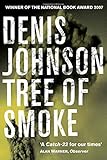
This is my review of Tree of Smoke by Denis Johnson.

Reminiscent at times of "The Quiet American", "Catch-22", or "Life and Fate", but hard to pin down, by turns brilliant and flawed, it is easy to understand both how this sprawling and vastly ambitious epic won The National Book Award, and why some critics and general readers have slated it.

"The Colonel knew how to lead but he couldn't follow…. Won over by the power of myth, he became one himself. He stood out grandly ……against the background of his own imaginings." A central figure is Colonel Francis Sands, maverick CIA officer whose panache enables him to get away for years with his unofficial activities, such as the possibly hypothetical exercise in "Psy Ops" (psychological operations), biblically entitled, "The Tree of Smoke". His fatherless nephew "Skip" hero-worships him, accepts without question his uncle's mission to eradicate communism in the Far East, and is desperate to work as a linguist for intelligence operations in 1960s Vietnam. Frustrated by the ludicrous, tedious tasks he has been allocated, shocked into hysterical laughter when faced with a casual atrocity, will Skip eventually grasp the truth about the Colonel and the war and how will he live out the rest of his days?

A parallel thread is provided by the Houston brothers, in particular James, who enlist in the military for excitement or money, and provide the poor white cannon fodder on which the US depends.

Those old enough to remember the Vietnam War, who were stunned by the spate of epic films including "The Deer Hunter", "Apocalypse Now", "Platoon" and "Good Morning Vietnam" may wonder if this rambling novel, not published until 2007, can have anything to add. Many (including me) will find the book hard to follow for Denis Johnson makes no concessions: he expects us to battle with American slang, military acronyms, a grasp of the stages of the war and general knowledge which extends to the history of the search for a yellow fever vaccine in Cuba. The novel is essentially a series of disjointed episodes requiring us to work out what is going on as well as what has happened between the scenes. All this lack of clarity seems to be part of Johnson's intention to convey a sense of the confusion bordering on lunacy that was part of the experience of being plunged into an alien eastern culture corrupted by western influence.

The author's freewheeling approach creates an uneven coverage. For instance, it is made tragically clear what has shaped the Houston brothers but James's descent into traumatised violence in Vietnam is too condensed. The surprising change in Skip Sands' life revealed towards the end is glossed over in comparison to the detailed portrayal of his character and life in much of the novel. Storm's at times surreal trek to find the man he believes to be still alive is described in great detail, but his role as the Colonel's side-kick remains sketchy to the end. Too many passages or dialogues read like notes for a novel, rather than the work itself.

On the other hand, with his capacity for striking, often poetic prose, Johnson is skilful in creating characters when he feels like it, together with a vivid sense of place. The strong play-like dialogues are suffused with the author's quirky humour which also alleviates the book's inevitable bleakness. One is held by a sense of anticipation, for at any moment a mundane scene may be transformed by farce, beauty, a danger averted or an act of brutality, as is the case in war. My main criticisms are that the book never quite delivers what it promises, it seems to lose its way in a disappointing ending, and is too long, by perhaps two hundred pages. Yet, it stays in one's mind and provokes thought and discussion.

⭐⭐⭐⭐ 4 Stars

A Siberian who prefers olives

This is my review of Dreams of My Russian Summers: A Novel by Andreï Makine.

Admiration for Makine's short novel "La Musique d'un vie" in English translation inspired me to embark on the much longer multiple prize-winning "Testament français" in French. I hope that this review of the original French novel may hold some points of interest for those reading the English translation.

It describes a sensitive Russian boy who spends summers in Siberia with the half-French grandmother Charlotte who regales him with anecdotes of Paris in the years leading up to the First World War. She backs them up with memorabilia from a battered trunk which hold the allure of an Aladdin's Cave for the boy. Unsurprisingly, he grows up with a sense of being split between two cultures, the harsh "reality" of Communist Russia holding less appeal than nostalgic memories of a past France. As a teenager, tired of his peers' mockery of his eccentricity, the boy makes a brief effort to break free from Charlotte's influence, but comes to realise how much he values it. It is a moot point to what extent Charlotte is responsible for nourishing his artistic sense as a writer, or aggravating a degree of mental imbalance.

This novel has a clearly autobiographical basis: following the disappearance of Russian parents, presumed to have been deported, Makine was brought up in Siberia by his half-French grandmother, who filled him with the language and culture of France absorbed from her childhood visits to Paris. After seeking asylum in Paris in his thirties and living on the breadline as a struggling writer, Makine resorted to the pretence that his early novels had been translated from Russian, since publishers would not believe that he could have written with such fluency and feeling in French.

A great admirer of Proust, Makine has imitated his style in "Testament français", which is short on plot, more a series of impressions, feelings and incidents. Particularly in the early chapters, I found the prose pretentious, with a cloying sentimentality. It was hard to believe that a boy of nine or so would be so enthralled by state dinners to welcome the Tsar and his wife to Paris in the 1890s, events about which Charlotte herself must have learned second-hand. And would the boy really have been so entranced by the sycophantic verse of José Maria de Heredia of which eight stanzas are included in the text? I was by turns irritated and bored by the repetition and exaggeration of ordinary images – a faded photo on the back of a newspaper cutting from the early 1900s of three demure young ladies in dark discreet dresses, over which the now teenage boy almost faints with emotion from the experience of mentally insinuating himself into their world, captured by click of the camera's shutter.

The writing seems most real to me when the narrator focuses on his own direct experience without any attempt at imitative artifice. For instance, there is a striking description of a sudden but fleeting storm bursting over the Russian steppe, to be replaced quickly by calm sunshine. He is probably very accurate in describing male obsession with female physical sexuality, although in the process the narrator appears very male chauvinist, to add to his intense self-absorption. The passages describing the sense of wanting to be both Russian and French are often quite powerful, and there are flashes of wry humour and insight. Although most characters apart from Charlotte and the narrator are thinly drawn, there are some vivid portraits, as of his tough, coarse, pragmatic aunt, a typical product and survivor of the Stalin era, unchanged even twenty years after the dictator's death.

Makine is a talented writer, and I shall probably read more of his work, but found this one too much of a chore. There is an English translation entitled "Dreams of my Russian Summers" which loses the point of the original title as revealed at the end.

⭐⭐⭐ 3 Stars

The Siberian who preferred olives

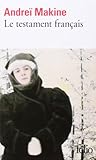
This is my review of Le Testament Francais (Fiction, poetry & drama) by MAKINE.

Admiration for Makine's short novel "La Musique d'un vie" in English translation inspired me to embark on the much longer multiple prize-winning "Testament français" in French.

It describes a sensitive Russian boy who spends summers in Siberia with the half-French grandmother Charlotte who regales him with anecdotes of Paris in the years leading up to the First World War. She backs them up with memorabilia from a battered trunk which hold the allure of an Aladdin's Cave for the boy. Unsurprisingly, he grows up with a sense of being split between two cultures, the harsh "reality" of Communist Russia holding less appeal than nostalgic memories of a past France. As a teenager, tired of his peers' mockery of his eccentricity, the boy makes a brief effort to break free from Charlotte's influence, but comes to realise how much he values it. It is a moot point to what extent Charlotte is responsible for nourishing his artistic sense as a writer, or aggravating a degree of mental imbalance.

This novel has a clearly autobiographical basis: following the disappearance of Russian parents, presumed to have been deported, Makine was brought up in Siberia by his half-French grandmother, who filled him with the language and culture of France absorbed from her childhood visits to Paris. After seeking asylum in Paris in his thirties and living on the breadline as a struggling writer, Makine resorted to the pretence that his early novels had been translated from Russian, since publishers would not believe that he could have written with such fluency and feeling in French.

A great admirer of Proust, Makine has imitated his style in "Testament français", which is short on plot, more a series of impressions, feelings and incidents. Particularly in the early chapters, I found the prose pretentious, with a cloying sentimentality. It was hard to believe that a boy of nine or so would be so enthralled by state dinners to welcome the Tsar and his wife to Paris in the 1890s, events about which Charlotte herself must have learned second-hand. And would the boy really have been so entranced by the sycophantic verse of José Maria de Heredia of which eight stanzas are included in the text? I was by turns irritated and bored by the repetition and exaggeration of ordinary images – a faded photo on the back of a newspaper cutting from the early 1900s of three demure young ladies in dark discreet dresses, over which the now teenage boy almost faints with emotion from the experience of mentally insinuating himself into their world, captured by click of the camera's shutter.

The writing seems most real to me when the narrator focuses on his own direct experience without any attempt at imitative artifice. For instance, there is a striking description of a sudden but fleeting storm bursting over the Russian steppe, to be replaced quickly by calm sunshine. He is probably very accurate in describing male obsession with female physical sexuality, although in the process the narrator appears very male chauvinist, to add to his intense self-absorption. The passages describing the sense of wanting to be both Russian and French are often quite powerful, and there are flashes of wry humour and insight. Although most characters apart from Charlotte and the narrator are thinly drawn, there are some vivid portraits, as of his tough, coarse, pragmatic aunt, a typical product and survivor of the Stalin era, unchanged even twenty years after the dictator's death.

Makine is a talented writer, and I shall probably read more of his work, but found this one too much of a chore. There is an English translation entitled "Dreams of my Russian Summers" which loses the point of the original title as revealed at the end.

⭐⭐⭐ 3 Stars

Sowing dragons’ teeth

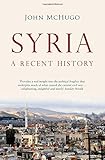
This is my review of Syria: A Recent History by John McHugo.

Drawing on firsthand experience of living in Syria, John McHugo has produced an informative analysis of the facts leading up to its tragic civil war. His detailed focus starts in the early twentieth century, just beyond the reach of living memory. When the Ottoman Empire crumbled after the First World War, a critical opportunity was missed to create, under King Faisal who had shown himself to be reasonably competent, an Arab state with the logical boundaries of Greater Syria, now divided between modern-day Syria, Lebanon, Jordan, Palestine, Israel and parts of southern Turkey. Instead, France and Britain were allowed to play imperial politics and carve up the territory along the notorious Sykes-Picot line, agreed in secret and, like too many other Middle Eastern borders, running across territories with no regard for ethnic groupings or geography.

Although McHugo accepts that an independent Arab state established in the 1920s might well have lapsed into tribal and religious conflict, and acknowledges the corruption which has fed unrest, he makes clear the West's part in inadvertently bringing about the current crisis. The disproportionate support for the Israeli cause without ensuring justice for the Palestinians has had complex consequences, such as the provocation of Israel's occupation of Syria's Golan heights, and the influx of Arab refugees into partly Christian Lebanon. This set up explosive tensions which Syria sought to resolve at the cost of antagonising the Palestinian leader Yasser Arafat rather than accept the Achilles heel of a weakened Lebanon through which Israel could attack Syria.

Instead of seeking a comprehensive and statesmanlike approach, the West confined itself to a somewhat blinkered preoccupation during the Cold War with attempts to gain the upper hand over the Soviet Union in the Middle East. "Once America had both Egypt and Israel as its allies as well as friendly relations with numerous other Arab governments….it did not need Syria" – which reacted by obtaining vital arms from Russia.

The author explains Ba'athism as an originally idealistic movement based on the three goals of unity, freedom and socialism – which of course must have been perceived as a threat by some Western powers. Yet when the Ba'ath party overrode elected politicians to gain power, it consolidated its position with nepotism and cronyism, thus undermining its founding ideals and reputation.

McHugh devotes two chapters to Hafez al-Assad, one of the pragmatic, ruthless secular Arab leaders who kept tribal and religious differences in check in the final decades of the C20. His son Bashir al-Assad seems to have attempted a more democratic approach on gaining office, but been driven by the pressure of events to adopt a more brutal and authoritarian approach, with less skill than his father.

McHugh ends on the bleak note that the most likely alternative to a victory by the regime is a descent into warlordism. The recent rise of Isis which has gained influence since the author went to press makes the effects of this anarchic outcome all the more grim. This book may sound like a depressing read at a time when Europe seems to be turning a blind eye to the political and economic chaos on its borders, but it has a positive effect in raising one's understanding of the complex chain of events, and increasing one's respect and sympathy for the Syrian people.

⭐⭐⭐⭐⭐ 5 Stars