“Tropique de la Violence” (Tropic of Violence) by Nathacha Appanah – hell in a corner of paradise.

This is a searing portrayal of Mayotte, the small island off the coast of Africa in the Indian Ocean, a far-flung remnant of the French colonies, sharing the status of “Department” in name alone with those in mainland France. This is a land of brutal contrasts: a little corner of paradise for tourists with its white sandy beaches and lush scents of flowering hibiscus and frangipani on one hand, on the other the hell of the shanty towns like Kaweni, nicknamed Gaza with tragic prescience. Here gangs of youths roam and steal, high on drugs, while the population is swollen  by the “clandestins”, immigrants “sans papiers” who  mistakenly see Mayotte as an easy backdoor route into France.

Moïse  symbolises the plight of an individual in limbo between two cultures.  He is the son of a young illegal immigrant who rejects him at birth for having two eyes of different colour, one black, one green. This dooms him to be branded a djinn, bringer of misfortune, symbol of the negative forces which bedevil the local community.  Yet his adoptive mother is an educated white woman whose untimely death leaves him ill-equipped to deal with harsh reality.  While he wishes to be accepted into a gang of disaffected black youths,  they only see him as a spoilt little rich boy, to be fleeced of his cash for them to spend on drugs and mocked for his natural politeness and, for them, ludicrous consideration for his pet dog.

The vivid descriptions of Mayotte and well-observed characters studies to some extent offset some scenes of extreme violence, which at times seems gratuitous. The author succeeds in arousing our sympathy even for the gang leader Bruce who has been brutalised by his own experience of rejection, and seems driven by jealousy of the privilege which Moïse enjoyed and took for granted in the past.

Highly praised, this book is worth reading,  particularly by those with little knowledge or understanding of the issues involved, although  it makes its key points early on, so that the agonising account of  Moïse’s predicament becomes somewhat repetitive,  even tedious.  My main criticism is that the different viewpoint adopted in each chapter includes characters who are clearly dead, but hover in spirit form, commenting on the scene in question. This may reflect the superstitions of the native culture, but felt like a surrealistic device too far.

I was intrigued by the possible ambiguity of the ending, left unsure whether it was a sad, but predictable because inevitable outcome, or if I was meant to read into it an ironic clever twist.

This has also been made into a film.

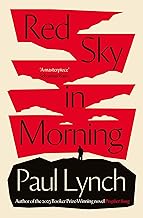
“Red Sky in Morning” by Paul Lynch: brutal brilliance

Set in C19 rural Ireland and America, this is the tale of Coyle, a poor, uneducated man who does not baulk at acts of violence when faced with injustice, or the need to survive, but is also gentle in his love for his wife and his little daughter. After accidentally causing the death of the landowner’s malicious son Hamilton, responsible for serving him notice to quit for no apparent reason, Coyle is forced to go on the run, with the foreman Faller and a couple of henchman in hot pursuit. It is unclear why Faller has such an implacable desire to avenge the death of such an unworthy character, nor what may have moulded the wily, vindictive +Faller into a personification of evil. So as Coyle endures the rigour of an Atlantic crossing, and the hardships of life in a gang of exploited Irish immigrants constructing an American railroad, based on real events at “Duffy’s Cut” in 1832, we know that the two men’s paths will ultimately cross again.

What may sound like a familiar, even hackneyed plot, is transformed by the power of Paul Lynch’s prose, remarkable in its original and lyrical stream of consciousness. Like poetry, almost every paragraph repays reading twice or more to absorb and reflect upon it. This often runs counter to the urge to turn the page not only to discover how events will turn out, but perhaps also to escape exposure to their too frequent gratuitous violence and bleakness. The latter are sometimes eased by gentle moments, when Coyle recalls his wife, or fingers the ribbon which is his only keepsake of his daughter. Yet overall, the acute observations and insights tend to be overwhelmed by scenes of brutality or acute suffering.

Quotations out of context are unlikely to do justice the writing, but here are brief descriptions of a storm and its aftermath.

These words evoke vivid images and authentic emotions, drawing on the author’s experience as a film critic.

Although I have yet to read “Prophet Song”, Paul Lynch seems to be a worthy winner of the Booker Prize for a quality of writing fed by his copious reading since early childhood, and very much in the vein of Cormac McCarthy, but with his own twist, the articulacy and skilful way with words found in so many Irish writers. “Red Sky at Morning” contains these ingredients, although being his first published novel, it may not be the best. Perhaps at times, the verbal pyrotechnics are a little too contrived, but this may be inevitable if a writer is prepared to take risks, pushing the limits of what words can convey.

It’s interesting to compare his style with that of Graham Greene, who aimed to achieve in his writing “a kind of verbal transparency which refuses to allow language to become a character in its own right” – hence the sentences which have been described as “lean and lucid”. In “Red Sky at Morning”, the words seem almost an end in themselves. The conclusion to be drawn seems to be simply, as Coyle’s wife reluctantly observes, that “all you can do in this life is to learn to accept loss”. Combined with the ambiguous, incongruously upbeat “Epilogue”, this left me dissatisfied. In view of the current state of the world, perhaps the author is justified in what he himself has called his “tragic world view”, but while having huge admiration for his talent, this is hard to take in large doses.

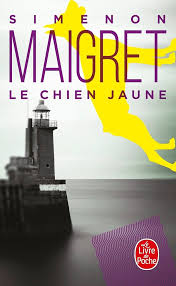
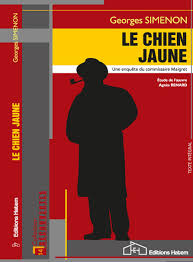
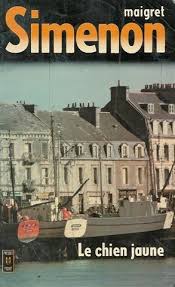
“Le Chien jaune” (The Yellow Dog) by Georges Simenon – promising but Simenon not at his best

Maigret needs no introduction, and the choice of “Le Chien jaune”, popular enough to be made into a film only a year after its publication in 1931, seemed a promising choice for a French book group.
It began well, with a customs officer observing the murder by an invisible assassin of a well-liked wine merchant shortly after he leaves a hotel bar. Summoned to investigate, as Maigret sits in the bar, he witnesses an attempt to poison the dead man’s colleagues. Meanwhile, a yellow dog, origin and owner unknown, has begun to lie by the till.

There was general agreement that Simenon shows once again his gift for capturing the ambience of a place, in this case the Brittany fishing port of Concarneau, which in the early 1930s may well have been the kind of provincial, inward-looking community where fear and prejudice could easily be aroused and manipulated. The impact of the journalists, descending en masse from national newspapers and bent on sensationalising events, is well portrayed.

However, there is something lacking. Most of the characters seem quite wooden, stereotypes or caricatures, while the plot plods through a disjointed series of events, with some of the most dramatic scenes described by third parties.

There is too much reliance on implausible scenes, as when Maigret and Leroy just happen to be sitting on the hotel roof when an intriguing meeting between two characters is visible through a nearby window. Maigret’s public admission of a criminal act for which he is never charged, and turns out to have made to protect a suspect for whom he feels sympathy, is also ludicrous.

Maybe this is unfair, in that Simenon, arguably the French (he was actually Belgian) equivalent of Agatha Christie, was a pioneer in making detective fiction highly popular. By creating Maigret as such a flawed character, needlessly brusque, uncommunicative and high-handed, perhaps he set the trend for dysfunctional but talented detectives. In this case, Maigret’s talent seems hard to justify: while informing his hapless sidekick Leroy that he is acting on intuition rather than following procedures, the fact that he could in no way have deduced so accurately and then explained the details of the complex crime so clearly in the usual “denouement” scene leaves the reader feeling a bit cheated.

If detective novels have become so much more sophisticated and dramatic in recent decades, do we still want to read about Maigret? Credited with having written more than 400 novels, Simenon’s many “romans durs” (hard novels) like “Le Train” or “Le Chat” seem to have more merit: psychological novels with tight structures and clear, spare prose, a wide range of themes and contexts and “real” characters.

Simenon’s extraordinary life is also more gripping than this encounter with Maigret.

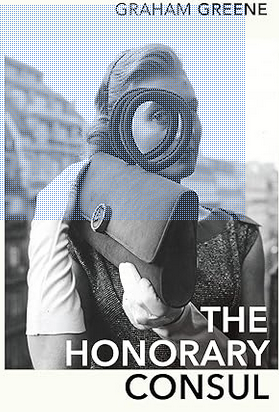
“The Honorary Consul” by Graham Greene – reaching the heart of the matter?

Set in Paraguay, presumably in the early 1970s since there is a reference to President Nixon, the central character proves not to be the “Honorary Consul” Charlie Fortnum, an alcoholic whose life revolves round “the right measure”, just enough whisky to blur reality without becoming unable to function. It is rather the “young” Doctor Eduardo Plarr, who seems quite middle-aged in his cool, cynical assessment of the world, and avoidance of emotional involvement when seducing other men’s wives, between visits to the local brothel. This is while clearly being a dedicated doctor, caring for the poor in the town he has chosen to inhabit, on the border with Paraguay. This seems to be the key to his detachment, stemming from the childhood trauma of having to escape with his mother to safe exile in Argentina, with his last memory of a father refusing to accompany them, preferring to risk long-term imprisonment as a political dissident.

The slow-paced novel focuses initially on the often mundane details of Plarr’s daily life, leaving readers to deduce some of the most dramatic events, to the extent that we keep thinking some vital point must have been missed. So it turns out that, motivated by an apparent opportunity to get his father out of prison, Plarr has collaborated with a group of political activists he happens to know from his school days. He has provided vital information for a plot to kidnap a visiting American ambassador, a valuable bargaining counter in negotiating the release of political prisoners, hopefully including Plarr’s father. This is in contradiction to the fact that we have been given to understand at the outset that Plarr’s father is already buried somewhere in Paraguay.

It soon becomes clear that the scheme has been bungled, with the far less valuable Charlie Fortnum captured in error. Plarr is faced with the practical and moral dilemma of how far to go in trying to remedy the situation, his motives complicated by the fact that he is having an affair with Charlie’s wife Clara, a former prostitute whom the Consul has married, to the disapproval of his social circle.

“The Honorary Consul” has been described as one of Graham Greene’s finest novels, and was apparently a favourite of his amongst his own works. So I was disappointed to find it wanting in comparison with his “The Quiet American”, to which I turned recently with relief as an antidote to some over-hyped, overlong current bestsellers.

If you are familiar with “The Quiet American”, you will see parallels in the two stories: Plarr and the cynical journalist Fowler; well-meaning but flawed Fortnum and the naïve young American Pyle; the local women Clara and Phuong, dependent on men to give them security, and so on. However, whereas the former conveys a powerful sense of place, and the culture of 1950s Vietnam, together with a strong development of the main characters, and the narrative drive which reveals their mixed motives, “The Honorary Consul” is less absorbing. This may be because the places, like the town where the story is mainly set, which Greene left unnamed “so as not to be tied down” are portrayed less vividly. The characters seem less convincing, more two-dimensional or caricatured. Written in the third person, there is too much of a tendency to “tell” readers about events (in a disjointed fashion) rather than “show” what they might deduce for themselves.

The drama of a potentially tense climax leaks away: while the survival of everyone directly concerned hangs in the balance, Plarr and Father Leon, the lapsed priest leading the band of kidnappers, indulge in lengthy, incongruous philosophical discussions about having, or renouncing, the Catholic faith in which they were brought up. Perhaps this is meant to be more of a novel of reflection on conflicting ideas and reactions, rather than a tense psychological drama, but with the added element of cynical farce, the reader is pulled simultaneously in too many directions.

Another interesting aspect is the extent to which the male chauvinism, bordering on misogyny, may have been an aspect of Greene’s own personality. Charlie’s wife Clara is portrayed as a sweet young woman who seeks to please men in exchange for what they are prepared to give her. Yet at their last meeting, she seems to be expressing a genuine love for Plarr which he is too emotionally damaged to return. Is it possible that he really does not take in the crucial question she asks him, because he thinks that “The only questions of importance are those which a man asks himself”?

With eighteen years between the publication of these two novels, and Greene approaching seventy when “The Honorary Consul” appeared, did he lack the motivation to hone the latter to realise its full potential? Perhaps one needs to know and care about Catholicism to appreciate what seems like a digression from the other moral questions and human failings that this novel seeks to portray and explore – but somehow fails to get to “the heart of the matter”.

Lessons in Chemistry by Bonnie Garmus

An instant bestseller in the US, quickly translated into many languages (one wonders at what cost to the quirky American humour and cultural references) and reproduced as a television mini-series, this is the debut novel by a former copywriter and creative director which at first made me suspect cynically that it just was a successful exercise in lucrative marketing. I modified this view slightly on reading that Bonnie Garmus was 65 years old when “Lessons in Chemistry” was finally published, having been rejected, it is claimed, some 98 times.

I find it hard to assess this tale of Elizabeth Zott, an ambitious young chemist embarking on a career in the 1950s, when women were expected to be mothers and homemakers, meekly occupy junior supportive roles in the workplace, generally give up their jobs on becoming pregnant, and fired if this happened “out of wedlock”. Perhaps as a result of coming from what sounds like a very dysfunctional family and possibly being somewhere on what is now called “the autism spectrum”, Elizabeth does not comply with the social norms of the day: everything is taken literally; she says exactly what she thinks, and stubbornly refuses to give up her goal to make groundbreaking advances in the field of abiogenesis – the early stages of evolution involving chemicals in “non-living matter”.

Eventually finding herself a single mother with a desperate need to earn a living after being debarred from research work by appalling levels of male prejudice, jealousy and rank abuse, she lands a job on early evening TV providing the nation’s housewives with wholesome family recipes, which she of course presents as a form of chemistry lessons. Oblivious to the fact that it was her looks which got her the job, Elizabeth mesmerises her viewers with the way she encourages them to think for themselves, have the confidence to pursue their interests and aim high, all in the course of providing scientific explanations for what makes a good pie.

Why has this theme hooked so many readers? It’s probably the sharp humour mixed with the kind of injustices which arouse readers’ sympathy. There are “marmite” characters, like the daughter who is being brought up to be astonishingly precocious, with a daily homily in her lunch box, or “Six-Thirty”, the faithful dog who thinks like a human and really seems to understand the hundreds of words Elizabeth claims to have taught him.

On the downside, apart from the over-reliance on coincidences, and chain of ludicrous events, virtually all the male characters are portrayed as unredeemed sexist monsters, in an overlong, convoluted plot which leads to a somewhat contrived, feeble conclusion. All this means that it is difficult to take this novel seriously – perhaps one is not meant to. Admittedly, it must remind older readers of how bad sexism was before the days of Equal Opportunities legislation, and is perhaps an eye-opener for younger women who do not realise how much has improved, even if not enough. It could spark debate on issues worth discussing. It’s certainly an easy read for someone, probably female, waiting for hours in an airport lounge or for some relatively minor ailment in A&E – or just simply sunbathing on a beach.

Was I supposed to be left wondering whether the author had meant to show that the extremes of good fortune, not just the ill luck, which Elizabeth experience, are all due to the influence of some man, i.e. not really her own efforts?

“The Quiet American” by Graham Greene: mixed motives

Fed by fear of the draft which deterred young Brits from going to America, and a spate of excellent but harrowing films, my memories of the Vietnam War are limited to the doomed efforts of the American government to drive the Communists out of the north in the 1960s. In fact, this war lasted from 1955-75, and was preceded by the shorter first Indo-China about which my knowledge is very shaky. This is the period in which Graham Greene sets his classic, “The Quiet American”, to which I turned with a huge sense of relief after struggling through a few superficial, over-hyped modern novels.

The narrator is Fowler, a cynical British journalist, although we never quite learn what disappointments have driven him so far from his native land. He finds solace in opium and his beautiful young mistress Phuong – a relationship which may seem exploitative to readers seventy years on. He reports objectively on the attempts by the French to prevent the insurgency of the Communist Việt Minh into their Far Eastern colony, showing great foresight in observing that the increasing American involvement will come to nothing, and “in five hundred years there may be no New York or London, but they’ll be growing paddy in these fields, they’ll be carrying their produce to market on long poles wearing their pointed hats”.

Fowler is therefore irritated by what he sees as the naivety of Pyle, an idealistic young American, newly arrived in Vietnam to work for the Economic Aid Mission. It becomes apparent that he may even be a menace, through his desire to meddle in the situation via direct action, by promoting a “Third Force”, as advocated by a writer he much admires.

As Fowler tries to warn him, “We are the old colonial peoples, Pyle, but we’ve learned a bit of reality, we’ve learned not to play with matches. This Third Force – it comes out of a book, that’s all. General Thé’s only a bandit with a few thousand men, he’s not a national democracy”.

Fowler’s growing animosity is fuelled by Pyle’s infatuation with Phuong, whom he wishes to marry and save from what seems to him a sad fate if she stays with Fowler – too old and separated from a wife who refuses to divorce him.

It is not a spoiler to reveal Pyle’s murder, which is reported at the outset. The intrigue lies in the revelation of how this comes about, and the question of the extent of Fowler’s involvement in it, and of the degree to which an action can be justified if the motives are suspect. This psychological drama plays out against vivid images of life in Vietnam of the 1950s, from the cities to the tense encounters with the enemy in the countryside. As a reader, one can simply be absorbed in Fowler’s personal crisis, without always being entirely clear about the various power groups involved. On the other hand, the novel is an opportunity to understand a past conflict more clearly, and consider parallels with the present.

In around 180 pages of tight prose peppered with wry observation and convincing dialogue (except perhaps when Fowler is telling Pyle about love while the two men take refuge in a watch tower), Greene transports us into a different world. To absorb all this, the book needs to be read slowly, more than once. It is a masterpiece, perhaps in danger of being forgotten beneath piles of more recent mediocre undemanding fiction.

“La Decision” – by Karine Tuil – “Believe those who search for the truth, doubt those who find it”.

Best-selling French author Karine Tuil seems to favour novels which focus on current controversial issues as they affect the lives of characters with high-flying professional careers but dysfunctional private lives.

In this case, Alma is a judge who has to decide whether French nationals of Arab origin who wish to return from the Middle East, where they have been in contact with organisations like Islamic State, pose a security risk, or may even face prosecution if there is sufficient evidence. The stress of her job is compounded by the fact that she has fallen out of love with her husband Ezra, and is embroiled in an unwise affair with a charismatic but unpredictable judge, Emmanuel.

Alma is particularly preoccupied with the case of a young detainee called Kacem. Is it too risky to release him into the community, so that, for the sake of the public, he must serve a prison term which is likely to radicalise him into a full-blown terrorist? An added complication is that Emmanuel is the judge representing Kacem, creating a “conflict of interest” for Alma.

This could form the basis for a compelling novel which works on several levels – gripping and also thought-provoking. Yet I was to be disappointed. Was the novel written too quickly? The various plot strands are not well-developed , nor skilfully interwoven. While legal aspects are often dealt with in detail if at somewhat tedious length, others concerning the relations between the characters are too brief, or disjointed and superficial. At times, the book resembles notes for a novel, with simply too much explanation and “telling” as opposed to “showing” readers, to enable them to draw their own conclusions. Too much seems implausible or contrived. Although it is not important for me to like a character, Alma appears too emotional and self-absorbed to be an effective judge, or to arouse much sympathy. The aftermath of “the decision” is potentially the most interesting and moving part of the novel, but marred by being too rushed, with a somewhat trite conclusion.

At least I learned a few idioms and fresh vocabulary in what is a fairly easy read in French. However, I would recommend “Les Choses Humaines” instead, in which the plot and characterisation are handled better.

“The Gardener”: by Salley Vickers – Insight versus second sight?


A talented illustrator of children’s stories, the improbably named Halcyon aka Hassie Days finds that contracts have dried up following her decision to focus on caring for her dying father.  Together with her sister Margot, she agrees to share their joint inheritance from him on the purchase of a neglected old house in the Shropshire village of Hope Wenlock.  This is clearly not a good idea since the two have continued their childhood bickering into adult life, and have very different personalities and aspirations, Margot being smart, materialistic and employed in some form of high finance.  It gradually becomes apparent that Hassie is going through a mid-life crisis, triggered by a recent love affair.

At first, I was hooked by Hassie’s wry humour, and insightful observation of varied local characters, or Margot’s friends, despite the apparent inability to manage her own life. The influences which have made the two sisters so different are intriguing.  The descriptions of the scenery around Wenlock edge, and the garden which Hassie transforms with the help of the resourceful Albanian Murat, who may be lying low for reasons connected with immigration, are very vivid and compelling.

However, the last five chapters proved a growing disappointment: “So many things happened in quick succession around this time that I may have got the sequence confused”. I am inclined to speculate with other reviewers as to whether the author was pressed for time to finish, or even struggling to find a happy ending that would not seem too trite.  While some loose ends or last minute crises are tied up too neatly, other threads are brought to the fore without being adequately woven into the tale.  For instance, the accounts of the C7 abbess, St.Milburga, are rather tedious information dumps. As she reads the journals of Nelly East, the former occupant of the house who was so repressed by her husband, Hassie’s affinity with her seems too sudden and undeveloped. Several incidents appeared implausible, too rushed, or both.  Murat remains a two-dimensional character to a frustrating degree.

I could appreciate the process by which Hassie might come to terms with fate, develop a sense of proportion and renewed purpose in life. However, the hint of magic realism, “away with the fairies”, was a step too far.

“Changer l’eau des fleurs” – Fresh water for flowers by Valerie Perrin

Violette has the unusual role of caretaker for the cemetery in the small French town of Brancion-en Chalon. With a tied house on site, the post was meant to be shared with her husband, but this idle philanderer, inaptly named Philippe Toussaint, rode out of her life on his motor cycle without warning nearly two decades previously.

In continual flashbacks, we learn how, born “Sous X” to an anonymous mother and brought up in children’s homes, the pretty but illiterate and unloved teenage Violette was an easy prey for control and exploitation by Toussaint. The birth of her daughter Leonine brings Violette great joy and a sense of purpose, but ties her more firmly to Philippe, until a tragic event which may also be a crime occurs.

Despite all this, the middle-aged Violette finds unexpected solace in the way of life which the cemetery provides: the ceremonies; the visitors; the incidents and anecdotes; the company of a team of undertakers, gravediggers and the Catholic priest with hearts of gold, if somewhat caricatured, and not least by the skill she has learned in planting her garden.

This novel has a filmic quality, no doubt due to Valerie Perrin’s work as a screenwriter, and her connection to the Director Claude Lelouch (of “Un Homme et Une Femme” fame). I wonder to what it extent it may have been inspired by John Irving’s “The Cider House Rules”, a book to which Violette appears to have become addicted.

A prize-winning bestseller in France, translated into many languages, “Changer l’Eau des Fleurs” (Fresh Water for Flowers) was the choice of my French reading group. I found the constant switches back and forth in time, including sub-plots to chart three often fraught love affairs over more than three decades, and clearly designed to build suspense, made it quite hard to keep track of the chronology – but by the end, this did not really matter. Also assuming different points of view, these flashbacks led to constant repetition, perhaps also intended to help the reader. A tendency to reel off a string of examples, when or two would do, and the inclusion of lengthy extracts from the lyrics of popular songs, contributed to the padding out of this book to 660 pages for a somewhat misnamed “Livre de Poche”. Admittedly, by checking out some of the singers on YouTube, I learned a little more about French popular culture.

Similarly, the novel is packed with colloquial idioms, but the desire to improve one’s French was stretched to the limit by the sense of being bombarded with melodrama, and some beyond ludicrous scenes, as when Violette, having somehow learned to ride a monocycle, scares the wits out of some noisy teenagers holding a midnight party in the cemetery, by careering down the alleys between the graves, draped in a shroud decorated with phosphorescent paint, a flashlight whistle between her lips. This was one of the points where I nearly abandoned reading, yet others have singled it out as hilarious. On the other hand, I appreciated a whole chapter devoted to random snatches of conversation heard by Violette as she gardened.

So, if one is not a reader who seeks to escape into a lengthy, sentimental soap opera, where flawed individuals sometimes redeem themselves, where events are often the result of tragic ironies, but the human spirit can survive with remarkable resilience despite it all, you can always choose a novel at the other end of the scale, like one of Claire Keegan’s, instead.

“Thunderclap” – A memoir of art and life & sudden death by Laura Cumming: a question of perspective

The well-known painting, “The Goldfinch” was the work of the little-known Carl Fabritius, whose life was cut short  in the devastation of the Dutch city of Delft in 1654  by the explosion  of a gunpowder store – the “Thunderclap” in the title of art critic Laura Cumming’s “memoir of art and life and sudden death”.

Having been fascinated by her study of the painter Velasquez, “The Vanishing Man”,  and found her attempt to piece together the facts of her mother’s childhood quite atmospheric and poignant, perhaps my expectations were too high for an original take in this case. It soon became apparent that, even with the most forensic research and deepest speculation which characterise the author’s past work, the facts are too thin to justify a full-length book devoted to Fabritius.  So it is filled out not only with observations on Dutch art, but recollections of the author’s own father, a talented Scottish artist who fed her appreciation of Dutch art. She flits between these themes in chapters which read more like articles from The Observer on which she has worked for years – chapters which can be read in any order.

Regretting the lack of an index, and deciding it was Fabritius  who really interested me, I combed the book for information about him, actually starting from the later chapters where the largest photos of his few known paintings are displayed with the most accompanying information and observations. So, the focus is on not only “The Goldfinch”, but a couple of self portraits of the artist himself, an intriguing view of a sleeping sentry with his dog, and the even more riveting  “A View of Delft”.  A small oil painting, only about eight inches by fourteen, this appears to be a product of the painter’s interest in perspective, so that the picture was designed to be attached to a curved surface and viewed through a peephole to give a more three dimensional effect in the days  before photography or film.

Although, to be honest, I found the book overly repetitive, disjointed and rambling, the author has  enabled me to appreciate Fabritius more fully, and to regret that such talent should have been curtailed so abruptly,  at the age of only thirty-two  (1622-54). How much more might he have painted, and would it have made his legacy more celebrated?