Re-entrance to a plauditry

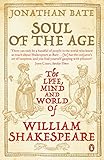
This is my review of Soul of the Age: The Life, Mind and World of William Shakespeare by Jonathan Bate.

Sequenced to follow the seven phases of a man’s life in the famous “All the world’s a stage” soliliquy, chapters takes the form of themed essays.

Readers will be struck by different revelations and insights in the spate of ideas. I realised for the first time that it was the banning of the cycles of medieval mystery plays by the Protestant Reformation which created a vacuum into which Shakespeare could present his new plays, untrammelled by dogma, relatively free to range over a wide range of topics and ideas.

I liked the idea of Shakespeare continually drawing on his Warwickshire roots. So, when culling ideas for “As You Like It” from a prose romance called “Rosalynd”, he turned the forests of the Ardennes into Arden. When insulted for his lowly origins by an educated, now forgotten rival playwright, who called him “an upstart crow beautified with our feathers”, Shakespeare took humorous revenge in “The Comedy of Errors” with a punning dialogue on “breaking in with a crow without feather” that is to say, a crowbar. The exchange is much more entertaining when you know the context.

It was the father of a friend of Shakespeare’s who translated into English details of the universe according to Copernicus, with the sun at the centre. When the accepted belief was in the “necessary correspondence between the order of the cosmos and that of the state”, Shakespeare showed his independence of mind and flexibility of thought in giving humorous irony to to Edmund in “King Lear”:

“when we are sick in fortune – often the surfeits of our own behaviour – we make guilty of our disaster the sun, the moon and stars, as if we were villains of necessity…..My father compounded with my mother under the dragon’s tail and my nativity was under Ursa Major, so that it follows I am rough and lecherous”.

Just before the abortive coup which ended in his execution, the Earl of Essex may have been inspired to sedition by Shakespeare’s Richard II: if Shakespeare had been sent to the Tower for this, great works such as Othello, Lear, Macbeth and the Tempest might never have been written. As it was, eighteen of his major plays which did not appear in print in his lifetime would probably have been lost if two colleagues from the Company of King’s Men to which he belonged had not ensured their publication after his death.

We see Shakespeare daring to experiment with the ideas of Montaigne, exploring a range of philosophies including the Epicurean view, suspected because of its association with atheism: the need to give vent to one’s feelings rather than maintain Stoical patience, for “Sorrow concealed, like an oven stopped, Doth burn the heart to cinders where it is.”

There are gaps in our knowledge of Shakespeare. Was he obliged to steer clear of King James’s court for a while since he had syphilis? Yet we have many remarkable details, such as the amount a colleague left him in his will, the fact that his energy was exhausting, but there was widespread admiration for his “wit” in the widest sense of linguistic talent, humour, imagination and judgement. So, the author’s occasional attempts at surmise seem like unnecessary contrivance.

With his astonishing knowledge of Shakespeare’s life and works, perhaps Jonathan Bate may be forgiven a convoluted style and a weight of detail which is sometimes too much to absorb. This book has helped me to appreciate Shakespeare’s wit and insight, filling me with good intentions to revisit his sonnets, even study some of his plays again.

⭐⭐⭐⭐ 4 Stars

“The Glorious Heresies” – Winner of the Baileys Women’s Prize for Fiction and the Desmond Elliot Prize 2016 by Lisa McInerney. Stab at a female Irish Irvine Welsh?

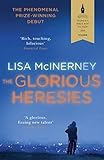
This is my review of The Glorious Heresies: Winner of the Baileys Women’s Prize for Fiction and the Desmond Elliot Prize 2016 by Lisa McInerney.

“It hit him like a midwife’s slap” is a good line in the Irish idiom, but what would a teenage boy know about midwives? I appreciate the raw energy of Lisa McInery’s style and the sincerity of her portrayal of a group of dead-end Cork-based drug-takers and dealers, prostitutes and criminals, their excuse being poverty in post-financial crash Eire, and a flaky, hypocritical Catholic tradition.

Nevertheless, what is described on the back cover as a “punchy, edgy, sexy, fizzling, feast of a debut novel”, “a gripping and often riotously funny tale”, left me cold. I found the unrelenting sordid violence unrelieved by any of the famous Irish quirky humour or lyrical prose. At one point, when a man is shot, there is no real sense of shock or emotion. It may of course have been the author’s intention to portray death like that in an arcade game, but across the board, characters are not developed in any way that makes me engage with them. Although it did not promise a “happy ever after”, the ending seemed somewhat sentimental.

This is one of those novels which divides readers. Whether or not one likes a novel is always subjective. Some of the most challenging novels the most worth reading are an acquired taste. However, after decades of reading a wide variety of fiction, I may commend this as a debut novel (but why should one make allowances for a first book anyway?) but, as others have said, it is quite long with a shambling plot, and I did not feel it was worth spending the time needed to read it.

⭐⭐⭐ 3 Stars

From Catholic monarchy versus social justice to “bleak chic”

This is my review of The History of Modern France: From the Revolution to the War with Terror by Jonathan Fenby.

Observing the newly restored Bourbon King Louis XVIII’s reluctant choice of ministers, the devious Talleyrand leaning on the arm of brutal Fouché , Chateaubriand described “vice leaning on the arm of crime”. A Christmas Eve dinner during the Prussian siege of Paris in 1871 included, elephant consommé and bear ribs in pepper sauce from slaughtered zoo animals, along with the more mundane stuffed donkey’ s head and roast cat with rats. These entertaining asides spice up Jonathan Fenby’s broad sweep from the ill-fated attempt to restore the monarchy, after Napoleon’s final defeat in 1815, in the shape of the unimaginative, ageing brother of the guillotined Louis XV1, to the economic decline under the unpopular socialist President Hollande, aggravated by terrorist events like the attack on the satirical magazine Charlie Hebdo.

Throughout the book, I kept seeing parallels between past popular revolts and the present unrest: left-wing republicans trying to limit working hours, although the modern-day 35 hours a week was a ten hour day in the Paris of 1848; C19 Parisians uprooting trees to form barricades, and today’s CGT unionists burning tyres outside power stations in protest against legislation to make organisations more competitive, with the irony of a modern socialist government seeming to work on the side of employers. Of course, the paradox of the First Republic of 1848 was far keener, “a reminder of how eminently respectable republicans turned the troops on their own people motivated primarily by the desire for a decent livelihood.”

Jonathan Fenby is most readable when he focuses on particular people or events: the succession of four monarchs, including the well-intentioned “Citizen King” Louis-Philippe, whose approach to reform was too moderate to appease the republican genie let out of the bottle, particularly in 1848, the Year of Revolutions, which perhaps the author could have explained more. Napoleon’s step-nephew (I think, a few family trees would have been useful) managed to hold power for eighteen years as France’s last monarch, and presided over some much-needed economic progress and restoration of national standing, despite being dismissed by Bismarck as “a sphinx without riddles” and criticised for his amoral pragmatism. The humiliation of his loss of the Franco-Prussian War in 1870 is an aspect of the ongoing rivalry between the two countries either side of the Rhine: now, France suffers by comparison with Germany as regards growth rates and trade deficits.

Fenby paints a fascinating portrait of De Gaulle, who comes across as an egotistical dictator, alternating as is often the case between arrogant certainty and melancholy, profoundly ungrateful for the help received from Britain and America, presumably a constant reminder of his own impotence when France was occupied in WW2.

The price of covering so much is a text at times so condensed as to become indigestible and occasionally unclear, particularly in the period 1870-1939 which I found hard going. I accept that forty-two governments between two world wars, with a system resulting in short-lived coalitions, is hard to cover adequately. Fenby tries to aid clarity with subheadings, boxes to feature somewhat arbitrarily chosen individuals, and day-by-day accounts of some key periods of unrest. However, I could have done with a glossary of the large number of players involved, a timeline of key events, plus an explanation of the current French voting system, to avoid the need to refer elsewhere.

Fenby leaves us with a rather bleak picture of a depressed country which despite its sense of being special, has fallen behind as it prefers “to reject economic modernisation in favour of defence of tradition”. Although the Republic has been accepted since 1870 as the regime that divides the French the least, the warring factions remain: “the country invariably opts for right over left with occasional eruptions to prove that the revolutionary legacy is not dead”. I would have preferred more of this kind of an analysis, perhaps a two volume history with a break in 1945, to give more space to develop themes.

⭐⭐⭐⭐ 4 Stars

Be careful what you wish for

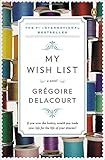
This is my review of My Wish List by Gregoire Delacourt.

“How can you do such a disgusting job – I work in advertising – and write such lovely books?” This sentence in the gushing postscript to this short novel explains the growing sense of unease I had experienced when reading it. This story is a marketable product pitched at female readers by an author with a knack for adopting the “voice” of “ordinary”, admittedly somewhat stereotyped, women, and for identifying an intriguing situation on which to build a bitter-sweet scenario.

In this case we have Jocelyne, owner of a small haberdashery in Arras, slipping into slightly overweight middle age with her dependable but dull and on occasion boorish husband, with two now adult children who have “flown the nest”. She seems to have had more than her fair share of misfortune: the loss of her mother and her father’s onset of illness when she was still a teenager put paid to her youthful ambitions, leaving her with low self esteem and a nagging sense of having made too little of her life. Into this rather unpromising situation falls the bolt from the blue of a huge lottery win, raising the dilemma we all share as to how we would spend this, if given the chance. Jocelyne’s periodic “wish lists” – progressing from “a lamp for the hall table” to “spend a fortnight in London with my daughter”, highlight the common inability to think on a grand enough scale, particularly if one is accustomed to put one needs second. Eventually, she only lists a Porsche as a “folly” that will please her husband.

There are some interesting aspects to the story: her fear that the money will destroy what is good in her life, her awareness that the most valuable things in life cannot be bought with money, that the planning of purchases over time can be more satisfying than a huge spending spree, money no object. The presumably intentional irony is that her knitting and sewing blog which costs nothing does more good in the world than the huge cheque she has won. Is it also intentional irony that the man she loves is so unworthy of her devotion, or are we meant to think that love itself is simply what counts more than money?

In the end, the novel disappoints by proving too shallow and sentimental, aptly described by the wonderful French word “guimauve” – marshmallows and mushiness. The two main male characters – husband and shadowy male love interest – are both too underdeveloped to be convincing and the plot drifts to a limp and disappointing ending.

⭐⭐⭐ 3 Stars

Si tu savais tout ça, tu ferais quoi?

This is my review of La liste de mes envies (Littérature française) (French Edition) by Grégoire Delacourt.

“How can you do such a disgusting job – I work in advertising – and write such lovely books?” This sentence in the gushing postscript to the French version of this short novel explains the growing sense of unease I had experienced when reading it. This story is a marketable product pitched at female readers by an author with a knack for adopting the “voice” of “ordinary”, admittedly somewhat stereotyped, women, and for identifying an intriguing situation on which to build a bitter-sweet scenario.

In this case we have Jocelyne, owner of a small haberdashery in Arras, slipping into slightly overweight middle age with the dull and on occasion boorish husband she still seems to love, with two now adult children who have “flown the nest”. She seems to have had more than her fair share of misfortune: the loss of her mother and her father’s onset of illness when she was still a teenager put paid to her youthful ambitions, leaving her with low self esteem and a nagging sense of having made too little of her life. Into this rather unpromising situation falls the bolt from the blue of a huge lottery win, raising the dilemma we all share as to how we would spend this, if given the chance. Jocelyne’s periodic “wish lists” – progressing from “a lamp for the hall table” to “spend a fortnight in London with my daughter”, highlight the common inability to think on a grand enough scale, particularly if one is accustomed to put one needs second. Eventually, she only lists a Porsche as a “folly” that will please her husband.

There are some interesting aspects to the story: her fear that the money will destroy what is good in her life, her awareness that the most valuable things in life cannot be bought with money, that the planning of purchases over time can be more satisfying than a huge spending spree, money no object. The presumably intentional irony is that her knitting and sewing blog which costs nothing does more good in the world than the huge cheque she has won. Is it also intentional irony that the man she loves is so unworthy of her devotion, or are we meant to think that love itself is simply what counts more than money?

In the end, the novel disappoints by proving too shallow and sentimental, aptly described by the wonderful French word “guimauve” – marshmallows and mushiness. The two main male characters – husband and shadowy male love interest – are both too underdeveloped to be convincing and the plot drifts to a limp and disappointing ending.

⭐⭐⭐ 3 Stars

Exploiter exploited

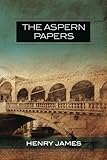
This is my review of The Aspern Papers by Henry James.

Determined to succeed where his colleague failed, an unnamed editor insinuates himself into the decaying Venetian villa of the ageing Juliana Bordereau. His aim is to obtain by some means the literary treasure he believes her to possess, the papers of her former lover, the long-dead, celebrated poet Jeffrey Aspern. Inspired by scholars’ interest in the letters of Shelley to his sister-in-law Claire Claremont, this novella is a subtle and absorbing psychological study of the destructive and corrupting effects of obsession, and of the complexity of people’s motives, set against the background of a crumbling, magical nineteenth century Venice with which everyone who has visited this city will still be able to identify.

In what James apparently regarded as one of his best works, his famously convoluted prose seems surprisingly clear and accessible, the dialogue is sharp and the descriptions evocative and vivid, as in the description of Venice viewed from a gondola as a series of scenes from a play. I like the way that the narrator made predatory by his obsession is not the only main character to be flawed: the ageing Miss Bordereau is understandably concerned to safeguard her privacy and may wish to provide for her faithful niece’s uncertain future, but proves mercenary and manipulative; Miss Tita may be a longsuffering companion with a sense of honour and duty, but proves not to be above taking the opportunity to exploit her exploiter. I think it might have been even better if the narrator had not appeared so self aware at times, but overall would recommend this as an introduction to Henry James, or in my case a book I have reread with undimmed admiration.

⭐⭐⭐⭐⭐ 5 Stars

Subtler than Steinbeck, warmer-hearted than Cormac McCarthy

This is my review of The Power of the Dog (Vintage Classics) by Thomas Savage.

In 1920s Montana, brothers Phil and George devote their lives to running their prosperous cattle ranch. Despite living and working so closely together, even to the point of sharing a bedroom, the two could not be more different. George is stolid, dull, but decent and kind. Phil, a brilliant literary creation apparently modelled on the author’s step-uncle, is a complex, multi-talented man of intriguing contrasts: intellectually brilliant, musical, athletic, skilful with his hands, Phil has not only rejected the glowing career he might have pursued, but insists on wearing the rough clothes of a working man and resists any kind of change, scorning for example the cars which disrupt the flow of cattle to the railhead. For reasons continually implied, but never fully revealed, he has twisted his sensitivity and insight into the winkling out of any weakness in the creatures he hunts: “He knew if a timber wolf was lame, noted the fainter print of the favoured paw in dust or snow. In the sudden elbow of a stream where the baffled water turned upon itself he watched the trout ‘conceal’ itself in the shadow of a rock”. The same applies to those unfortunate enough to cross his path, subjecting them to merciless jibes if the mood takes him. So, when lonely George marries a young widow whom Phil regards as a socially inferior gold-digger, he sets out with typical obsessive patience to destroy her. The tale is bound to end in tragedy, but for whom?

By turns nostalgic, poignant or ironic, this gripping psychological study is very-well constructed so that, on reflection at the sudden unexpected ending, a trail of previous random details reveal themselves as clues and slot neatly into place. All the main characters are fully developed, with a depth and subtlety which even evokes some sympathy for Phil. Digressions on the way are as striking as the main plot, in their vivid descriptions of the terrain, and the portraits of minor characters, such as the Indian, unable to give up his pride over being the son of a chief, who leaves his poverty-stricken reservation without permission in order to show his own son the fertile lands of his youth: “the fields thick with purple lupine that waved and billowed in the breeze like water….the dark gray thunderheads that reared high over the mountains and lumbered like grizzlies across the sky, heavy with water”.

The fact that so much of the novel seems to have been based on Thomas Savage’s own experiences of belonging to a large ranching family gives the book its authenticity. It is a pity that this book was not hailed as a masterpiece when it first appeared in 1967. Perhaps even now that it has been “rediscovered”, too many readers will be put off by the instances of at best cavalier and at worst cruel treatment of animals in the book, starting with a graphic description of castrating calves in the opening paragraph: but this is all part of the reality of a life which the author knew first-hand.

⭐⭐⭐⭐⭐ 5 Stars

In the wrong place at the wrong time

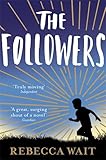
This is my review of The Followers by Rebecca Wait.

Drifting through life in a state of apathy bordering on depression, single parent Stephanie becomes dominated sexually and mentally by the magnetic Nathaniel who persuades her to join what turns out to be his religious cult, housed in a rundown, isolated moorland property called The Ark. This is much to the disgust of Stephanie’s spiky and perceptive twelve-year-old daughter Judith. Stephanie’s decision contributes to a chain of events leading to a shocking climax.

Following the common device of hooking the reader with a flash forward in the first chapter, we are introduced at the outset to a dysfunctional young adult Judith, reluctantly visiting Stephanie in jail where she is serving what sounds like a life sentence for a crime which has left her daughter understandably emotionally scarred. For quite a large part of the book, I would have preferred not to know this in advance, but was eventually won over by the author’s effective interweaving of “Before” and “After”.

Rebecca Wait is skilful in gradually revealing the chain of events, and in showing us the characters’ personalities and often confused thoughts. I was particularly struck by her portrayal of children, not just Judith on the verge of adolescence, but also those born and raised in the Ark who have been taught to view as an evil “Gehenna” the outside world which they have never experienced, even to the extent of walking down a street or watching TV. The gulf between the two worlds is continually shown through the by turns humorous and poignant interactions between Judith and Moses, the boy of her age who desperately wants to be her friend whilst clinging to the comfort of the beliefs she continually questions.

This is not merely a tension-building, gripping page turner but also a psychological drama exploring such issues as responsibility for one’s actions, dealing with conflicting values and guilt, and the extent of one’s duty to other people. I found the build-up to the climax too melodramatic, but it is arguably only reasonable that at this stage all the adults have become at least a little mad. Even given that Nathaniel had a talent for picking out weak and suggestible people, I was unconvinced that "the followers" would accept so meekly the increasingly erratic and extreme Nathaniel’s religious cant and manipulative ploys, but agree that there are plenty of real-world examples of a never fully explicable willingness to be controlled. It was chilling to read how the children had been conditioned, partly through knowing no other life.

Although most of the characters are insufficiently developed, one could argue that the story has been pared down to make a greater impact, leaving readers free, unlike the "followers", to reflect and draw conclusions for themselves.

⭐⭐⭐⭐ 4 Stars

“Snowblind” by Ragnar Jonasson: Scandi-gris

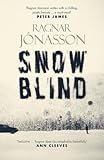
This is my review of Snowblind (Dark Iceland) (Dark Iceland 1) by Ragnar Jonasson.

Being a sucker for detective fiction, I was ready to be hooked by this novel set in Siglufjörður, a real but obviously fictionalised small town in northern Iceland. It seems implausible that fresh from police college Ari Thór would leave Reykjavik to accept a post there, without having visited the place or discussed the move with his trainee doctor girlfriend, still less likely that the job would be offered without interview, unless it is very hard to fill. This seems possible in that Ari Thor soon develops misgivings over the isolation of the small town, linked by road to the rest of the world only via a narrow tunnel, together with the apparent lack of any real crime, and the sense of being an outsider heightened by finding himself an instant topic of unbridled gossip in the close-knit community.

Although the book is halfway through before it gains the momentum to become a full-fledged crime mystery, I like the way that Ragnar Jonasson sets the plot against the background of the 2008 financial crisis, referring continually to its implications for ordinary people, and also describes a pattern of life in which Icelanders are often obliged to leave their home towns for work, yet feel drawn back inexorably, partly by the magical beauty of the summers. Although the author writes less than I had expected about the depressing effect of prolonged darkness, he conveys well the claustrophobia created by heavy snowfalls which trap people in their communities. Ari Thór’s immaturity and impulsiveness, his attempts to conceal his inexperience and difficulty in handling his relationships with women all seemed quite convincing and aroused my sympathy.

I suppose this has been called literary fiction because the main characters are developed in some depth, with an attempt to explore their psychology and inner thoughts. The problem for me is that at first there seem to be too many of them, with over-similar “voices”, each revealed in turn in a somewhat indigestible slab of backstory, often involving the traumatic effect of the death of a close relative during the character’s childhood or youth.

Clues are dropped on the way, without being too obvious, and the plot is credible but the “denouement” seems a bit rushed. Also, although the English translation comes across as natural and does not jar, the style tends to be bland and prosaic, so may not do justice to the original.

Scandi-gris rather than noir, this is an easy, entertaining read, with some interesting psychology and a strong sense of place but which lacks tension or striking prose.

⭐⭐⭐ 3 Stars

The not famous two go sleuthing

This is my review of The Trouble with Goats and Sheep by Joanna Cannon.

When a middle-aged woman disappears from a suburban road, gossips fear the worst, but her neighbours are embroiled in a rising tide of panic and recrimination as they fear that a guilty secret from the past is about to be exposed. Prompted by the vicar’s sententious platitude that “if God exists in a community, no one will be lost”, bossy ten-year-old Grace and her compliant but underestimated friend Tilly pose as helpful brownies to gain access to neighbours’ homes in order to check whether or not God is there. Quite how this is going to help the situation is never made quite clear.

The story is set in the long, hot summer of 1976 which a number of writers have used as a backdrop to weird goings-on. Despite some novel if overwritten images –– “the sky was ironed into an acid blue, and even the clouds had fallen from the edges, leaving a faultless page of summer above our heads”, “the avenue…bewildered by the heat” – I grew weary of descriptions of the unrelenting drought, but this may have been the author’s intention. The focus on “contemporary accuracy” with references to Harold Wilson and his pipe, “Are you being served?”, “The Good Life”, Patsy Cline singing “Crazy”, “The Drifters” and “Angel Delight” often seems contrived.

At first, the chapters written from Alice’s viewpoint seem the strongest, until the contrast begins to jar between her childishness and some implausibly insightful comments: observing a Mrs Morton she reflects “Early widowhood had forced her to weave a life from other people’s remnants, and she had baked and minded and knitted herself into a glow of indispensability.” In order to drip-feed the reader with the details of what is really afoot in “The Avenue”, Joanna Cannon has to resort to a number of different viewpoints, all in the third person and often involving flashbacks. This often makes the storyline seem fragmented, with the highly stereotyped adults soon becoming tedious caricatures. Trite comments apart, there is a good deal of humour in the book, but the hypocrisy and prejudice of the adults is laid on with many trowels.

As the story labours its way to a surprisingly abrupt and anticlimatic ending, I was probably wrong to be irritated by a number of small errors: the “six week” school summer holiday runs from early July through to September, starting on July 5th, at least a fortnight earlier than I remember to be the case. Dahlias bloom in July alongside freesias – perhaps a quirkish effect of the heat. The persecuted Walter Bishop has several cedar trees in his front garden, something I have never seen outside a stately home. My main problem was being unable to form a clear sense of place – a mental picture of the estate, somewhere a bus ride from Nottingham. At various points, we are told about terraces and a corner shop, but houses in the Avenue have garages and sound detached. Lace-curtained windows of kitchens and “living rooms” both seem to overlook the road plus the houses seem to have “sitting rooms” as well. Here, an alcoholic single mother lives close to a property manager. The neighbours mostly seem to have known each other from childhood but are they working or middle class? You need to know this about a community in the UK. And, although some appear to have jobs, how is it that they all seem able to converge on a dramatic scene at the drop of a hat?

It’s the fantasy land of a children’s story in what purports to be an adult novel. The “genres” are all mixed up but in the end it proves to be a lightweight, by turns sad, funny, sentimental, unsubtle psychological novel. A poignant situation and any sense of real suspense are both blunted by a storyline which descends into tongue-in-cheek parody – to give it the benefit of the doubt – particularly when the neighbours gather in their deckchairs to watch over the creosote image of Jesus which has appeared on a drainpipe.

⭐⭐⭐ 3 Stars