“Eleanor of Aquitaine: A Biography” by Marion Meade – Making the most of a woman’s lot

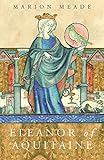
This is my review of Eleanor of Aquitaine: A Biography (WOMEN IN HISTORY) by Marion Meade.

Eight centuries on, records still remain to prove that Eleanor of Aquitaine was a remarkable woman: beautiful, robust, energetic, courageous, resilient, intelligent, cultured and a shrewd negotiator when given the chance. In a world where the status and security of feudal lords depended on the possession of lands, her inheritance of the extensive and prosperous French Duchy of Aquitaine made her an attractive marriage partner for two rival kings: firstly, the indecisive and monkish Capetin Louis VII of France, whom she grew to despise, and later by complete contrast the Angevin Henry II, Plantagenet ruler of England, a vigorous, driven man with an uncontrollable temper and insatiable sexual appetite.

Eleanor accompanied Louis on an ill-fated Crusade, slowing the procession down with her vast quantities of baggage. She often risked dangerous voyages, even when heavily pregnant, and almost up to her death, aged eighty-two, embarked on tours round her lands to maintain the loyalty of vassals and foil rebellions.

In the unlikely event of her being as promiscuous as painted by detractors, this would have fallen far short of Henry’s predatory treatment of women. Scandalous gossip, embellished long after her death, buzzed round her close friendship with handsome men like Uncle Raymond of Antioch, her probably mythical, failed attempt to elope with Saladin, and demand for divorce from Louis and immediate marriage to Henry, fourteen years her junior. Yet ultimately she was always to be constrained by the superior power of men: the Pope blocked her divorce until Louis decided to end the marriage because of her apparent inability to bear sons. Ironically, she produced four boys in rapid succession for Henry, the ill-fated John born some years later being the last of her ten children. When, in the 1170s, Henry’s heavy-handed mismanagement of his sons provoked their revolt, Eleanor’s support for them was punished with sixteen years of imprisonment, but this did not break her spirit.

When it suited Henry to let her administer affairs in his frequent absences from England, she performed with great competence. Similarly, in her self-imposed exile to Aquitaine, unable to tolerate close at hand the humiliation of Henry’s overt affair with the legendary Rosamund Clifford, she again stabilised with her shrewd and fair management a region which Henry had only disturbed. Yet again, when her favourite son Richard Coeur-de-Lion succeeded Henry, she ran Aquitaine in his absence and drummed up a heavy ransom for his release when he was kidnapped by, of all people, the Duke of Austria.

Marian Meade’s journalistic style, which sometimes slips into quaint phrases involving “hie” and “goodly”, and often seems padded out with purple prose, succeeds in breathing life into what could be a tedious, indigestible wade through long-forgotten events. I have to believe her assertion that “none of the dialogue is invented”, but the continual references to, say, Eleanor’s thoughts, together with a lack of clear sourcing of anecdotes (at least in the edition I read) make this seem like “faction” rather than academic biography. Whatever the truth, this very readable account brings home the insecurity of Medieval life. Apart from the risk of sudden death, feudal property-owners were forced into a continual soap opera of shifting allegiances, trying to take advantage of each other, or avenge some past wrong. It is fascinating to appreciate the lack of a sense of “nation state”, the ease with which castles, lands and marriageable offspring were traded: even the Lionheart did not speak English! The ephemeral fragility of the Angevin Empire which Eleanor worked so hard to build with Henry gives sobering food for thought.

⭐⭐⭐⭐ 4 Stars

Qui sommes-nous au juste?

This is my review of Ce que le jour doit à la nuit : Volume 1 by Yasmina Khadra.

When Younes is transported from dire poverty in the slums of 1930s colonial Algeria to live under the new name of Jonas with his prosperous uncle, good looks ease his path but do not save him from the snobbery of new acquaintances who will never forget he is an Arab. The story is strong on descriptions of native poverty, and also on Jonas's conflicted emotions and loyalties when civil war breaks out over the demand for Algerian independence. Jonas is continually drawn back to his old home, haunted by memories of relatives and neighbours. Under pressure, he feels impelled to speak out on behalf of the oppressed Arabs, he even begins to learn about the history of the struggle, but although you may be carried along by the expectation that he is about to take up arms against his former friends, this may not be in his passive and introspective nature.

Against the background of the deteriorating political and social situation, Khadra confronts Jonas with a moral dilemma which changes the course of his whole life. I sympathise with readers who are unconvinced by his behaviour – which is of course necessary to sustain the plot – and admit to finding him almost masochistic, wallowing in adverse situations.

The story seems long, often repetitive and over-reliant on coincidences. The passages describing carefree teenage years with friends are rather dull and stereotyped, although perhaps necessary as rose-tinted memories on which he can dwell in later life. The style of emotional passages is somewhat overblown. This suggests the likelihood of a rather sentimental film version, which I plan to avoid.

The text is cliché-ridden, a mixed blessing for a non-French reader: I noted many idioms, but it was time-consuming looking them up. Does Khadra use so many stock platitudes because he was taught English as a second language? Khadra is of course a man, who adopted the female pseudonym of `Yasmina' to avoid adverse repercussions whilst he was still employed by the Algerian army.

The novel fosters a greater appreciation of the term `Nostalgerie', coined to describe the tendency of 'pieds-noirs', exiled in France, to exaggerate the pleasures of life in pre-independence Algeria, refusing to face up to recent changes, rather like some of the characters at the end of this novel, although not Khadra himself.

Jonas reaches some telling conclusions about life, but these might have come better at the end. For me, the dramatic climax and appropriate ending is Chapter 17, which could have been revamped to come after Chapter 19, thus removing the Final Section 4, set in the early C21, which ties up loose ends, but drags the story on too long into the realms of sentimentality and leaving nothing to the imagination.

Much shorter, more tightly written and plotted, `Les Hirondelles de Kaboul' seems a considerably more profound and moving work, perhaps ironically in view of Khadra's Algerian origins.

⭐⭐⭐⭐ 4 Stars

Katiba by Jean-Christophe Rufin – Between two worlds

This is my review of Katiba (LITTERATURE FRA) (French Edition) by Jean-Christophe Rufin.

Published in 2010, this political thriller is prescient as regards recent terrorist attacks in France and the radicalisation of young Muslims. Author Jean-Christophe Rufin’s experience as a globe-trotting doctor, aid worker, diplomat and historian have made him a novelist interested in serious political and ethical issues, with the first-hand knowledge to weave dramas around them. Having enjoyed his book of short stories based on far-flung parts of the world, “Sept histoires qui viennent de loin”, I had high hopes of this political thriller named “Katiba” after the training camps for Islamist fighters in the remote desert areas of North Africa.

It was therefore disappointing to find that, after a dramatic opening chapter, the novel becomes quite clunky and disjointed. This is partly because the author has chosen to switch continually between different characters in various locations as a way of juggling several parallel story threads. At first Jasmine seems to be the key character, an enigmatic young woman whose half-Arab origins have not prevented her gaining a post in protocol at the Quai d’Orsay, the French Ministry of Foreign Affairs. Is anyone quite what he or she (although there aren’t many females in this book) seems, be it the charismatic Kader, an effective trafficker in drugs, cigarettes and arms, or Archie, the suave Director of Providence, the US-based private intelligence agency contracted to sniff out suspected Islamic terrorist plots? The one person we know to be working “under cover” is Dimitri, the disarmingly naïve young medic deployed to a Mauritanian hospital to spy on a possible cell of radical fanatics among the doctors.

Rufin can be quite long-winded and pedestrian over the banal details of an event, although the description of how to assemble a suicide belt makes compulsively shocking reading. In an attempt to create a sense of tension, he leaves some key points unclear for long periods, which can be confusing. Yet, when he chooses to enlighten us, there is too much reliance on having one character explain the situation to others, a device which is obviously for the benefit of the reader, when it would be much better, although clearly more of a challenge for the author, to reveal what is really afoot through dramatic scenes.

Admittedly, the plot builds up to a final climax, there are striking descriptions of the barren Sahara, which proved very accurate when I googled photos of it, and some perceptive observations, not least the recurring reference to the Senegalese proverb that “a dog may have four paws, but cannot follow two paths at the same time”. Yet overall, I found too many of the large cast of characters either stereotypes, or undeveloped. The complex, contrasting motivations of the key players were not explored in much depth, a missed opportunity.

On the other hand, this is a worthwhile read for practising one’s French and is also likely to divide opinion, so is a good basis for discussion.

⭐⭐⭐ 3 Stars

Brilliant passages but misses the mark overall

This is my review of The Little Red Chairs by Edna O’Brien.

It is not surprising that the enigmatic, charming Doctor Vladimir Dragan, self-styled healer and sex therapist causes a stir in the Irish backwater of Clooniola, steeped in Catholic tradition and Celtic superstition, but beginning to feel the effects of the EU, bringing funds for a motorway and a stream of east European workers to revive the tourist trade.

Is Vlad truly spiritual or a charlatan? He is clearly escaping from his previous life, but is this as a victim, or perpetrator of war crimes? Has grumpy ex-Schoolmaster Diarmuid hit the nail on head in likening him to Rasputin? To what extent is he a thoroughly human mix of strengths and failings for which there are extenuating circumstances?

The “little red chairs” of the title refer to the 643 set out along the main street in Sarajevo to commemorate the number of children who died in the long siege conducted by Bosnian Serbs, with 11,541 red chairs to mark the overall death toll. Edna O’Brien is ambitious in attempting to combine a portrayal of the psychology of a leader driven to genocide with an understanding of the ongoing suffering yet resilience of the migrants forced to leave their families and possessions in an attempt to form a more secure home in a very different and often unwelcoming culture.

Not having read Edna O’Brien for years, I was at first impressed by her distinctive style, poetical Irish whimsy with flashes of sharp wit, but would have been tempted to give up around page 89 if this had been the work of a less celebrated and experienced writer. I found it hard to forgive some very unconvincing scenes, like the farcical book group in which the locals read “the chapter called Dido from the Aeneid, Book IV”. Apart from the fact that the Irish are too often portrayed as stereotypes or caricatures, there is a surfeit of characters, not leaving enough space to develop them as individuals. I never had a sense of what really “makes Vlad tick” and agree that using a deceased friend in one of his dreams to reveal some of his guilty past to the reader is one contrivance too many. I don’t know to what extent Edna O’Brien has used real examples for her portraits of migrants, but their stories are too often provided in over-long monologues in an artificial style which jars as unrealistic. I know it is hard to create authentic “voices” for characters using English as a second language, but everyone appears to have a “voice” which is a variation of Edna O’Brien’s.

I found some of the author’s “vignettes” moving or amusing – the young bartender Dara, intrigued but puzzled by Vlad, the description of a robin “same tilt to the head, the little flirt, with her tricks, landing then darting off into the thickets”, Fidelma's persecution by the malicious cleaning supervisor Medusa, with her snake-like plait, the satnav which had “lost its navigating marbles”. However, there seem to be too many digressions, so that a potentially powerful theme based on a thinly-disguised Radovan Karadzic is dissipated, tailing off into a somewhat sentimental conclusion.

⭐⭐⭐ 3 Stars

To be a parrot or a wren

This is my review of The Poets’ Daughters: Dora Wordsworth and Sara Coleridge by Katie Waldegrave.

The remarkable two volume biography of Coleridge (STC) by Richard Holmes inspired me to read Katie Waldegrave’s very readable and apparently effortless achievement of the difficult task of interweaving the parallel lives of Dora Wordsworth and Sara Coleridge, brought up a few miles apart, and friends from childhood.

Dora should have been the happier and more successful of the two: her parents’ marriage was stable, her father was a renowned poet with a supplementary income from his sinecure as “Distributor of Stamps for Westmorland” and they lived in a large house with dramatic views over the Lake District. Yet it seems that for much of her adult life, Dora suffered from acute anorexia, which eventually debilitated her so much that she died in her early forties. Although we cannot be sure of the cause, it must have been related to periods of intense emotional repression. The only times she is recorded as clearly happy are when flirting innocently with the married poet, Edward Quillinan who eventually became her husband, when teaching in a local boarding school against her parents’ wishes, and on various trips away from home, as far afield as Portugal. Otherwise, Dora’s role as a dutiful daughter, working tirelessly as her father’s assistant, coming to terms with the realisation that he would never complete his masterpiece “The Recluse” as he had promised Coleridge, was in conflict with the sadness over seeing other young women of her age finding husbands and forging lives separate from their parents. Her reluctance to marry without her father’s approval delayed her own wedding by several years, and must have caused her considerable stress.

Abandoned by her brilliant but erratic father, Sara Coleridge was dependent on the goodwill of her mother’s brother-in-law, Southey. Like Wordsworth a successful and reasonably affluent poet, Southey fortunately treated her (almost) like a daughter, although on becoming an adult she would have been obliged to work as a governess if her beauty and intelligence had not caught the eye of her first cousin Henry Coleridge. Sara was as it proved justifiably nervous that the duties of housekeeping and childcare would divert her from intellectual pursuits. Before marriage, she confessed to her brother Derwent, “I should have been much happier, with my tastes, temper and habits, had I been of your sex……The thing that would suit me best …would be the life of a country clergyman – I should delight in the studies necessary.. and am sure I …..should not…. shrink from the active duties of it”. The malaise which dogged her throughout her adult life, and led to her own opium addiction, ironical in view of her father’s history, seems to have been worst when her children were young.

What galvanised Sara from her sickbed were Thomas de Quincy’s critical essays accusing her father of plagiarism. Although she had never really known him, apart from his habit of blazing into her life for a few weeks at a time to bewitch her with frightening fairy-tales or to teach her Italian, Sara made it her life’s work to “set the record straight” by editing and interpreting her father’s writings, not shrinking from difficult metaphysical works like the Biographia Literaria. She clearly felt qualified to comment on Coleridge, because she had come to know and understand him through reading his work. They clearly had a similar cast of mind. Prematurely facing death in her forties, Sara wished briefly to have spent more of her all too limited time writing poetry, yet in fact managed to write some fine pieces, including that it is better to know “the stains of frailty” of a noble mind, like her father’s, “than fain would see it white as snow”. She appears quite modern in her insistence on honesty.

⭐⭐⭐⭐⭐ 5 Stars

Addictive genius

This is my review of Coleridge: Darker Reflections, 1804-1834 by Richard Holmes.

The second part of this remarkable two-volume biography covers the last half of Coleridge’s life, from his self-exile to Malta to escape his unhappy marriage, debts and impossible love for Wordsworth’s sister “Asra”. Although much of the poetry for which he is now most remembered had already been written, and he sometimes mourned the loss of his ability in this area, often in lyrical terms which ironically belied this view, he still produced some striking verses, also writing a good deal of philosophical work, which was not fully appreciated in his lifetime.

Richard Holmes shows how Coleridge continually ricocheted between the depths of despair and degradation to moments of high achievement. On the downside, he had a dramatic falling out with Wordsworth which became the subject of London gossip, which also began to feast on his failures as a husband and father, and the squandering of his early great talent through his opium addiction, no longer a secret. His metaphysical writing was mocked by the critic Hazlitt, in terms with which one can sympathise judging by some of the quotations provided. Less acceptable were his cruel personal attacks, which seem particularly ungrateful since Coleridge had once smuggled him out of the Lake District to escape justice for having molested a local girl. The negative feedback naturally made publishers wary, so that Coleridge was forced to use a firm which went bankrupt, denying him much-needed earnings from several years of work which he had managed to sustain against the odds. To some extent reunited with his two grown-up sons, it was a bitter blow when the older boy Hartley proved too like his father in his intensely imaginative but addictive personality, so that he was deprived of his Oxford fellowship because of his drunken habits.

On the plus side, when in Malta, Coleridge proved a competent civil servant, although he had mixed feelings about a role which distracted him from his “true calling” of creative writing. On another occasion, he wrote a highly successful play for the London stage. He always seemed to have enough admirers to bale him out in his hour of need, such as the surgeon Morgan with his wife and sister, who became a kind of replacement copy of his intense relationship with Wordsworth, his sister Dorothy and Sarah Hutchinson (Asra). For the last eighteen years of Coleridge’s life, he lived with the family of a successful London doctor, Gillman, who understood how to regulate his opium addiction, receiving in return the reflected “kudos” of managing a man who, although always controversial, ended his life as a “national treasure”, visited by a succession of admirers of romantic poetry, of the glittering conversation which never faded, and writing, considerable despite all the stillborn and uncompleted plans.

Coleridge is at time maddening in his apparent “lack of will” in resisting opium. On the one hand able to analyse his failings with remarkable candour and insight in his calmer moments, he also believed that the addiction which induced nightmares, inertia, embarrassing outbursts and despair bordering on suicide was beyond his control, due to something in his personality or perhaps early experience. It seems likely that he was manic-depressive at a time when laudanum was the sole, over-used painkiller for both physical and mental ailments. Despite all this, it is hard not to share Richard Holmes’ admiration for his resilience and the fact that he never “gave up” for long. Many aspects of his thinking all seem remarkably modern, so that one can imagine him joining in some current intellectual debate.

Part Two is in some ways sadder and more sombre as Coleridge, no longer the energetic young man running down Lake District fell-sides, becomes heavy, shambling, and prematurely aged, often haunted by the destructive effects of his addiction. Yet, as his astute long-standing friend Charles Lamb observed, it was wrong to dismiss as “Poor Coleridge” a man who had in fact experienced and created so much. He even suggested that the addiction was in part necessary to Coleridge’s originality, and enhanced it. Following his death, Lamb wrote: “I feel how great a part he was of me, his great and dear Spirit haunts me. I cannot think a thought, cannot make a criticism of men and books, without an ineffectual turning and reference to him. He was the proof and touchstone of all my cogitations….Never saw I his likeness, nor probably can the world see it again.” Richard Holmes’ lasting achievement is to enable us to understand and relate to these sentiments.

⭐⭐⭐⭐⭐ 5 Stars

“Much madness is divinest sense to a discerning eye”

This is my review of We Have Always Lived in the Castle (Penguin Modern Classics) by Shirley Jackson.

In this quirky psychological novel, eighteen-year-old narrator Merricat Blackwood is part child-like tomboy, part manipulative sociopath, fantasising about “living on the moon” with her beautiful elder sister Constance, who may be an agoraphobic with an obsessive desire to bottle food and clean the house, or simply unwilling to face the world after being acquitted of the poisoning of four close members of her family. Why was Constance found innocent with so much circumstantial evidence against her? What could have motivated her to commit the murders, particularly as she seems so gentle and incapable of violence? Is there a more obvious suspect, in which case how can this possibility have been overlooked?

The horrific crime has turned the local villagers’ longstanding resentment of a snobbish family into vicious bullying, masking fear of possible deviancy beyond their comprehension. Wealthy neighbours tend rather to a prurient curiosity, in its way just as bad. Shirley Jackson plays on our very similar reaction, skilfully dripping out clues to arouse and sustain our sense of unease and anticipation of horror beneath the bland exterior of a well-ordered, New England house with Dresden figurines and a harp in the drawing room and spice cookies cooling in the kitchen.

“I found a nest of baby snakes near the creek and killed them all; I dislike snakes, and Constance had never asked me not to”, remarks the narrator Merricat, casually chilling. The menace contrasts with passages of innocent beauty as she plays with her acutely observed cat Jonah in “the long field which looked like an ocean, although I had never seen an ocean; the grass was moving in the breeze and the cloud shadows passed back and forth”.

How will the arrival of Cousin Charles, clearly interested in the Blackwood’s safe possibly packed with money, disrupt the contented balance in which the two young women against all rational expectations manage to conduct their lives, caring for the sole survivor of the poisoning, a half-senile, wheelchair-bound Uncle Julian?

As the story spins off the rails in its dramatic climax, it veers into black comedy so that, unless a liking for this genre is sufficient, one is left with admiration for Shirley Jackson’s writing, rather than any real empathy with the arguably insane characters. Casting around for deeper levels of meaning, I noted her portrayal of human nature – the way in which people who regard themselves as decent and normal may turn against individuals they find odd, even to the point of getting carried away into extreme behaviour, Nazi Germany being a case in point. The hostility of Jackson’s New York neighbours to her Jewish husband may have fed this theme.

Likewise, Jackson’s studies of social anthropology and interest in witchcraft may have moulded Merricat’s behaviour as she buries objects, hangs her father’s book in a tree, or invokes magic words to ward off unwelcome influences from outside, like Cousin Charles. Observation of once wealthy families, clinging to their superiority and clutter of possessions from past generations, unable to face up to the changing times, is another theme.

⭐⭐⭐⭐ 4 Stars

Troubled genius

This is my review of Coleridge: Early Visions by Richard Holmes.

The first volume in a mesmerising two-part biography, Richard Holmes provides a fascinating psychological portrait of Coleridge (STC) and an exploration of the Romantic movement which enabled me to see beyond its often cloying sentimentality, all set in the context of the looming threat of the French Revolution, and the growing divisions in Britain over the need for political and social reform.

A young man of remarkable mental and physical energy, making a name for himself as a poet, political journalist, lecturer, preacher and budding philosopher, Coleridge’s charisma and eloquence gained him many admirers and staunch friends, only too often later alienated by his unreliable, extreme behaviour. Part of the problem was that his evident ability brought too many offers of work for him to handle. Combined with a tendency to be continually distracted by his own projects, STC was at times overwhelmed into inaction, increasingly fuelled by opium and alcohol, the list of unfinished work becoming a tragi-comedy even to him.

In his defence, STC still managed to produce an impressive quantity of poetry and prose. Opium was the main painkiller available to a man who seemed to suffer more than his fair share of ill health, plus it probably enhanced STC’s creative abilities except when overdoses proved catastrophic. Even without opium, he displayed classic symptoms of bi-polarity: mood swings, acute self-absorption, tendency to be easily distracted into a new project when he should have been doing something else, problems with sleep and organising his affairs, uninhibited displays of emotion, and a “grandiosity” over each new scheme, generally conceived on too ambitious a scale to be feasible in reasonable time.

The neglect of his wife Sara is often shocking, as when he left her pregnant with a small child to undertake what turned out to be almost a year spent in Germany, learning the language and studying the literature. Even news of his newly born son’s death did not bring him home. Having insisted on marrying Sara even after his need for a wife to help him sustain a utopian community in America had fallen through, he found living with her intolerable. Perhaps he was running away from the guilt of being unable to provide a steady income (having at one point turned down part-ownership of a newspaper which would have secured his wealth) plus he felt a compulsive need to wander at night through the moonlit Quantocks with the Wordsworths, travel to some exotic foreign land, or the stimulus of London gatherings. His attempted escape to live with the Wordsworths in the Lake District could not prove the idyll of self-sufficiency or “pantisocracy” of which he had dreamed as a young man, for his obsessive passion for Wordsworth’s sister-in-law “Asra” was a source of destructive tension. STC’s long periods spent apart from the children he professed to love is also disturbing evidence of the selfishness so evident alongside his intense sensitivity: again, he may have been evading the painful knowledge that they were being supported largely by his brother-in-law, the poet Southey.

Despite his obvious faults, his verbal magic and self-deprecating wit still leap from the page to win us over. Also, he could be generous, as when he set aside his own work to edit publications for Wordsworth. The latter is portrayed as a controlling egoist, who did not flinch from removing STC’s poem “Christabel” from a joint work, thus establishing dominance in their working relationship, which STC for humbly accepted for too long.

Part 1 ends with Coleridge still in his thirties, sailing off to Malta under the protection of a naval convoy, convinced he would die abroad, his honour saved by the life insurance taken out to benefit his wife. Had he perished at that point, he would have been remembered as a talented poet, author of “Kubla Khan” and “The Ancient Mariner”, his reputation less tarnished than was to prove the case, although a large body of his work would never have been written.

⭐⭐⭐⭐⭐ 5 Stars

“The Foundling’s War by Michel Déon” – Disappointingly dull ramblings through a corrupt and artificial wartime world

This is my review of The Foundling’s War by Michel Déon.

Enjoyment of Michel Déon’s French take on Tom Jones, a rambling account of the foundling boy Jean Arnaud’s adventures, which end mid-stream with his departure for the Front on the outbreak of WW2, in the company of conman Palfy, gave me sufficient enthusiasm to start on the sequel – but this proved a disappointment, with all the shortcomings of the first novel magnified in spades. Déon has been praised and honoured for his straightforward prose style as opposed to Sartre’s intellectual existentialism, but the novel is far too sprawling and long-drawn-out.

The thin plot is dominated by Jean’s infatuation with Claude, a beautiful young married woman with a small child and mysterious absent husband. Portrayed as pure and virtuous, she effectively strings Jean along, accepting his moral support, claiming to love him, even letting him into her bed, but for a long time denying him sexual intercourse. Perhaps fulfilling the male author’s fantasy, Jean “has his cake and eats it” by enjoying in parallel a “no strings attached” physical relationship with film actress Nelly Tristan, transformed in his company from a foul-mouthed, tippling social embarrassment into a sensitive declaimer of sentimental French poetry.

The weak storyline is padded out with lengthy recollections of events from the previous novel or with tedious scenes which often seem quite pointless. Déon’s claim that it is possible to understand this sequel without reading the first book is a little misleading: those taking him at his word are likely to become confused over details of Jean’s parentage and his first loves, like Chantal.

Whereas some interesting characters were developed in the first book, like Jean’s restless grandfather Antoine and the village curate, the sequel is dominated by too many exaggerated and generally unappealing caricatures: Palfy, with his network of louche friends and lack of compunction over fraternising with Nazis; the “ultra-respectable” brothel keeper Madame Michette with her bizarre mix of gullibility and guile, and fantasies of being a spy; Jesus, the Spanish painter with the irritating lisp who is prepared to sell his artistic soul for money and avoid commitment until his sudden falling for “enemy German” Laura, or La Garenne, the crooked dealer in art porn. The lesser characters are mainly bland ciphers. There is little sense of place, like the lure of the South of France for Antoine in his Bugatti (previous novel).

In the first book, Déon sometimes revealed himself as an intrusive narrator, over-anxious to reveal future events. In the sequel, this tendency has run out of control, as he even destroys the tension of the two most dramatic, all too rare, incidents by digressing into what lies in store. He keeps giving us potted histories, often in the form of letters, rather than taking the trouble to develop characters and weave events into the plot. This seems like lazy writing. He consistently “tells” rather than “shows”, bludgeoning us into what we should think, with often heavy-handed philosophising, rather than let us experience events directly and form our own judgements.

Just occasionally, there are flickers of insight, as when the narrator (better still if it could have been a character) observes how the isolation caused by war blunts the impact of a tragic event through the delay in receiving it. At one point, Jean actually reflects on the contrast between the simple, honest couple who are sheltering him, and the “artificial et brilliant” life he has been leading.

Handsome, charming, easy-going Jean has always tended to consort with raffish characters, but it is troubling to see him frittering away his time in the company of wheeler-dealer Nazis and collaborators on the make. Although a contrast to many WW2 novels, perhaps in some ways more realistic to see the Occupation of France from this viewpoint, I felt uneasy about the shallow, cynical gloss over the hardship of those who refused to or could not profit from the Occupation, the suffering and risk taken by members of the Resistance and the mistreatment of French Jews, as at the Vel d’Hiv.

Apart from providing a means of practising my French, the novel often bored me, and since it seems to me have to been still further weakened in translation, I have only given 2 stars for the English version.

⭐⭐ 2 Stars

“Les Vingt Ans Du Jeune Homme Vert” by Michel Deon – Disappointingly dull ramblings through a corrupt and shallow war-time world

This is my review of  Les Vingt Ans Du Jeune Homme Vert (Folio) [Mass Market Paperback] by Michel Deon.

Enjoyment of Michel Déon’s French take on Tom Jones, a rambling account of the foundling boy Jean Arnaud’s adventures, which end mid-stream with his departure for the Front on the outbreak of WW2, in the company of conman Palfy, gave me sufficient enthusiasm to start on the sequel – but this proved a disappointment, with all the shortcomings of the first novel magnified in spades. Déon has been praised and honoured for his straightforward prose style as opposed to Sartre’s intellectual existentialism, but the novel is far too sprawling and long-drawn-out.

The thin plot is dominated by Jean’s infatuation with Claude, a beautiful young married woman with a small child and mysterious absent husband. Portrayed as pure and virtuous, she effectively strings Jean along, accepting his moral support, claiming to love him, even letting him into her bed, but for a long time denying him sexual intercourse. Perhaps fulfilling the male author’s fantasy, Jean “has his cake and eats it” by enjoying in parallel a “no strings attached” physical relationship with film actress Nelly Tristan, transformed in his company from a foul-mouthed, tippling social embarrassment into a sensitive declaimer of sentimental French poetry.

The weak storyline is padded out with lengthy recollections of events from the previous novel or with tedious scenes which often seem quite pointless. Déon’s claim that it is possible to understand this sequel without reading the first book is a little misleading: those taking him at his word are likely to become confused over details of Jean’s parentage and his first loves, like Chantal.

Whereas some interesting characters were developed in the first book, like Jean’s restless grandfather Antoine and the village curate, the sequel is dominated by too many exaggerated and generally unappealing caricatures: Palfy, with his network of louche friends and lack of compunction over fraternising with Nazis; the “ultra-respectable” brothel keeper Madame Michette with her bizarre mix of gullibility and guile, and fantasies of being a spy; Jesus, the Spanish painter with the irritating lisp who is prepared to sell his artistic soul for money and avoid commitment until his sudden falling for “enemy German” Laura, or La Garenne, the crooked dealer in art porn. The lesser characters are mainly bland ciphers. There is little sense of place, like the lure of the South of France for Antoine in his Bugatti (previous novel).

In the first book, Déon sometimes revealed himself as an intrusive narrator, over-anxious to reveal future events. In the sequel, this tendency has run out of control, as he even destroys the tension of the two most dramatic, all too rare, incidents by digressing into what lies in store. He keeps giving us potted histories, often in the form of letters, rather than taking the trouble to develop characters and weave events into the plot. This seems like lazy writing. He consistently “tells” rather than “shows”, bludgeoning us into what we should think, with often heavy-handed philosophising, rather than let us experience events directly and form our own judgements.

Just occasionally, there are flickers of insight, as when the narrator (better still if it could have been a character) observes how the isolation caused by war blunts the impact of a tragic event through the delay in receiving it. At one point, Jean actually reflects on the contrast between the simple, honest couple who are sheltering him, and the “artificial et brilliant” life he has been leading.

Handsome, charming, easy-going Jean has always tended to consort with raffish characters, but it is troubling to see him frittering away his time in the company of wheeler-dealer Nazis and collaborators on the make. Although a contrast to many WW2 novels, perhaps in some ways more realistic to see the Occupation of France from this viewpoint, I felt uneasy about the shallow, cynical gloss over the hardship of those who refused to or could not profit from the Occupation, the suffering and risk taken by members of the Resistance and the mistreatment of French Jews, as at the Vel d’Hiv.

Apart from providing a means of practising my French, the novel often bored me, and since it seems to me have to been still further weakened in translation, I have only given 2 stars for the English version.

⭐⭐⭐ 3 Stars