Convenience Store Woman by Sayaka Murato – relative normality

“relative normality”

Logical to a fault, as the other children weep over a dead bird, Keiko appals her mother by suggesting they take it home to cook for her father who has a penchant for eating small birds, grilled Japanese style. This is just one example of the possibly autistic behaviour which sets her apart from “normal people”.  As an adult, despite her university education, Keiko deals with her situation by working for eighteen years in a  clinically bland convenience store, where the rigid routine provides a clear framework to guide her actions, together with the speech patterns and fashion sense of her co-workers for her to imitate. When her small circle of acquaintances begin to criticise her for being unmarried, Keiko comes up with yet another solution which seems pragmatic to her but ludicrous to others.

Although promoted as “hilarious” and “funny”, this book  struck me as quite sad,  in showing how those who do not “fit in” may be  mocked and excluded.  Beneath its quirky approach there lies quite a subtle exposure of the arbitrary, even ludicrous, nature of much accepted “conventional” behaviour, into which people are led by the desire to conform or are conditioned to adopt by, for instance, the promotional offers in the convenience store. Since I believe that Japanese behaviour is more conformist and group-oriented than say, in Britain, a reader may fall into the trap of feeling a little superior, but on reflection, I suspect that  the truth revealed in this book can be universally applied, prompting each of us to question the norms of our own society.

Logical to a fault, as the other children weep over a dead bird, Keiko appals her mother by suggesting they take it home to cook for her father who has a penchant for eating small birds, grilled Japanese style. This is just one example of the possibly autistic behaviour which sets her apart from “normal people”.  As an adult, despite her university education, Keiko deals with her situation by working for eighteen years in a  clinically bland convenience store, where the rigid routine provides a clear framework to guide her actions, together with the speech patterns and fashion sense of her co-workers for her to imitate. When her small circle of acquaintances begin to criticise her for being unmarried, Keiko comes up with yet another solution which seems pragmatic to her but ludicrous to others.

Although promoted as “hilarious” and “funny”, this book  struck me as quite sad,  in showing how those who do not “fit in” may be  mocked and excluded.  Beneath its quirky approach there lies quite a subtle exposure of the arbitrary, even ludicrous, nature of much accepted “conventional” behaviour, into which people are led by the desire to conform or are conditioned to adopt by, for instance, the promotional offers in the convenience store. Since I believe that Japanese behaviour is more conformist and group-oriented than say, in Britain, a reader may fall into the trap of feeling a little superior, but on reflection, I suspect that  the truth revealed in this book can be universally applied, prompting each of us to question the norms of our own society.

Short, neatly plotted, this first person narration in an excellent English translation  proves more thought-provoking than I had expected.

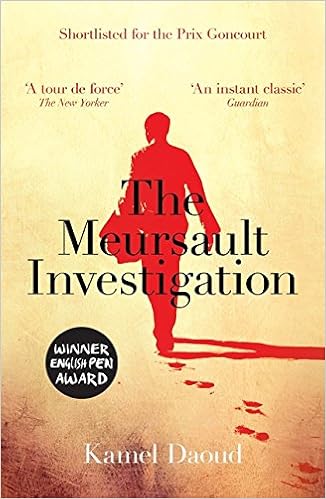
“Mersault, contre-enquête” by Kamel Daoud – just existence. Translated as “The Mersault Investigation”

It is not an entirely original idea to reverse a situation found in the plot of a famous classic, as did Jean Rhys when she wrote “Wide Sargasso Sea” from the viewpoint of Mr Rochester’s wife Bella in “Jane Eyre”, before she married him and was incarcerated in his house as a lunatic.

In this novel, the Algerian author has focused on the younger brother of the anonymous Arab shot by the Frenchman Mersault in the disorienting, blinding sunlight over the shimmering sea off an Algiers beach in Camus’s exploration of absurdism in the context of a pointless murder.

Kamel Daoud portrays the victim’s brother whom he names Haroun, to be found, several decades after the shooting, reminiscing in a local bar to the visitor from France who has come to probe him about the murdered Arab in the novel.

Haroun is embittered by the appalling effect of the death on his life. Not only did he lose the kindly young man who supported him after their father had abandoned the family, but their mother was clearly driven mad by the event, continually searching for the body, the lack of which to provide irrefutable evidence of her son’s death meaning that she has been unable to claim a pension. She appears emotionally cold towards the surviving son whom she seems to have resented for being the one to survive. The discovery that the murder has become the topic of a best-selling novel, bringing fame and fortune to the writer, only adds to the sense of outrage. Yet the ultimate insult is the failure to give the victim a name, remedied here by the information that it was in fact “Moussa”. ( It seems that the brothers names are Moses and Aaron in English).

Strictly speaking, this is not a counter-enquiry into a murder, but a somewhat cynical portrayal of Algeria, post the trauma of civil war and independence, casting an absurdist light on the religious bigotry used as a tool of social control, the enduring poverty, stagnation, corruption and betrayal of vision .

It is beneficial to have read “l’Étranger” first because of the frequent references made to it. When I reread it after finishing “Mersault, contre-enquête”, I was struck by how often Daoud mirrors events in the earlier novel: in “L’Étranger” (The Outsider), the opening sentence tells us that “maman” has died today, whereas in the later novel, “maman” is still alive. Just as Mersault describes his close observation of the comings and goings in the street below the balcony of his apartment, Haroun portrays the view from his overlooking the busy square which represents a microcosm of life in Algiers. In this, both create a strong sense of place.

Similarly, Mersault’s expression of his atheism, and his existentialist view of the absurdity of life (although he does not use these terms), reactions which so outrage both his defence and the prosecution, are imitated by the narrator Haroun’s ranting against God and the influence of the mosque. This led to the issue of a fatwa against the real-life author for blasphemy, which rather seems to justify his criticisms.

Note the parallel irony: whereas Mersault’s essential crime seems to be that he did not show grief at his mother’s funeral, for Haroun it is that he killed a Frenchman in symbolic revenge after Algeria gained independence rather than before.

Although this book has won much praise, I was sorry to find it too repetitive and meandering, with a frequently somewhat overblown style as read in the original French. There are a few striking passages such as the description of the narrator’s mother’s face in old age: a kind of amalgam of the faces of all his ancestors, passing judgement on him. Although only about 150 pages in length, the novel at times seems too long for its relatively thin substance.

This novel also reminded me of the much more engrossing “The Reluctant Fundamentalist”, perhaps because it employs the same device of a narrator button-holing someone to unburden himself, Ancient Mariner-wise.

Based on an interesting premise with great potential, this novel could have been executed better. Prompted to reread “L’Étranger”, the clarity of the prose, narrative drive and tighter structure defined for me why that is the superior novel, even though Mersault’s almost autistic lack of emotion and engagement in an absurd world is less explicable than Haroun’s very understandable anger over his lot.

It also struck me that, for Camus, although the book is located in Algeria, his country of origin, existentialism is the main point, whereas for Douad, the tragedy of the failed project of Algerian independence is a major concern.

April Lady by Georgette Heyer: Taking a gamble

April Lady by [Heyer, Georgette]

In Regency London, not quite nineteen-year-old Nell is desperate to obtain the sum needed to pay the bill for an expensive dress which she had forgotten when assuring her husband Cardross that she has no further outstanding debts. She is also consumed with guilt over lying to him over the use of her generous allowance to finance her brother’s losses at the gaming table, which her husband has forbidden her to do. Instead, she lets him think that she has foolishly  taken up gambling herself and incurred losses of her own. All this is making Cardross  regret having ignored the advice of friends who advised against his marrying  the daughter of an inveterate gambler who has ruined his aristocratic family with his addiction. The situation is aggravated by Nell’s concealment of her genuine love for her husband, as she follows her mother’s advice to be compliant at all times but not to appear too needy, and certainly not show any resentment over his mistress. Cardross also has to deal with a spoilt, capricious young half-sister, who is determined to marry a  respectable if dull but poor young man who is not her social equal. As matters reach a head, how will they be resolved?

Georgette Heyer was a prolific author, admired from the 1930s to her death in 1974 for  her immensely detailed knowledge of Georgian culture, even down to the upper class slang in vogue (now quite hard to follow and frankly the most irritating aspect of the novel). Reading this out of curiosity and expecting to find vacuous froth, I was surprised  how much it engaged me. Tightly plotted, it rattled along at a lively pace with well-developed characters.

I believe that Georgette Heyer was influenced strongly by Jane Austen, and  sacrilegious as it may sound, she holds her own in comparison. There is a clear parallel in the wry wit, although Heyer is actually much funnier.  She provides more detail of, for instance, customs which Jane Austen had no need to explain at the time, also tending to focus on upper class families, some even accustomed to socialising with the Prince Regent, whereas Austen’s theme was more often the lives of the country gentry.

Although I am not sure to what extent it is intentional, I like the way the author reveals the flaws in the aristocratic Regency world:  despite an obsession with conforming to expected norms and not lowering “the ton”, the idle rich fritter away their time gambling and flirting, particularly at masked balls. Even a “good”,  generous and loving husband thinks nothing of dominating and infantilising his young wife – also, he does not  apply his high moral standards to himself. A young man wastes his time on silly pranks because he is not expected to work at some activity which would employ his energy and ability, and so on.

If all Heyer’s  books are like this, reading them could pall quite quickly like too much cream meringue, but I would not regret reading her from time to time.

Miss Buncle’s Book by DE Stevenson

When her dividends dry up in the 1930a depression, Barbara Buncle sets about writing a book for publication to make ends meet, using the male pen-name of “John Smith” to cut more ice with the publisher. Since, to use her own words, she has “no imagination” this is inevitably about the doings of the inhabitants of her village of Silverstream, whom she has known for years. Mr. Abbott of Abbot and Spicer agrees to publish the book because the characters seem so real, and is also intrigued by the puzzle as to whether the author is writing subtly “tongue in cheek” or “a very simple person writing in all good faith” based on acute observation. The bestselling “Disturber of the Peace” provokes outrage among those who discover that they have been blatantly parodied in the clearly recognisable village which has been renamed “Copperfield”. They are determined to track down and punish “John Smith”, but even when some suggest that the author may be female, it does not occur to them that she might be the dowdy and insignificant Barbara Buncle. Under pressure from Mr. Abbot to write a second book, what will she reveal next, will she be exposed and, if so, with what outcome?

I was initially reluctant to read this for a book group, expecting it to be dated, trivial and at best provide a bit of escapism from the modern world. On one level, it is all these things, but is also an insight into a past way of life, and written with the same kind of clarity and humour as apparently employed by Miss Buncle, it carries the reader along.

Dorothy (D E) Stevenson wrote stories compulsively from her childhood onwards and became a prolific and successful novelist of mainly romantic fiction, since then fallen out of print for decades. It is interesting to speculate how she would have used her talent in different circumstances: if born a man like her father’s cousin Robert Louis Stevenson, she might have written adventure stories; if born now, she might have applied her fertile imagination to TV drama series. As it was, she followed the conventions of her time in which a widow living beyond her means could not think of finding a job but had to scheme to trap a wealthy husband; a vicar’s wife who found it extravagant to hire a taxi still had three servants and a nanny; men dominated their wives who had to resort to subtly manipulating them without appearing to; the two women who lived together were never explicitly referred to as lesbians, but the intelligent one who had never been allowed to get educated and develop her brain is shown playing the “male” role to support her weak and indecisive partner, and so on.

So, in writing about a world in which “the good ended happily and the bad unhappily – that is what fiction means”, Dorothy Stevenson is worth reading mainly for her humorous observation of human nature.

Washington Black by Esi Edugyan: relentless quest

Washington Black: Shortlisted for the Man Booker Prize 2018

Born into captivity in 1818 on the inaptly named Faith Plantation in Barbados, George Washington Black wields a hoe to weed the fields from the age of two, progressing to cutting the sugar cane by the time he was ten years old, with only Big Kit, the tough, superstitious slave woman from Dahomey to look out for him. The arrival of a sadistic new master in the form of Erasmus Wilde brings a turn for the worse in an already bleak situation, Big Kit tells “Wash” of her plan to kill them both, as a means of escape back to freedom in their African “homeland”, but fortunately for him, holds back from committing this extreme act. Wash then catches the eye of the master’s brother Christopher, known as “Titch”, a very different man, liberal-minded and obsessed with scientific discoveries, including the perfection of his “cloud-cutter”, a kind of hot air balloon for which Wash will “provide ballast” but also prove useful as an assistant, with a natural talent for drawing.

When Wash and Titch are forced eventually to escape from the plantation, the book becomes a mixture of adventure yarn and right-of-passage novel. The scene moves from Barbados to England, even Morocco, via America and Nova Scotia. Undoubtedly original and imaginative, the prose includes some striking passages, such as the description of the octopus which Wash encounters and catches when he has somewhat unbelievably dived down to the shallow seabed with minimal training.

I chose to read it partly because I was so impressed by Esi Edugyan’s earlier work, Half Blood Blues, with the added incentive that both books were shortlisted for the Man Booker Prize. However, I have a number of reservations. The plot hinges on some highly implausible dramatic incidents, which I suppose could be accepted on a par with “magic realism”, but there is also a reliance on far too many unlikely coincidences. It is frustrating to know that the book was inspired by real events, without knowing exactly what they were.

I realise that the dialogues may be intended to reflect the speech of the period, but they often seem stilted and artificial, while apart from Wash, the characters are not developed as rounded, convincing individuals. Although Wash is a sympathetic hero, I did not believe that an illiterate and brutalised slave could narrate this tale at the age of only eighteen, using such a sophisticated vocabulary and displaying so great a level of knowledge and understanding, based on perhaps a maximum of four years in Titch’s company, spending the rest of the time in unskilled manual labour. This seems like yet another case of a first person narrator being given the “voice” of the author, a problem which could have been avoided by writing the whole thing in the third person.

In its defence, the book also includes some intriguing themes, such as the extent to which, perhaps because of suffering in early life, some of the main characters cannot sustain or even form relationships, and are driven to wander rootlessly through life, even viewing death as a means of escape to freedom. Another is how, even when he is technically free, Wash may still be exploited by white men who perceive themselves as liberal and anti-slavery.

In the case of this uneven novel with brilliant patches, duller tracts which lack narrative drive, and an ambiguous ending, I was left a little unsure as to what the author was trying to achieve.

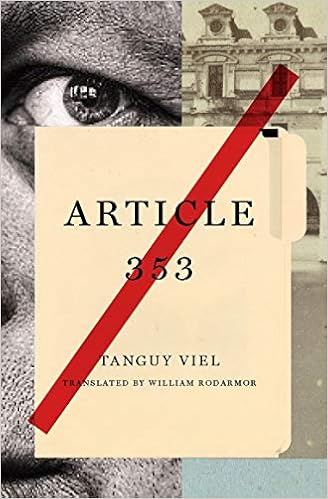
Article 353 du Code Pénal” by Tanguy Viel: Utter conviction (Article 353 in English Translation)

Despite its dry title, this short, unusual novel is a riveting masterpiece.
Under French law, a suspect in initially examined by a “juge d’instruction”, who gathers and evaluates the evidence to decide if it is sufficient to go to a trial. In this case, how can the suspect’s guilt be in doubt? We know from the outset that the narrator Martial Kermeur has pushed his unsuspecting companion Antoine Lazenec overboard during a fishing trip on the latter’s boat, left him to drown and calmly submitted to police arrest, thinking how he would have committed the action anyway, even if the police had been watching him at the time.

Closeted together for several hours, Kermeur recounts slowly to the judge , in great detail how he came to meet the flamboyant property developer Lazenec, and be ruined by him, alongside others in the remote, economically depressed community on the Brittany coast. Kermeur seems to have suffered a tidal wave of misfortune (there being many references to the sea): he has been made redundant, his wife has left him and, manipulated by the wily and ruthless Lazenec, in a foolish moment of pride Kermeur invests his redundancy money in Lazenec’s ambitious scheme to demolish the local chateau and convert the grounds into a holiday resort. When the scheme fails to materialise, Kermeur is left destitute and ashamed in the presence of his young son Erwan, who has always looked up to him.

This is not only a detailed psychological study of the interplay between the main characters, in which the details are skilfully revealed and the tension ratchetted up but also a vivid and moving portrait of a tight-knit community under pressure. Tanguy Viel presents Kermeur’s thoughts in a kind of stream of consciousness, often going off at a tangent, but very expressive. Kermeur often seems simple and garrulous, but he is also sensitive and perceptive, with a wry humour. He does stupid or unwise things, including a serious crime, and yet he arouses one’s sympathy. Justice must be applied to him, but in what form? Is the judge’s final decision justifiable?

Highly recommended for a good read and an interesting discussion. This is definitely best read in the original French, but I understand that the English translation by is good.

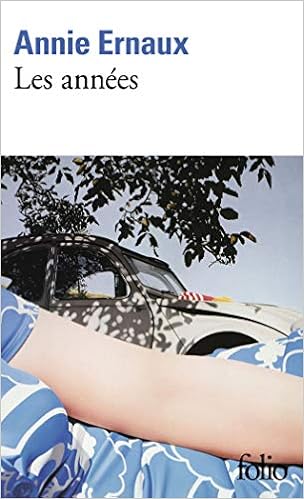
“Les Années” or “The Years” by Annie Ernaux: an individual take on “collective memory”

This is an autobiography which aims to avoid “sentiment”: “The point is not to speak of the personal”. Instead, referring to herself in the third person, or writing collectively as “we”, Annie Ernaux adopts a fragmented approach which tends to distance the reader from her.

As implied by the choice of quotations at the outset, she is preoccupied with our insignificance in the scale of things – not only shall we be forgotten as individuals, but matters of great importance to us will seem trivial to our descendants, and our way of living may come to seem ludicrous, even blameworthy. This has become very topical since our materialist way of life, justified by “the need for growth” is now under criticism for destroying the planet for future generations.

Annie Ernaux’s attitude may explain her tendency to give more importance to fleeting, often banal memories than to major events in her life. The opening pages are a list of ephemeral images, some from before she was born, reflecting her insight that, influenced by our parents’ talk, we may have a kind of false memory of events which happened to other people in the past before we even existed. Many of the images are sordid or grim, and it would seem quite arbitrary – a woman urinating behind a café, the glimpse of a thalidomide victim with no arms. This sets from the outset a somewhat depressing, negative, joyless tone which is never fully dispelled.

She often seems more interested in the social history through which she has lived than in recounting the main events of her life. So, on one hand she writes a good deal about the impact of the 1968 riots, the social revolution resulting from the availability of the pill or the arrival of a consumer- driven society which also discarded the taboos and traditions which constrained our childhood until the 1960s. On the other, I never learned, for instance, whom she married, nor when and how the couple parted. She makes no allowance for the reader’s frustration if significant details are hinted at but kept hidden. She writes about a woman’s desire for divorce, mixed with fear of rupture and independence, in an abstract, generalised way. In just one poignant scene, which reveals complex feelings during what may be the last family holiday with her husband in Spain, she becomes an individual with whom one can sympathise, suggesting that a little more “sentiment” in the book would not have gone amiss.

I formed the impression of a bright girl from a narrow, working class background, who “escaped” via the encouragement of her teachers and a good education. However, breaking the taboos over sex outside marriage just a few years ahead of “the pill” and loosening of the abortion laws, she joined the ranks of those obliged to marry and start a family before they would have chosen to do so. She seemed dissatisfied with her lot as a teacher, perhaps because of her long-held desire to be a writer. Drawn to left-wing movements, uneasy over consumerism and the faceless development of new urban areas, Annie Ernaux nevertheless comes across as an “academic” socialist, actually rather contemptuous of workers in the unappealing new suburbs built for them, where she would never willingly set foot.

It is not her style to discuss explicitly her frustration over being diverted by family responsibilities from achieving the ambition to become an admired author. Instead, it is revealed when, oppressed by the annual ritual of the Christmas celebrations in which she now occupies the head of the table, she imagines the crazed action of overturning the table and screaming. Perhaps because she is a writer, a recurring theme is her panicked sense of only having one life, which she has allowed to slip by, without realising it: the living of her past life amounts to a book, but one that has not yet been written – until now.

I found the book hard-going at times. The repetition and lists of people and events are quite tedious and I was not familiar with many of the cultural references. It was fascinating to learn about, say, Ranucci, the last French citizen to be sentenced to death as recently as 1976 by guillotine, which seemed particularly barbaric and antiquated although it was originally seen as more humane than other methods, but the need to look things up continually fragmented the reading of an already disjointed text which rambles on for over two hundred and fifty pages in short sections with no chapters to form natural breaks.

Annie Ernaux has said: “This is the story of events and progress and everything that has changed in 60 years of an individual existence but transmitted through the “we” and “them”. The events in my book belong to everyone, to history, to sociology”.

Yet this approach only works if the events are clearly explained in context to those who did not experience them at the time, and may be ignorant of them now. Admittedly, those who can share her experiences may derive a nostalgic pleasure from being reminded of them.

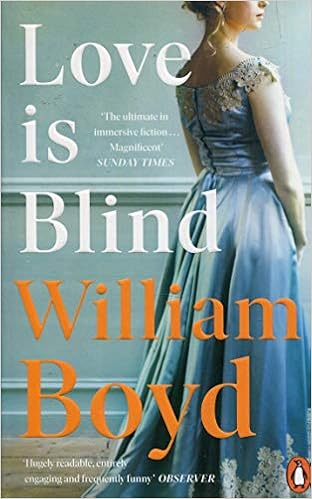
“Love is Blind” by William Boyd – a little off-key

When Ainsley Channon finds that his son is not unexpectedly making a hash of running the Paris branch of his piano manufacturing and sales company, he sends his protégé, young Scottish piano-tuner Brodie Moncur to use his initiative to improve business. In the process, Brodie becomes infatuated with Lika, a beautiful Russian aspiring opera singer. Their relationship has to be conducted in secret, since she is the mistress of the once celebrated but now physically declining and alcoholic pianist John Kilbarron. From the outset it seems doomed to fail, owing not only to Kilbarron’s jealous and unstable character but also the menacing presence of his “minder” brother Malachi, who may have designs on, even some hold over Lika as well.

It was never quite clear to me why Brodie loves Lika so much, in what seems like a purely physical relationship. She seems dull and devious, dragging Brodie down the same path, changing him from a purposeful, outgoing individual into a passive, moping drifter with his life on hold – but of course, as the title states, “Love is Blind”. Admittedly, Brodie has occasional insights, such as the fact that being in love does not guarantee happiness, while we can never truly know another person, even when there is supposedly mutual love.

I was disappointed by some aspects of the early chapters. The book opens with a detailed description of how to tune a piano, which made little sense to me in the absence of a labelled diagram or two, clearly out of place in a novel. It read like a piece of research conducted to give the story authenticity, but dumped rather clunkily into the text. Then there are the potentially interesting situations which do not lead anywhere, such as Brodie’s visit to the family home, where his widowed father “Malky” dominates eight of his children into adulthood, reserving particular venom for Brodie, the only one to have escaped so far. A charismatic preacher in public, Malcolm Moncur degenerates somewhat implausibly into a gross, drunken bully behind the scenes. Like too many of the characters, he comes across as a caricature. It is never clear why he detests Brodie so much. Is there any significance in the fact that he is so dark compared to his siblings?

The pace is slow as if an essentially thin plot is being padded out, until the novel reaches a dramatic climax at the end of Part 3, two-thirds of the way through. After this, the tension is more sustained, and some past threads are pulled together more, to reach a passably satisfactory ending.

With its varied locations, from Scotland to Russia and the remote Andaman Islands, and the extensive cast of characters, this is an original if rambling take on a well-worn romantic theme but it did not really move or engage me, although many critics and general readers have clearly found it entertaining and engrossing.

“Sea of Poppies” by Amitav Ghosh – cast out on the Black Water

The first book in the “Ibis” trilogy, named after the sailing ship which is the setting for some of the action, “Sea of Poppies” focuses on the C19 opium trade operated by the ruthless East India Company. It begins in rural India, where Deeti struggles to make a living from the poppy harvest which has replaced the crops which at least guaranteed a level of self-suffciency. She is resigned to marriage with a man who has become addicted to opium to ease the pain of his wounds, gained in fighting for the British colonialists. The fact he is employed in an opium factory does not help.
At the other end of the social scale is Neel, the unimaginably privileged native landowner, so complacent in his sense of entitlement that he has allowed himself to be trapped into debt by the hard-nosed employee of the East India Company, Mr Burnham. Aided by his eccentric Indian agent Baboo, Burnham is prepared to do whatever is necessary to gain full control of Neel’s lands.

Flitting between an at times confusing horde of characters, some larger than life and stereotyped, reminiscent of a Dickensian novel, the storylines gradually merge to bring the main players together on the Ibis, a converted former slave ship, which is scheduled to transport a group of criminals and unlucky migrants rejected by their families to provide cheap labour for the East India Company.

One of the most likeable and straightforward characters is Zackary Reid, the American carpenter-turned-sailor who, being the son of a slave girl and the master who freed them both, has a natural sympathy for some of the disadvantaged Indians he encounters. Another is Paulette, the spirited and frankly quite devious daughter of a deceased European botanist.

There is a good deal of humour, often somewhat heavy-handed, along with considerable violence and degradation. Despite the frequently implausible, exaggerated to the point of ludicrous events, with people on the brink of death miraculously saved, the novel provides vivid descriptions and creates a strong awareness of the nature and implications of the opium trade, and the attitudes and values of the various parties concerned. For instance, with the risk of an imminent war between Britain and China, Burnham, despite claiming to be a devout Christian, has no understanding of why Chinese rulers might wish to end an exploitative trade which is wreaking havoc on their population, and is over-confident that the conflict will be short-lived.

His Indian roots may make it easier for the author to identify with and portray a period perhaps understandably neglected by western writers. He has certainly undertaken an impressive amount of research on every aspect of the story, including opium manufacture and the operation of sailing ships. A downside of all this is that the presumably authentic language used by, for instance the Lascar and British sailors or even Burnham’s wife is so peppered with native language, jargon or slang as to be virtually incomprehensible at times. I found this very distracting, and would have liked a glossary, together with a map and list of characters for quick reference.

I do not mind the abrupt ending of the story, clearly akin to a cliff-hanger to encourage us to read on, although the novel could be regarded as free-standing, leaving one to imagine “what happens next”. However, for the time being, I do not feel sufficiently engaged to read the rest of the trilogy, I think mainly because I find some of the drama needlessly overdone.

The Body Lies by Jo Baker – “When the trick is to make the whole thing up and still to tell the truth”

The Body Lies by [Baker, Jo]In this slow-building psychological thriller, a young creative writing lecturer discovers to her cost that she has become the obsessive focus of her most talented student Nicholas Palmer’s work, with the risk that he may move from “merely” recording his close observation of her, intrusive as that is, to actively manipulating her to fit his story, in his belief that, to be authentic, writing must be based on real experience.

It is also a study of how, even in these days of increased equality, men continue to dominate and exploit women in a number of ways, often without being aware of it. It was not until after I finished the book that I realised the writer who narrates this novel is never named, perhaps with the aim of making her a kind of microcosm of women’s lives in general.

At the outset, pregnant and walking home from work in London one dark evening, this young woman is mugged by a stranger, and makes her injuries worse by trying to resist. Three years later, she is still sufficiently traumatised to seize the opportunity to escape in the form of a lecturing post in a northern university, offered on the strength of her success in publishing a novel.

It is perhaps implausible that she should choose to rent an isolated country cottage a bus ride from the campus, or that she should so readily leave her husband behind to continue with his school post until the end of the year, expecting him to make regular week-end commutes to visit her. Of course, these factors are necessary to the plot.

With what some readers have described as irritating passivity, she takes on a mountainous workload, not appearing to have learnt the knack of “saying no”. The boss responsible for this is supposed to be her mentor, doubly ironical in view of the fact he seems perpetually on the brink of sexually harassing her.

I am not sure to what extent Jo Baker is trying to be facetious, but she neatly debunks some recent attempts to ensure equality and respect in academic life. The disruptive student Nicholas objects to the failure to issue a “trigger warning” before a fellow-student’s description of a crime scene. Yet his own writing is far darker and more sinister, bearing in mind that he claims only to write “what happened…the truth”. Also, isn’t it a contradiction in terms to apply censorship to a creative writing course?

Since finishing this I made a start on “A Country Road, a Tree” and realised that Jo Baker is a writer who seeks to avoid any kind of “typecasting”, but rather to create a different style and theme in each work. Comparisons between her books are therefore hard, but “The Body Lies” suggests she has developed in marshalling her material and honing her style. There may be the odd inconsistency in the sequence of events, the skilfully constructed sense of menace may peter out into the damp squib of a somewhat trite ending, and there may not be any very profound fresh insights into the female condition, but she has produced a well-written and neatly plotted page-turner, via a wry parody of the current state of academic life.