Life as Art

This is my review of The Great Beauty [DVD] [2013].

The “Great Beauty” is the Rome that tourists too often miss, with sunlight playing on fountains and ancient intricate carvings, the haunting voices of choirs floating from balconies, children playing tag with white-robed nuns in lush green gardens glimpsed through stone archways.

Wealthy writer Jep Gambardella knows Rome well, but his appreciation of its beauty is heightened when, in the middle of his extravagant 65th birthday party he is struck by the decadence and vacuity of his life. Later, in post-dinner balcony drinks, the shallowness and empty pretentiousness of so-called close friends becomes almost intolerable. The death of a long-lost girl friend who apparently always loved him from a distance may also remind him of what might have been.

Made sharply aware that time is running out on his dilettante life, Jep does not do much about it, apart from take up with an ageing stripper with a heart, mocked by his snobbish friends for her name Ramona and choice of a see-through dress on her first outing with him. Great beauty seems inseparable from moments of soft porn. Apart from making a visually stunning film, full of people with striking features, often reduced to “living works of art” in their designer costumes, I am unsure what the director Sorrentino is trying to achieve. I would have liked more of a plot, and although I do not mind a film that is largely about visual design combined with music and a few witty comments, at nearly two-and-a-half hours, this is not quite enough to sustain one’s interest, plus the frenetic partying became oppressive. Watching all this began to seem perhaps more questionable than the privileged self-delusion and emptiness of the existences lived out in the film.

I felt I could not win with this film which is overlong and rambling yet leaves embedded in the mind the same powerful visual images you would get from visiting a gallery of remarkable artworks. Walking out mid-way would leave a sense of having missed out on memorable scenes. Sitting it out may seem like a waste of time: one “gets the message” in the first half, and then there is nowhere else to go. I was a little disappointed that Sorrentino focuses on the idle rich, and does not show us the beauty of ordinary lives, despite their pain and disappointment.

Comment Comment | Permalink

⭐⭐⭐⭐ 4 Stars

Mad, sad and dangerous to know

This is my review of L’Eté Meurtrier by Sébastien Japrisot.

In this complex, slow-burn psychological thriller, when gorgeous, provocative and probably mentally unstable Eliane sets her cap at decent young car mechanic and part-time fireman "Ping-Pong", you know it will not end well. As the viewpoint switches, mainly between these two characters, Eliane's motives are revealed, the desire for vengeance over a past wrong, but this is a tale of misunderstandings, twists and fateful coincidences which do not fall into place until the final pages.

I agree with reviewers who have found this excellent, although it may take a while for you to appreciate its cleverness – many of the apparently irrelevant fine details prove significant in the end. Apart from building up the tension to a point when you cannot put the book down, Japrisot contrives to create sympathy for all the characters, and to present a vivid picture of life in a small French town where people know each other's business, filling doorsteps and windows along the way to watch Eliane and Ping-Pong as they set off for their first date. The main characters are strongly drawn, with realistic, changing emotions and reactions, in, for instance, Eliane's relationships with Ping-Pong and his two very different brothers. The one weak link for me is Eliane's former school mistress whom I found unconvincing. There is also humour, as in Eliane's continual exaggerated references to time to show her youthful impatience – "I waited a thousand years for him to answer" etc.

It's true there may be a pattern in Japrisot's characters: working class men prone to violence, neurotic young women who play on their sexuality and so on, but he was a past master of the twisty thriller that lends itself to film-making.

If you are not French, this may prove hard going because of the idioms, but it is worth the effort for the sense of suspense, the plot twists and the atmosphere of small town life near Grasse and Digne, where forest fires rage in the distance during intolerably dry summers, and the main source of interest is the Tour de France.

⭐⭐⭐⭐⭐ 5 Stars

Left in the dark

This is my review of Ain’t Them Bodies Saints [DVD] [2013].

I was drawn by positive reviews to this Texas backwoods tale of Bob and Ruth, two lovers who get caught up in a shoot-out with the local law officers. Bob takes the rap and goes to jail, leaving Ruth to bear and bring up their child, swearing to wait for him. This has all the potential for a drama of doomed love, but despite good performances from Rooney Mara as Ruth, Patrick Wheeler as the soulful sheriff waiting in the wings for Ruth's favours and Keith Carradine as the storekeeper who brought up the young couple "gone to the bad" I was left frustrated and disappointed by the film.

What one professional reviewer has described as "elliptical storytelling and dreamy magic-hour light" struck me as a very confusing presentation of key details and an underlit, wavering filming technique which often makes it well nigh impossible to see what is going on. Too often, an important scene is flashed onto the screen for a fraction of a second, leaving the viewer unsure what has happened – who shot whom or why. Worst of all, Case Affleck's drawl renders Bob incomprehensible half the time. Although clearly handsome, he comes across as monumentally stupid and dull. In order to make us care about Bob and Ruth, the writer/director needed to develop their characters, relationships and complex motives for their crime.

Although the recent "Beyond the Pines" was flawed, it succeeded better in this type of theme.

⭐⭐ 2 Stars

What matters only love

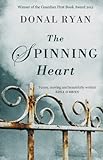
This is my review of The Spinning Heart by Donal Ryan.

This is oddly reminiscent of "Under Milkwood", perhaps because it uses the poetical yet often also earthy voices of a variety of characters to capture the spirit of a rural community. A short intense and condensed novel, with all the flesh of scene-setting and background information stripped away, it comprises twenty-one internal monologues which combine to show how the collapse of the building boom in Ireland wreaked havoc on the already sad and dysfunctional lives of many ordinary people.

Pain is piled on by the shovel-load, and it would all be unbearably bleak but for the author's ear for the poetry and droll wit of the Irish way with words. There is continuous entertainment in not only the language but the links between the various characters, their different readings of situations, and the poignant plot which gradually emerges around the ever-present figure of the charismatic but troubled Bobby Mahon. Donal Ryan is prepared to take risks: one "voice" is a ghost in limbo, and I was unsure for a while if another was not a "split personality".

If there are flaws in this original book, one is that some of the "losers" portrayed are a little too similar and so seem superfluous, another that many characters share the same streak of repressed violence plus a fundamentally introspective, articulate, self-aware voice that is probably too much that of the author. At times, I felt I was being told too explicitly what to think about a particular person, as in the case of Bobby's embittered father Frank, rather than left to deduce it for myself. The style is less convincing when Ryan abandons his Irish patter, as for patriarch Josie Burke's educated liberal lesbian daughter Mags.

Although my interest flagged a little in the middle of a book which seemed to have "made its point" about the state of Ireland quite quickly, what proves to be a carefully constructed tale twists to an effective ending.

Overall, it is an impressive first novel, which repays a second reading.

⭐⭐⭐⭐⭐ 5 Stars

Antiquated tales leave me cold

This is my review of La Légende de Saint Julien l’Hospitalier-The Legend of Saint Julian the Hospitaller (French/English) [Annotated] (Rafael Estrella’s Dual Language Library) (French Edition) by Gustave Flaubert.

This omits "Un Coeur Simple", for me the first and best of Flaubert's "Trois Contes". Although very different from the former and each other, these two tales share a kind of overblown Gothic violence and romanticism which I believe was popular in the C19, but which now seems mawkish and dated. La Légende de Saint Julien l'Hospitalier is the tale of a spoilt young man who develops a craving for violence, and then suffers the effects of a curse; Hérodias is based on the story of the beheading of St.John the Baptist, approached in a rather oblique way. I understand that Flaubert wanted to create "reveries" on imagined religious characters,and was keen to write stories with very little subject matter, so that all the emphasis is on the words used. He succeeds in this for me with "Un Coeur Simple", the tale of a simple servant who becomes obsessed with a parrot, but the two fables included here left me cold. The sentences are so pared down in places for the style to seem disjointed, as if passages are missing. The language also seems far from plain and direct but rather convoluted, with a good deal of archaic language to do with say, different types of falcon, or items of Roman clothing.

As for the translation, if you can discipline your eye to read the French in bold text and only consult the English when necessary, this is quite a useful aid, particularly since some of the antiquated specialist vocabulary on, for instance, hunting dogs or medieval arms, may not be in your dictionary. However, it seems to me that translations of some phrases and sentences have been omitted, whereas on other occasions bits are added "by way of explanation". Also, the quality of translation is very uneven: some passages are crude literal translations, but others seem very loose and inaccurate, perhaps in an attempt to capture the meaning of Flaubert's often oddly condensed style.

⭐⭐⭐ 3 Stars

Errant Knight of the Crime Squad

This is my review of Laidlaw (Laidlaw Trilogy Book 1) by William McIlvanney.

Curiosity over the recent revival of interest in a crime writer said to have inspired Ian Rankin, led me to read the first in his trilogy on DI Laidlaw. Prickly, sardonic, subversive, a maverick with a rocky marriage and a boss who only tolerates him because he gets results – all this sounds like a stereotype of fictional detectives we have come to know, but Laidlaw was one of the first, appearing in print back in 1977.

This investigation of the brutal murder of a young woman is less of a whodunnit- we are catapulted into the murderer's confused psyche in Chapter 1, and more of a whydunnit, exploring the personalities of the main characters against the background of gritty gangland Glasgow. The images are often striking and original: "A Glasgow sun was out, dully luminous, an eye with a cataract", Laidlaw is described as "looking terrible with a right eye like a roadmap", or a man watches "a blackbird balance its beak like a nugget of gold". The language is often quite poetical and repays reading slowly, but the pressure is on to find out what happens next.

Some scenes read almost like a play, as when Laidlaw's young sidekick Harkness asks how they can begin to relate to the murderer. Laidlaw's unusual view is that, "This murder is a very human message. But it's in code. We have to try and crack the code. But what you are looking for is a part of us. You don't know that, you can't begin."

When we first meet Laidlaw, he is "feeling a bleakness that wasn't unfamiliar to him….doing a penance for being him." Since this negativity, combined with great intensity, often oppress both Harkness (driven to ask "who wants to be batman to a mobile disaster area") and Laidlaw's long-suffering wife Ena ( she's looking after the three kids he claims to love whilst he is out philandering), you may wonder how the author expects his readers to put up with his creation. Yet, the gloom is offset by wry humour and tight plotting. Although I sometimes found the style of writing contrived (and could not get some sentences even after several readings), this novel stays in one's mind longer than the usual monosodium glutamate thriller, and leaves you with the sense that it is both gripping and worth reading.

⭐⭐⭐⭐⭐ 5 Stars

More is less

This is my review of The Son by Philipp Meyer.

This saga covering five generations of the McCullough family portrays the creation of the state of Texas as an example of a central theme of history – survival of the fittest as a succession of invaders seize and exploit the land for themselves, often destroying the landscape in the process. In this case, "the dry rocky place it is today" was once a green land of deep black soil, trees, tall grass, "even the steepest hillsides overrun with wildflowers".

The viewpoint switches on a three chapter cycle: Colonel Eli McCullough, tough and vengeful, even psychopathic, made acquisitive by harsh experience, who survives capture by the Comanche Indians as a teenager to become head of a major cattle and oil dynasty; his granddaughter Jeanne Anne, a "chip off the old block" who carries on his work; his son Peter, sensitive and introspective, so dismissed as weak, his whole life blighted by the guilt of the family's casual massacre of an old Mexican family, rivals for land. Ironically Ulises Garcia, a descendant of both families, may prove a worthier inheritor of the Colonel's wealth than his pampered great-great-grandchildren who have lost their fighting spirit. Running three main threads in parallel may confuse the reader, and for me it detracted from the dramatic tension of some key events, but it helps to remind one continually of the connections between the characters, the causes and effects of their actions.

Although at times it may seem little more than a swashbuckling western or prequel to a Dallas-type soap, this is raised above the average by the depth of Meyer's research. Too often, chunks of this are planted in the middle of the drama, but some passages are fascinating, such as the detailed description of how Indians made ingenious use of every part of a buffalo, leaving only the heart within the rib-cage to show the gods they were not greedy, or the chilling account of exactly how a teenage white boy turned native would set about preserving his first scalp.

The well-knotted ending enhanced my opinion of the story after some lengthy periods of frustration in which I wished Meyer had worked a little harder on his dialogue and character development – inevitably thin at times with so many players, and that he had been more ruthless in leaving out some minor scenes to leave more space for "showing" rather than the "telling" which is often too dominant. These shortcomings, such as the corny Hollywood-style of communication adopted by Eli's Comanche companions around 1850, place this book closer to airport blockbuster than literary fiction. I'm sure it will sell very well, it is impressive but not in the same league as Cormac McCarthy with his mindblowing prose.

This will inspire many to revisit the history of the development of the west, but in the meantime a glossary of e.g. Mexican terms used and of some historical characters mentioned would have been useful.

⭐⭐⭐⭐ 4 Stars

Four stars for imagination and humour but –

This is my review of Mr Penumbra’s 24-hour Bookstore by Robin Sloan.

When unemployed computer geek Clay Jannon takes on the night shift at Mr. Penumbra's 24-hour bookstore, he soon suspects it is a cover for some other activity, and so the mystery begins. This is a quirky blend of imaginative tecky inventions, such as a Google project to develop a form of renewable energy that runs on hubris (it is not always so easy for a non-tecky reader to know where to draw the line as to what is feasible), and nostalgic harking back to a Lord of the Rings fantasy world. The bookshop is archaic, with shelves ascending into what reminds Clay of the shade cast by dense trees in some magical forest.

Apart from a highly creative imagination, Robin Sloan writes with continual quick-fire touches of humour. Still unsure as to whether I could cope with what I suspected was intended for a 20-something male computer geek readership, I was won over early on by the image of the aged Penumbra tottering to the solid shop-front desk, "you could probably defend it for days in the event of a siege from the shelves".

Despite my admiration for all this, I fear that it could not sustain my interest. The main characters are two-dimensional, the explanations often tedious, the writing-style too often banal, the basic mystery ludicrous, the denouement which I cannot reveal a bit of a corny cop-out. I only read to the end for the sake of a book group meeting which included a skype chat with the author- a charming and humorous man with a very positive attitude to life.

I could have done with more of the occasional original insights such as that, "we imagine things based on what we already know and we run out of analogies in the thirty-first century."

So, I am torn over my assessment of a work that is original and funny in parts, yet also has a juvenile quality, an implausible non-mystery at its heart (try explaining it to someone!) and some dull passages to wade through.

⭐⭐⭐ 3 Stars

“The Strongman: Vladimir Putin and the Struggle for Russia” by Angus Roxburgh – Kaa’s self delusions over the Bandar-log

This is my review of The Strongman: Vladimir Putin and the Struggle for Russia by Angus Roxburgh.

More readable than many crime thrillers, this mixture of clear analysis with entertaining anecdotes has an authentic ring, Roxburgh being a former BBC Moscow correspondent and sometime PR advisor to Putin’s press secretary.

He acknowledges Putin’s initial success in restoring law and order, curtailing the power of the oligarchs who hijacked Russia’s rapid adoption of capitalism in the 1990s, stabilising the economy, reducing debt, achieving growth (admittedly with the aid of high Russian oil and gas prices) and even in supporting the Americans in their fight against Afghanistan – perhaps not in itself a good thing.

Roxburgh expands on the depressing recent turn of events as an increasingly authoritarian leader establishes the “vertical of power”, appoints cronies to senior positions in key industries, and turns a blind eye to, if not exactly ordering, the liquidation of anyone who dares to criticise corruption in such chilling cases as the shooting of the journalist Anna Politovskaya and the killing in prison of the young lawyer Sergei Magnitsky, “arrested by the very officials he had accused of fraud”.

Thought to have accumulated a vast personal fortune, Putin seeks to retain personal majority support as president partly by impressing people with his often stage-managed macho exploits, but also by resorting to ballot-rigging and laws to restrict the freedom of speech, conscience and mass media, “the fundamental elements of a civilised society” which he promised on first coming to power. Opposition is still too fragmented to bring him down, and he can dismiss the disaffected middle classes as the tools of western influence. Roxburgh is particularly interesting on the comparisons between Putin and his one-term presidential stooge, Medvedev, who seems more liberal and flexible, but unable to stand against him.

Roxburgh is fair-minded in showing how the West has repeatedly failed to see matters from the Russians’ perspective, to sense, for instance, how humiliated they felt to be excluded from NATO when former Eastern Bloc countries have been admitted, and to be regarded as the enemy against which NATO must protect itself. The author points out how the US has repeatedly tried to get Russia to give up nuclear weapons, without relinquishing its own one-sided plans for anti-missile defence. How can Putin be expected to take lessons over Chechnya from a government that went to war with Iraq on spurious grounds, without UN approval and which makes drone attacks on Pakistan?

After an almost naïve expectation of being welcomed by the West, it is sad to see Putin growing hardened and bitter in his sense of rejection borne of a mutual lack of understanding. It is no criticism of Roxburgh that he has no solutions to offer except, “the evidence of history suggest that pragmatic engagement is the only chance of success…..that in the end Russia will reform from within, not under outside pressure”.

⭐⭐⭐⭐⭐ 5 Stars

Mad, sad and dangerous to know

This is my review of One Deadly Summer (Panther S.) by Sebastien Japrisot.

In this complex, slow-burn psychological thriller, when gorgeous, provocative and probably mentally unstable Eliane sets her cap at decent young car mechanic and part-time fireman "Ping-Pong", you know it will not end well. As the viewpoint switches, mainly between these two characters, Eliane's motives are revealed, the desire for vengeance over a past wrong, but this is a tale of misunderstandings, twists and fateful coincidences which do not fall into place until the final pages.

I agree with reviewers who have found this excellent, although it may take a while for you to appreciate its cleverness – many of the apparently irrelevant fine details prove significant in the end. Apart from building up the tension to a point when you cannot put the book down, Japrisot contrives to create sympathy for all the characters, and to present a vivid picture of life in a small French town where people know each other's business, filling doorsteps and windows along the way to watch Eliane and Ping-Pong as they set off for their first date. The main characters are strongly drawn, with realistic, changing emotions and reactions, in, for instance, Eliane's relationships with Ping-Pong and his two very different brothers. The one weak link for me is Eliane's former school mistress whom I found unconvincing. There is also humour, as in Eliane's continual exaggerated references to time to show her youthful impatience – "I waited a thousand years for him to answer" etc.

It's true there may be a pattern in Japrisot's characters: working class men prone to violence, neurotic young women who play on their sexuality and so on, but he was a past master of the twisty thriller that lends itself to film-making.

I read this in French, which was hard going because of the idioms, but probably enhances the authenticity – the atmosphere of small town life near Grasse and Digne, where forest fires rage in the distance during intolerably dry summers, and the main source of interest is the Tour de France.

⭐⭐⭐⭐⭐ 5 Stars