’71 – Apocalypse then in Belfast

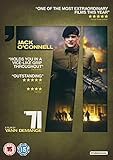
This is my review of ‘71 [DVD].

Based on the real tragic and messy situation of 1971 Belfast, this is a tense and gripping thriller, well-filmed, with an evocative score and some excellent acting, in particular from the leading player Jack O’Connell.

Having barely finished his gruelling army training, Gary Hook is sent to Belfast as one of a unit of inexperienced young soldiers, out of their depth in peace-keeping exercises which rapidly prove to be grim urban guerrilla warfare. Against a backdrop of burning cars and housewives banging dustbin lids on the pavement in a tribal rhythm, we see the soldiers struggle to hold back a hoard of furious civilians, spitting abuse and hurling stones as they see their neighbours beaten up by RUC men, whom the army has been ordered to defend. In the mêlée, Hook becomes separated from his colleagues and is left behind, menaced from two sides by an out-of-control faction of young IRA fighters who want a soldier’s scalp, and the sinister Military Reaction Force (which was created in 1971), supposedly deployed to use their local knowledge to help the Brits, but in fact running double agents in murky, shifting partnerships about which Hook may inadvertently have learned too much. We gain a keen sense of Hook’s will to survive, his confusion when injured yet without losing basic compassion for the weak and vulnerable, and the growing realisation that fighting in the army is not what it has been cracked up to be – not, as he had perhaps thought, a promising break for a lad brought up in a children’s home. Right up to the end, you know that the director is prepared to show how the essentially good, as represented by Hook, may not escape into a happy ending.

The identity of the various factions is a little hard to work out during the film, particularly for those who cannot remember the Irish troubles of the 70s, but it is a powerful reminder of a period we should not forget.

⭐⭐⭐⭐ 4 Stars

Troubled times

This is my review of Fortune De France 1 (Fiction, Poetry & Drama) by Merle.

This opening novel in a thirteen part saga of the Huguenot de Siorac family during an unsettled period of French history starting in 1547 has at last been translated into English as "The Brethren". "Fortune de France" is best read in its original language, if possible, since it conveys more of a sense of the period, of the personalities of the key characters and the alternating humour and pathos of the chain of incidents. By contrast, the English translation which I used to check a few points appears to be a rather wooden literal translation.

The story is told by Pierre, a sometimes hot-blooded but perceptive and questioning narrator. At first, I was a little bored by what seemed like a dry beginning, and thought I would prefer to read a straightforward history of a period which I have never quite grasped: the French Wars of Religion between the Catholics and equally intolerant Protestants.

Quite soon, I became intrigued by the main characters: the contrast between the serious, puritanical Sauveterre, and his more charismatic "blood-brother" Siorac, spontaneous, often generous, yet capricious with a capacity for great inconsistency and callousness. A doctor by training, he risks his life saving his bastard child Samson from a plague-ridden village, only to introduce him into his household as his son, regardless of the feelings of his long-suffering wife. When "the brethren" feel prepared to risk declaring their protestant faith, Siorac tries to get all his children and servants on side, before cornering his wife with the command to abandon her catholic faith, although he knows that she is devoted to it.

There are some daft episodes of three musketeer bravado, but also some tense and moving scenes exploring the psychology of people with complex emotions of jealousy, rivalry, divided loyalties, duty, fear, to which we can relate even when they are bound by very different beliefs and attitudes from our own. Siorac faces the disapproval of a highly regarded doctor with his scepticism over the value of bleeding people as a cure, but when proved right does not point this out since he knows that the other man's vanity will not let him accept the truth. There are also some interesting and convincing accounts of how the Sioracs fortified their property, related to their (remarkably few) servants and workers, and made a living from the land.

I'm not sure I feel motivated to read any more of the series, but found this a surprisingly good read – in French, but less so in English.

⭐⭐⭐⭐ 4 Stars

Troubled times somewhat lost in translation

This is my review of The Brethren (Fortunes of France 1) by Robert Merle.

This opening novel in a thirteen part saga of the Huguenot de Siorac family during an unsettled period of French history starting in 1547 has at last been translated into English as “The Brethren”. “Fortune de France” is best read in its original language, if possible, since it conveys more of a sense of the period, of the personalities of the key characters and the alternating humour and pathos of the chain of incidents. By contrast, the English translation which I used to check a few points appears to be a rather wooden literal translation.

The story is told by Pierre, a sometimes hot-blooded but perceptive and questioning narrator. At first, I was a little bored by what seemed like a dry beginning, and thought I would prefer to read a straightforward history of a period which I have never quite grasped: the French Wars of Religion between the Catholics and equally intolerant Protestants.

Quite soon, I became intrigued by the main characters: the contrast between the serious, puritanical Sauveterre, and his more charismatic “blood-brother” Siorac, spontaneous, often generous, yet capricious with a capacity for great inconsistency and callousness. A doctor by training, he risks his life saving his bastard child Samson from a plague-ridden village, only to introduce him into his household as his son, regardless of the feelings of his long-suffering wife. When “the brethren” feel prepared to risk declaring their protestant faith, Siorac tries to get all his children and servants on side, before cornering his wife with the command to abandon her catholic faith, although he knows that she is devoted to it.

There are some daft episodes of three musketeer bravado, but also some tense and moving scenes exploring the psychology of people with complex emotions of jealousy, rivalry, divided loyalties, duty, fear, to which we can relate even when they are bound by very different beliefs and attitudes from our own. Siorac faces the disapproval of a highly regarded doctor with his scepticism over the value of bleeding people as a cure, but when proved right does not point this out since he knows that the other man’s vanity will not let him accept the truth. There are also some interesting and convincing accounts of how the Sioracs fortified their property, related to their (remarkably few) servants and workers, and made a living from the land.

I’m not sure I feel motivated to read any more of the series, but found this a surprisingly good read – in French, but less so in English.

⭐⭐⭐ 3 Stars

Huge potential obscured by the style

This is my review of The Lives of Others by Neel Mukherjee.

Not to be confused with the brilliant film of the same time about life in Communist East Germany, “The Lives of Others” is an unsparing dissection of the Ghoshes, a wealthy but dysfunctional Bengali family whose paper business is falling apart under the social and economic upheavals of the 1960s, compounding the mismanagement of stubborn patriarch Prafullanath.

The family members often seem like considerably more than the seventeen included in the family tree at the front of the book, since they are also referred to by their relationships, explained and listed at the back. The often tedious need to flip back and forth is increased by the glossary of Indian terms also at the end, fascinating but frustratingly incomplete.

The kaleidoscope of scenes flitting between different characters forms a potentially endless soap opera with the use of frequent flashbacks to fill in the gaps: Chhaya, the embittered sister, too “dark” and ugly to be married off, who makes it her business to spy on the rest of the household and stir up trouble with her poisonous tongue; her twin brother Priyo whose wife Purnima resents her inferior status and nags him endlessly to claim a larger role in the business; Purba, the downtrodden widow of a younger brother, who is scapegoated unfairly for his death, and confined to a cramped ground floor room with her two children, dependent on the leftovers her relatives sometimes condescend to send down to her, and so on. At times, these mainly unappealing characters seem caricatures in their snobbery, insensitive treatment of servants and callousness to those less fortunate than themselves, yet they probably provide a very accurate insight into Indian culture and attitudes. A major contrasting thread is the journal-style letters written in the first person by eldest son Adinath, who has become a communist sympathiser, and disappeared to join the Naxalites, living amongst poverty-stricken villagers with the aim of stirring them up to revolt. The identity of the intended recipient (a lover?) is not revealed until near the end, and the letters are never sent.

Although I admired this book for its vivid portrayals of inequality in India, and the in-depth psychology of the characters, I found it hard going, mainly because of the style. Dialogues often struck me as very stilted and false, although they may accurately convey a sense of “Indian English” even when the characters are, I think, speaking Hindi. The prose is by turns drowned in detail, or inflated with windy pretentiousness. Dramatic scenes are scuppered by a distracting inappropriate choice of words. I was particularly irritated by the way a boy’s budding mathematical genius provides the cue for the inclusion of mathematical theories, even notation, which must be incomprehensible to most readers. Has the author dug out some old maths notes, or culled them from a student in this field? I was reminded by contrast of Vikram Seth’s ability in “An Equal Music” to convey a sense of musicality to someone unable to read a note.

Yet, Muckerjee is capable of writing. He describes a destitute farmer’s “blunt nail” of land. He captures the effect of moonlight: “The shadows it cast looked painted: they hugged their parent objects in such a way that their inkiness leaked, as if by capillary action, back into the buildings or shrubs or humans and cloaked them in that same unreality”. I was left wishing that he had written less and honed it more ruthlessly, to achieve a masterpiece on a par with “A Fine Balance” or “A Suitable Boy”.

⭐⭐⭐⭐ 4 Stars

Gone Girl: Deserving each other?

⭐⭐⭐ 3 Stars

This is my review of Gone Girl [DVD] [2014].

In the media storm over his wife Amy’s disappearance on their fifth wedding anniversary, laid-back Nick fails to show the normal reactions of anxiety and distress. Has he murdered her, and if so, for what reason, or is Amy the one playing some manipulative game? Has she been emotionally warped by her artificial, hot-house childhood as the marketing symbol of the best-selling series of “Amazing Amy” books penned by her insensitive parents, always portraying a girl enjoying popularity and success not actually experienced in real life?

This is the intriguing basis of a psychological thriller which switches back and forth in time, between the viewpoints of the two main protagonists, with unpredictable twists right up to the end.

Having read the book first, usually a disadvantage for a film, I was initially disappointed by a slow-paced, lacklustre and muffled dialogue, to my British ears. Once Nick was established as a suspect, all this began to improve. Yet, in some ways, the film remains at an inevitable disadvantage compared with the medium of a book, which alternates between two clearly unreliable narrators, enabling us to get into their thought processes. Much is left to the imagination, whereas in the film you may, for instance, witness an act of which someone is accused, leaving less doubt that it has really occurred. The book is more satisfying in several other respects: the witty patter of the writing, the stronger development of the “Amazing Amy” aspect, the deeper background to Nick’s past, including the role of his dysfunctional father. In the book, the ending seems more powerful, provoking conflicting and changing reactions whereas, in the film, I did not care much either way.

The film’s strength over the book is to provide a vivid portrayal of the ghastly intrusion and distortion of the American media, where caricatures of female presenters, ageing anorexic, dyed and lacquered, mail-box-mouthed harridans stir up the fires against Nick or restore him to the fold in a gush of sentimentality. The film is often wrily amusing, with some pithy dialogues and good acting across the board. Some of the moments of greatest realism and honesty, which are therefore the most truly moving, are between Nick and his long-suffering twin sister.

Human shuttlecocks

This is my review of The Good Soldier by Ford Madox Ford.

"This is the saddest story I have ever heard" is a somewhat off-putting opening sentence. It is hard to feel very sorry for snobbish, convention-bound people who feel hard up even when holding large estates, employing servants and swanning round foreign hotels, with the lack of any occupation to give them a sense of proportion.

At first, I was even more deterred by the style, the mannered, at times almost querulous tone which I would have expected from a Victorian spinster aunt, rather than from a character I could never quite believe was an American male. Just when I was wishing I did not need to read this for a book group, I was struck by the description of the "good soldier" Ashburnham's luggage: "the profusion of his cases, all of pigskin and stamped with his initials…It must have needed a whole herd of Gaderene swine to make up his outfit". Even if this novel is not intended to be a farce (which would have saved it for me), it surely includes some sharp notes of mocking parody.

First published in 1915, this tale of two "perfect" couples whose friendship over more than a decade masks a web of deception, hypocrisy and guilt, since they are unable to keep to the moral and religious conventions to which they feel bound, has been described as "the finest French novel in the English language" and is highly regarded by some as "stylistically perfect". I accept that it is an early example of "stream of consciousness" – of the well-punctuated variety – and what has been called "literary impressionism", as the author plays games with us through his distinctly unreliable first person narrator. In the midst of his self-confessed ramblings, the American provides us with some original, often vicious insights, belying his claimed lack of observation bordering on stupidity over what is really going on under his nose – although is he really as passive in the affair as he makes out? He shifts back and forth in time, revisiting scenes to peel off yet more layers to reveal that each incident was not quite as he implied or stated earlier, or to show how it might appear differently to the various characters concerned. Although he does this quite skilfully, providing a few unexpected shocks on the way, there is a good deal of repetition of details. A fairly thin story seems overlong, and the heavy emphasis on telling the reader at great length what to think – even if this gets contradicted at times – is less satisfying than the style we have come to prefer – showing events for us to draw differing conclusions.

Perhaps this is worth reading as an early twentieth century classic, but I cannot say I really enjoyed it. Arnold Bennet, who lived at the same time as Ford Madox Ford, creates for me a much more real past peopled with more convincing complex characters over whom it is easier to feel moved.

⭐⭐⭐ 3 Stars

Pride – A reminder to question our values

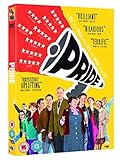
This is my review of Pride [DVD] (2014).

Although I remember the bitterness and violence of the 1984 Miners’ Strike, the role of a gay and lesbian group in supporting them, and the miners’ act of gratitude in leading the 1985 Gay Pride march completely passed me by. This piece of recent history forms the dramatic background to the lives of ordinary individuals including a feisty young Irish gay who identifies with the miners’ cause when he sees them being vilified, and the catering student struggling to come to terms with the gayness he is concealing from his conventional family.

This uplifting film manages to be both funny about prejudice, using humour to debunk it, yet poignant in its coverage of the fear of AIDs and the grim awareness of the frequent shortness of a gay life in the 1980s. Scenes of a mining community under pressure in the breath-taking beauty of the Welsh valleys made me question the sense and morality of the rapid destruction of the coal industry in Britain. Reminders of worker solidarity made me think how skewed our values have become, as we privatise public sector services, cut the benefits of the poor to pay off deficits caused by feather-bedded bankers, and subject ourselves to the jargon of performance management and marketing.

The film is honest in showing the bickering and division, as gay men display a macho indifference to the lesbians’ demands for recognition, and the leaders of the pride march want to play down the political angle after the failure of the miners’ strike. A few characters are stereotypes and the rapid scene changes reduce some plot details to sound-bites which could make the situation hard to follow for those too young to have lived through the crisis. A few scenes fall short, such as the unlikely abortive assault on a miners’ social event by the two sons of the rampantly homophobic committee member,but the acting is mostly very convincing, with the added power of the music – one of the most moving scenes is when, starting with a lone voice, a roomful of miners’ families rise to their feet in their common knowledge of the song of solidarity, “Bread and Roses”. We must have bread, but we still need a few roses in life.

⭐⭐⭐⭐ 4 Stars

Meaning at your fingertips

This is my review of Collins English to French (One Way) Dictionary & Grammar (Collins Dictionary and Grammar) by HarperCollins Publishers.

Although I accept the need for a two way version, I found this extremely inexpensive English to French dictionary very useful in kindle format during a recent trip to France. It proved a convenient and very compact way of checking out words I wished to use or to cope with unfamiliar terms in newspaper and magazine articles. I liked the way it goes beyond individual words to include idioms. This is useful for occasions when you do not have online access or the opportunity to use a mammoth bound dictionary.

⭐⭐⭐⭐ 4 Stars

The dangers of making the world a safer place

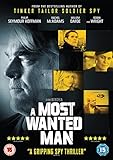
This is my review of A Most Wanted Man [DVD].

With the German authorities determined that the port of Hamburg should not be a seedbed of Islamic terrorism as it was for 9/11, the Americans and Russians are equally keen to take a hard line when Chechen dissident Issa Karpov turns up in the city. Maverick spymaster Günther Backmann, played by Seymour Hoffmann in one of his last roles, is determined to use Karpov as what he sees as a minnow to catch the barracuda of a Islamic benefactor who is suspected of siphoning off money for military purposes. Karpov's past and his current motives remain unclear, but how far can anyone be trusted?

As is usually the case, Le Carré's work requires total concentration, giving too little time to pin down possible flaws, or catch the answers to the questions which surface after the event. Yet, this film seems to me relatively clear, working towards a dramatic conclusion, which makes the mistake of dragging on just a minute or two too long. The ready assumption is that Karpov is "the most wanted man" but perhaps it is Backmann who manages to rile too many people.

The quality of acting of the main players is consistently high and mercifully audible, with generally sharp and engaging dialogues. Seymour Hoffmann stands out in his portrayal of a shambling yet astute character, capable of ruthless manipulation, perhaps a little too arrogant for his own good, yet displaying at times a surprising empathy for those he uses as pawns. This makes Hoffmann's premature death even more of a poignant waste.

⭐⭐⭐⭐ 4 Stars