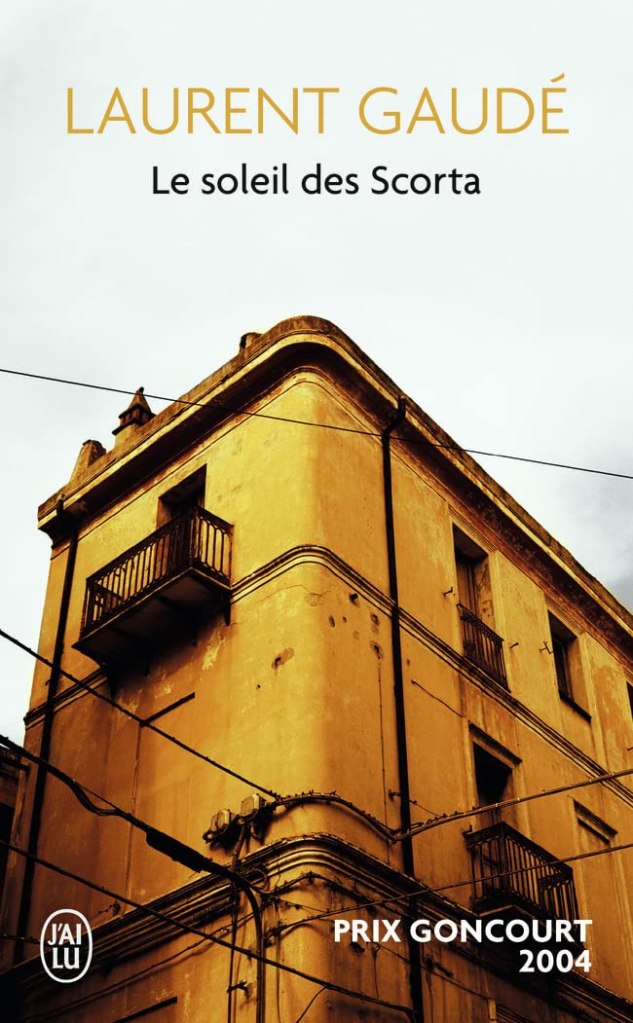
Le Soleil des Scorta by Laurent Gaudé: “There is nothing new under the sun”.

It’s the 1870s in “Les Pouilles”, the arid, sun-scorched heel of Italy’s boot. A weary donkey carries former bandit Luciano Mascalzone, prematurely aged by years in jail, back to his home town of Montepuccio, where he plans to fulfil his dream of “possessing by force” the beautiful Filomena Biscotti, a final crime for which the local men will surely kill him. The opening scenes, with their vivid sense of place and of a simple, sentimental, inward-looking community, quick to deliver rough justice, calls to mind a spaghetti western.

The succeeding chapters which trace Mascalzone’s descendants, the “Scorta” line, through four generations, starting with his bastard son Rocco, resemble a darker version of Daudet’s “Lettres de mon moulin”. They present a series of incidents which reveal the gradual change of a community over a century, focusing on the relations within a family in which each generation feels tied to a land it seems impossible to leave, but where making a living means a struggle to survive. Whether this takes the form of Rocco’s acts of violence and theft by which he enriches himself, or the sheer hard work rebuilding a business selling cigarettes like his grandson Elia, it gives a sense of pride. Those with less drive may be satisfied to labour growing olives, or fishing. Life evolves gradually, but not always for the better: the fishermen’s tradition of supplementing their income with smuggling switches from cigarettes to Albanians or refugees from further afield; the streets of Montepuccio may be lit with electricity, but they are thronged with tourists, and bright young people, including Elia’s daughter Anna, leave to study in the cities of the north.

Striking descriptions of the landscape ring true, since based on Laurent Gaudés own experience of frequent visits there, where his wife’s family and neighbours must have provided the models for his characters. Since he has also made a name as a playwright, it is not surprising that this novel has a distinctly theatrical flavour. One can imagine many of the scenes as stage sets: at one extreme Rocco’s defiant, remarkably vigorous death-bed speech to his startled audience; at the other the family celebration with a huge banquet held on a fishing platform in a rocky cliff, which remains “engraved” ad the high point of the family’s memories.

The story is related in old age by Rocco’s daughter Carmela to Don Salvatore, the once fiery priest and outsider, nicknamed “le Calabrais”, who has softened his jaundiced view of the locals. Sensing the onset of senility, Carmela is anxious to ensure that, after her death, details of the family’s history should be passed on to Anna, including one closely-guarded secret which seems ironical more than shameful, but might indeed dent the reputation of “les Scorta”, if widely known.

Despite its insights into human nature and evocation of a distinctive community, the frequent sentimentality, exaggeration and sheer implausibility of some events may captivate the reader, but make it more like a series of fables or flights of fancy than seriously moving. On the other hand, it makes one reflect on a disappearing way of life which has perhaps been dismissed too readily for its superstition, prejudices and poverty, so undervalued for its strength of ties to family, land and traditional ways of living.

In the English translation, the title is “The House of Scorta”.

Eileen – The Making of George Orwell by Sylvia Topp

This systematic, thoroughly researched biography of George Orwell’s first wife Eileen Blair has been overshadowed by Anna Funder’s more recent, subjective and at times dramatised account, “Wifedom”. The latter’s damming portrayal of Orwell, as an appallingly selfish man whose clumsy advances would nowadays trigger the wrath of the #MeToo Movement, induced me to turn to Sylvia Topp’s work for a second opinion.

It is true that Orwell pursued his interests with a single-minded obsession, whether it was to rush off to Spain to fight Franco’s fascist forces, or to lead an arduous life of self-sufficiency in a rundown cottage in an isolated village, rearing goats and selling eggs to make ends meet. He also seems to have made frequent passes at women,  apparently regarding fidelity in marriage as  unimportant, yet still deviously concealing an attempted fling with one of his wife’s so-called best friends. The fact that a fascination with young Arab girls prompted him to ask  Eileen for permission to visit a Moroccan brothel is particularly disturbing. He seems callous in his lack of concern over her ill health, but perhaps because he was frequently so unwell himself, he underestimated the risks of her final operation, leaving her to die alone while he went abroad. The empathy which prompted him to comfort a traumatised stranger he came across during the London blitz did not seem to extend to his wife.

Yet Sylvia Topp makes it repeatedly clear that Eileen willingly chose to devote her life to supporting Orwell for the decade of their marriage. This was despite being sufficiently ambitious to be very disappointed not to get a First at Oxford, and eventually finding an interest which could have given her a fulfilling, independent career – she was working on a Masters in the psychology of education when she met Orwell. She was conventional enough to think that, approaching thirty, “it was time” for her to get married. She also seemed to have a leaning towards achieving success vicariously through others, not only Orwell but also her high-flying brother Eric whose medical articles and books she typed and edited long before she took on the same role for Orwell.

By modern standards, Eileen was not a feminist. Yet since Oxford University only started awarding women degrees in 1920, four years before she began to study there, while women only gained the right to vote in 1918, and then had to wait a decade to have the voting age reduced from 30 to 21, she possibly felt that this was sufficient clear evidence of advances in achieving equality. She was clearly not a victim but prepared to speak out,  and show initiative when she really wanted to do so.  Admittedly, Orwell’s frequent bouts of illness as his TB developed cramped her style, but she seems to have been an innately kind person who could not have done otherwise than care for him. 

The couple somehow found time for a very active social life, entertaining friends in their often uncomfortable homes, and there is a pattern in their guests’ comments on Eileen: energetic, lively and attractive. She had no shortage of admirers: while Orwell was fighting in Catalonia, she had an enjoyable social life in Barcelona, forming a close relationship with a man called George Kopp, who may have wanted to marry her. Yet when Orwell was shot, she helped to ensure he received the best possible treatment, and later saved him from arrest as a suspected communist, by contriving to give him advance warning.

With her belief in Orwell’s talent, Eileen seems to have enjoyed being closely involved in his creative writing.  There is evidence that her feedback led to a marked improvement in his style, which colleagues noticed without identifying the reason.  The couple were intellectually very compatible, able to discuss issues on equal terms, and Orwell valued her opinion and trusted her enough to tell his publishers to deal with her, and accept her decisions in his frequent absences. There is even a suggestion that aspects of “1984”, an certainly the title of the classic, were derived from a poem which she wrote before even meeting Orwell: “End of the Century, 1984”.

The couple were also bound by a rejection of materialism, concern for social justice, and perhaps a sense of there being some virtue in a life of struggle, although Sylvia Topp notes tartly how they frequently took advantage of the good will and home comforts of wealthier relatives.  Ironically, by the time of Eileen’s tragically early death, Orwell’s writing was beginning to bring in a good income, although he too only lived for a further five years.  They paid a high price for a shared addiction to strong black tobacco.

Despite a tendency to be overdetailed and to speculate too long over minor points, to the extent that in order to get “hooked” quickly, it might be advisable to skim-read the first three chapters, and later through Eileen’s final employment at the BBC, this biography proves in the main very absorbing and revealing, not only about Eileen and Orwell, but also the times in which they lived.             

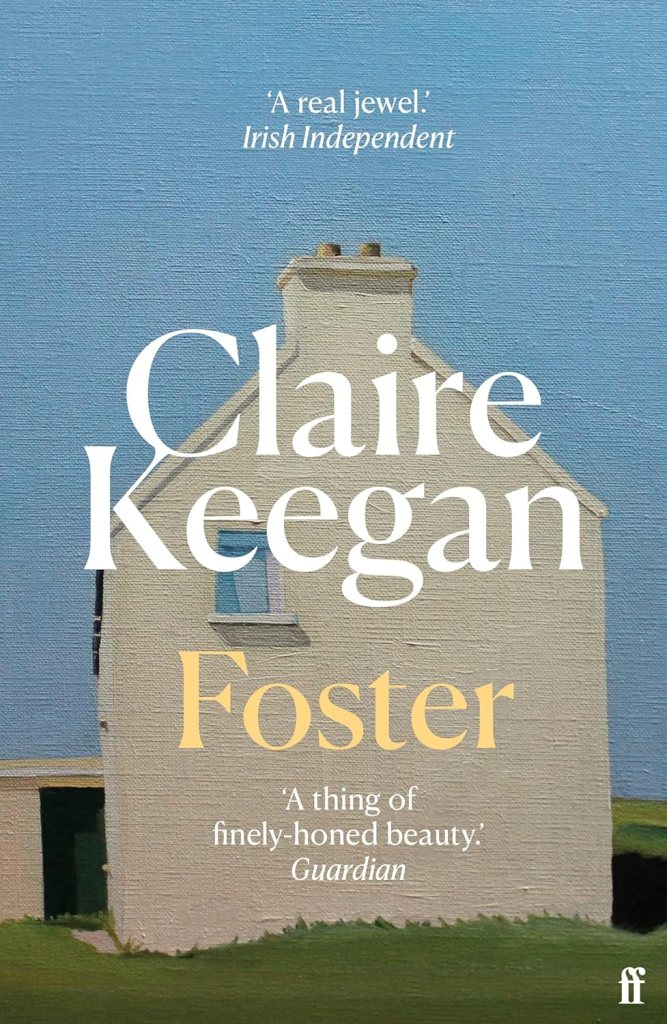
“Foster” by Claire Keegan: when less is more

“The wind is high and hoarse in the trees, tearing fretfully though the high boughs…..A big loose hound whose coat is littered with the shadows of the trees lets out a few rough, half-hearted barks…..The presence of a black and white cat moves on the window ledge.” This spare, poetical prose sometimes sounds incongruous, too mature in the thoughts of the young girl narrating this story, unusually observant as she is. But does this really matter? Recounted in the present tense to give a sense of immediacy, this is one of those simple tales which hang on the subtle way in which the facts are revealed.

In the rural Wexford of southeast Ireland during the early 1980s (as we glean from references to the IRA hunger strike in the Maze Prison), a girl – whose name we are never told – is fostered with a farming couple, the Kinsellas, to ease the burden on her heavily pregnant mother. Home life sounds chaotic, since her mother already has to care for at least four children, and do more than her fair share of running the farm, with a husband who clearly drinks away what money there is, leaving too little to pay for the hay to be cut, gambles away a red Shorthorn cow, and casually accepts handouts of potatoes, rhubarb and “the odd bob” sent to his wife. His callousness is revealed when he forgets to unload the girl’s luggage as he drives away, but never seems to make any move to remedy his error.

The Kinsellas could not be more different. Working hard in quiet cooperation, they are keeping at bay a suppressed grief which the girl only discovers after some weeks, from a neighbour’s gossip. Yet although the girl’s presence can only enhance their sense of loss, they still give her the care and attention which she has lacked, so that she blossoms and develops in the space of a few weeks. Suddenly, it becomes clear, as it would to a child with little sense of time passing over a long summer holiday, that the school year is about to start, her mother has given birth and she must return to her old life. The sense of belonging and the affection which have grown make the parting all the harder, on both sides. As is the case with Claire Keegan’s novellas, the ending is ambiguous, leaving the reader to reflect on what happens next. Yet it seems that the girl has gained some permanent benefit from the experience, as perhaps the Kinsellas have as well.

Much of the emotion in this book is implied, together with the way in which observations are used to reveal the characters’ lives and the rural setting, laced with the Irish turn of phrase in the dialogues. As John Kinsella observes, “You don’t have to say anything. Always remember that as a thing you need never do. Many’s a man lost much just because he missed a perfect opportunity to say nothing”.

This novella has been made into the film “The Quiet Girl” which has also been highly praised.

“Le Chat” or “The Cat” by Georges Simenon: an impasse in more sense than one

In addition to his detective novels featuring the chief inspector Maigret and other works, Georges Simenon wrote 117 “romans durs”, literally “hard” but described in English as “psychological novels”. One of the best known of these, published towards the end of his writing career, is “Le Chat” or “The Cat”, so popular that it was made into a film in 1971.

“Le Chat” was apparently inspired by a visit to his mother in the 1950s, where Simenon was struck by how she and her partner did not speak to one another, but seemed to express a mutual hatred via the cruelty they inflicted on each other’s pet animals.

From this bizarre situation sprang the tale of two lonely, recently bereaved people in their sixties who happen to live in the same Parisian cul-de-sac and make the mistake of getting married, only to find that their differences in class, taste and habits make them completely incompatible and provoke a profound conflict. The husband Émile Bouin is painted in a more sympathetic light – he’s a simple working man, goodhearted if a bit vulgar, who likes to drink a glass or two in a café and smoke his “nauséabonds” cigars. By contrast, Marguerite is a dainty “petite bourgeoise”, daughter of the founder of a biscuit factory, eventually ruined through a partner’s financial mismanagement. Frail in appearance but with a will of iron, she is portrayed as self-centred, vindictive and superficial.

She detests her husband’s pet Joseph, an independent alley cat who seems to menace her beloved parrot. Despite being deeply religious, she is suspected by Émile of having murdered his cat. This is the beginning of a long-term feud which the pair conduct into their early seventies, communicating solely via written messages. So Émile’s “Attention au beurre” is loaded with meaning – implying malignly that the butter may be poisoned just as Marguerite did away with Joseph. Needless to say, the parrot has come to grief as well, but has been restored to its cage in stuffed form, to trouble Émile‘s conscience.

The monotonous, oppressive life the pair lead is revealed from the outset, and would soon become intolerable even to the reader, but for the continual touches of dark humour. Simenon also captures the nostalgia and melancholy of a former Paris in the 1960s when inner city neighbourhoods of close-knit communities in which people know each other’s business, or think they do, are being disrupted by redevelopment schemes. Even the couple’s cul-de-sac is being demolished by the bulldozer.

Deftly constructed with flashbacks and digressions, Simenon skilfully reveals past events which have shaped the characters, their motivations and emotions, against the atmospheric backdrop of open air cafes and bars, dance halls on the banks of the Seine, or meetings in the Parc Montsouris. Simenon’s clarity of expression and insight hook the reader despite the essential sadness of the theme as it draws to its ironic conclusion.

Simenon embarked on his “romans durs” with the intention of winning The Nobel Prize for Literature, but never achieved this ambition, causing him to change his career from “novelist” to “no profession” in his passport, in a surge of disillusion. The more French novels I read, the more I think he deserved such a prize.

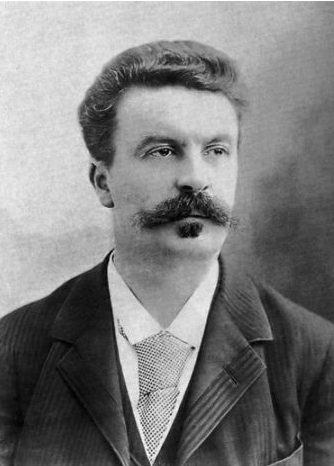
“Une Vie” by Guy de Maupassant: A Woman’s Life

For his first novel, Guy de Maupassant sought the advice of his mentor Flaubert, and there are similarities between his heroine Jeanne and Madam Bovary – both underoccupied, privileged C19 women of whom little is expected except to be married and follow a conventional path with no self-fulfilling goals to give them a sense of purpose. It took Maupassant more than five years to complete Une Vie, by which time Flaubert was dead. Meanwhile, he was producing a spate of short stories and plays, often on risqué themes which would titillate the public and bring him commercial success.

Yet “Une Vie” took more time because it was meant to be different, with its slow-paced focus on the on the inner life of an unremarkable individual. At first, I was a little bored by the banality of Jeanne’s life, as she returns from the narrow education of a convent to the family home where her head is full of naïve, romantic notions. The plot becomes more interesting when she marries the handsome Julien, but her honeymoon in Corsica turns out to be her one true adventure, and indication of how her life might have been. Julien soon proves to be mean with her family’s money, which was probably his reason for marrying her, and unfaithful as well.

Maupassant is particularly successful in entering into the mind of a woman, describing her emotions, even the experience of childbirth. He also creates a strong sense of place in the descriptions of the countryside on the Normandy coast, and some atmospheric scenes. He develops the psychology of his characters to good dramatic effect, as when, during her wedding party, Jeanne’s father is forced to tell her the facts of life, which he does in the most oblique and ineffectual way possible, because her mother cannot bring herself to do it. Then there is the cynical worldliness of the local priest when she confesses to him that she wants another child: part of his advice is to suggest that she pretends to be pregnant as a way of effectively tricking her husband, taken off his guard, into giving her the child that she longs for, but he really does not wish to have.

Jeanne’s acute sensitivity makes her ill-equipped to cope with the relentless sequence of misfortune which dogs her, and in turn unsurprisingly weighs the reader down. Maupassant may well have been unaware of this effect on us, since he was prone to periods of deep depression, being influenced by the philosophy that it is the destiny of mankind to suffer, because the faulty will is more powerful than reason, causing us to make bad decisions.

The author’s own mother also had a philandering husband and suffered depression, but was less passive than Jeanne, and made the decision to separate from him. This, plus the fact that Maupassant had a younger brother who kept getting into debt through gambling, show how much the author used his close relatives as models for Jeanne, Julien and their son Paul.

The essentially rather gloomy “novel of mourning” is leavened with a few somewhat melodramatic events, each of which could have made one of his intriguing short stories. Although not exactly an enjoyable read, this is an interesting experiment, which prompts reflection and lingers in the mind.

Demon Copperhead by Barbara Kingsolver: facing one’s demons.

This modern American take on Dickens’ David Copperfield is set in an impoverished part of the Appalachians, where closure of the coal mines has destroyed the local economy, and too many people, particular the young, fall prey to drug pushers and “Big Pharma” schemes to encourage consumption of their opioid painkillers like Oxycontin which led to widespread substance abuse and addiction.

The narrator is Damon aka Demon Copperhead, born on a trailer floor to a drug-addicted teenage single mother, shortly after his young father’s death by drowning. This is the cue for the author, who has switched her focus from the environment to social injustice, to expose the failings of the foster care system, the ravages caused by the underregulated use of drugs like “Oxy”, and the unfair labelling, even mockery, of the rural poor who in fact may benefit from a stronger sense of community and closeness to the natural world than their urban counterparts. Perhaps Barbara Kingsolver’s love of nature, which prompts some of her best prose, has made her express this view through Demon, who comes to believe that the “rural poor” do not deserve to be mocked as “hillbillies” since they can at least hunt or produce their own food without the need to “hustle” for cash, and are prepared to relate to strangers by looking them in the eye.

It may be beneficial to have read David Copperfield recently enough to be able to match the modern characters to the original ones, but this is not essential. The author’s ability to enter the mindset and sustain the speech pattern of a bright, talented, resilient but sadly deprived, ill-educated and often mistreated young man is an achievement, assisted by her personal knowledge of the language that years spent later outside Appalachia “tried to shame” from her tongue. On the other hand, the corny, wisecracking style often grates.

This novel is hard going for a non-American reader by reason of the copious slang, unfamiliar cultural references and acronyms – a few footnotes would have been useful. Heaven knows how it will stand translation into other languages. Dickens had to write his novels in instalments for magazines, presumably leaving readers panting for more, but I found it mentally exhausting to read Demon Copperhead for more than a few chapters at a time. This was partly owing to the style, but also to the relentless piling on of depressing, often unduly sordid events, leavened only occasionally by the odd dollop of sentimentality, or rare stroke of good fortune which one knows cannot last.

However, it is the sheer length of this book which is the problem. At nearly 550 pages in paperback, it would have benefited from the stripping out of a good deal of repetition and “filler” – something that it was much harder for Dickens to do, obliged to publish early chapters before he had finished the whole story. So perhaps the author has gone too far in imitating Dickens, by reproducing some of his flaws, also including a tendency to produce stereotypes or somewhat exaggerated, unconvincing characters

Yet Barbara Kingsolver has created a sympathetic person in Demon, raised awareness of some important social issues, and been quite ingenious at times in her reworking of Dickens’ original plot and cast of characters.

“Act of Oblivion” by Robert Harris: At what price?

Following the vacuum created by Cromwell’s death, encouraging the restoration of the monarchy in England, the “Act of Oblivion” issued a general pardon, with a few exceptions including the “regicides” who had signed Charles l’s death warrant.  Robert Harris makes two of these real men the central characters of his novel: Ned Whalley, turned loyal soldier prepared to be ruthless in the loyal support of his cousin Cromwell, and Ned’s son-in-law Will Goffe, a devout Puritan with a passion for preaching  and a streak of fanaticism, as indicated in his unshakeable belief that the Second Coming will take place in the year 1666, as foretold in the Book of Revelation. This delusion at least makes their trials more bearable, as they endure a precarious existence on the run in the New World, with their nemesis, the fictional but plausible Richard Nayler, in unrelenting pursuit long after others have lost the taste for it, driven less by his desire to avenge the king’s execution,  than by a deep personal grudge.

The author succeeds in maintaining a continuous sense of tension and menace, so that right to the end, one is unsure whether Whalley and Goffe will escape capture, let alone survive. If the narrative sometimes lacks pace, this perhaps serves to remind us  of the inevitable tedium of being forced to lie low, often in very uncomfortable conditions, always on the alert and rarely certain of whom one can trust.

Robert Harris never misses the chance to reveal characters’ strengths and flaws, so that, wherever one’s sympathies lie in the first place, they tend to keep shifting. We see how, when they were in a position of power serving a triumphant Cromwell,  the essentially decent Whalley and Goffe were capable of being as cruel as Nayler, who in turn sometimes has unexpected flashes of compassion.  Writing a memoir to pass the time, Whalley comes to question some of Cromwell’s motives and actions, while Goffe seems rigidly set in his religious certainties. While perhaps King Charles ll and his brother James are portrayed as unremittingly debauched to the point of caricature,  even they appear worthy as they trot round London on horseback, reassuring people in the aftermath of the Great Fire.

Having dragged somewhat in places, the narrative passes too rapidly through the events of the Plague and Great Fire of London which test the faith of Will’s long-suffering wife Frances. The unpredictable, nail-biting end is also quite abrupt. Yet overall, this novel is well-constructed, wears the detailed research on which it is based quite lightly, and certainly stimulates interest in a fascinating period of our history, which could have turned out very differently. It also raises the moral dilemma of how far to go in following one’s principles, at the price of losing almost everything else which one loves or enjoys.

La femme rompue – The woman destroyed, by Simone de Beauvoir – feminism through cautionary tales.

In her trilogy of novellas which takes its overall name from the third story, “La femme rompue”, or “The Woman Destroyed”, Simone de Beauvoir, celebrated feminist writer and longstanding companion and lover of Jean Paul Sartre, portrays three women not dealing well with a crisis in later life. In each case, the crisis is due partly to external factors, including the behaviour of others, but also appears to be partly of their own making.

In l’Âge de discretion (The Age of Discretion), the first story, the sixty-something narrator is increasingly disappointed by her husband’s premature acceptance of ageing and being “past it”, and depressed by the unexpectedly lukewarm reception of her new work. Her complacency is shattered by the discovery that her son Phillipe has rejected the academic profession into which she has steered him, and the left-wing values of his parents, for a career making money. De Beauvoir’s clear, expressive prose with its sharp dialogues explores every facet of the narrator’s changing emotions as the facts are gradually revealed.

She contrives to create some sympathy for the woman, even while exposing the full extent of her failings: she often appears to be an unreliable witness, is jealous of the suspected influence on Philippe of his partner Irène, has sought to control Philippe too much herself, and proves overemotional and extreme in her reactions when she cannot have her way.

The same mixed response applies to Monique in “La Femme Rompue”, although I feel rather more sympathy for her as the growing sense that she has lost connection with her husband triggers his confession that there is indeed “another woman” in his life, but not one that Monique can respect – as if that would really ease her pain. Published in the 1960s, it would seem that de Beauvoir is writing this as a cautionary tale for women who put all their eggs in the basket of sacrificing a career to support a husband and children, running the risk of losing all of these, with nothing to fall back on.

I was least satisfied with the shortest story, “Monologue”, in which a dense stream of consciousness is spouted by an ageing woman who has gone mad in her desire for revenge on those who have wronged her. It is exhausting and tedious (perhaps intentionally!) and somewhat confusing if read in French as a second language. This bleak, disjointed recital seems simplistic in suggesting that the narrator’s sense of her mother’s neglect and preference for her brother when she was growing up can be blamed as the initial cause of a chain of dysfunctional relationships, including with her own daughter. “Monologue” differs from the other novellas, in that it reads like an exercise in creative writing, which lacks authenticity because De Beauvoir is too cool and controlled to identify with her crazed character.

Ceremony of Innocence by Madeleine Bunting: the costs of turning a blind eye.

Journalist Fauzia is appalled to learn that her friend Reem, a recent Cambridge graduate from Bahrain, has disappeared in Cairo a few days before she is due to present a paper on her PhD research. Fauzia’s fear is mixed with guilt, since she is responsible for having enabled Reem to make progress in her PhD by giving her a laptop of sensitive information which she lacked the courage to use herself. This provided evidence of the involvement of Fauzia’s ex-husband’s family, the Wilcox Smiths, in shady, very lucrative business deals with corrupt regimes in the Middle East.

The storyline then switches back to 1969, to trace the course by which Fauzia’s former father-in-law Martin made the transition from decent diplomat working for an Empire in decline to ruthless entrepreneur. Then, forty years on, we see the prosperous family through the eyes of Kate, a poor relative, as she makes ends meet by taking as a lodger Hussein, a doctor seeking asylum in the UK, having been tortured as a Shia in his native Bahrain.

The threads are gradually drawn together against the background of British “establishment” members who have lost political influence on the world stage, and seek to maintain status through the accumulation of wealth, regardless of the cost to others. It seems that a bad conscience can be quashed all too easily by conspicuous do-gooding and steering conversations through channels of vacuous politeness. Some bleak incidents are leavened for the reader with lengthy accounts of daily life in the Wilcox-Smiths idyllic country house, although at other times the incongruity of this makes the harsh realities appear more shocking.

This complacency explains the relevance of the title, which is taken from the famous line by Yeats: “The ceremony of innocence is drowned”. It seems more apt for this book than the earlier one in the same verse, “Things fall apart; the centre cannot hold”, which the African writer Chinua Achebe has used already for his novel exploring the tensions created by colonisation.

Despite an original approach to an interesting and important theme, at times this novel risks falling between the two stools of political thriller and critical study of upper class manners. Initially, I was so impressed by “Ceremony of Innocence” that I thought the favourable comparisons with John Le Carrés work, made by some reviewers, did not go far enough. The variety of characters, with a convincing mixture of redeeming features and flaws (apart from the ruthless misnamed Dotty), seem particularly well-developed and realistic. Then I began to notice a few somewhat unlikely or unclear plot twists, the uneven structure of the novel, or the point where old habits die hard, and former journalist Madeleine Bunting has Hussein recount the circumstances which have brought him to England in the kind of objective, articulate flow better suited to an article based on interviews with asylum seekers. The novel’s climax is rather abrupt, although perhaps this is deliberate to build up the tension. The inconclusive ending, still dragging a few loose ends, is arguably appropriate to the morally ambiguous events. Ensuring that everyone gets the justice they deserve would have been too far removed from real life.

Some reservations apart, this novel proves very readable and thought-provoking, a good way of inspiring us to find out more, or to be reminded about the Middle East, and Britain’s involvement and degree of culpability in recent crises and personal tragedies there.

“Le suspendu de Conakry” by Jean-Christophe Rufin: run-of-the-mill

The quay of Conakry harbour is crowded with Guineans, mesmerised by the spectacle of a body suspended from the mast of a sailing boat in an apparent vicious act of revenge, but for what reason? The victim is a wealthy Frenchman who may have had a large amount of money stashed on board after selling his business, so was theft the main motive? Bored in his job, with secret dreams of being a detective, the unlikely consul at the local French embassy,  Aurel Timescu, cannot resist the unexpected opportunity to investigate the crime unofficially in his manager’s convenient absence.

The first in a series which has proved popular, this novel marks a change in direction for author Jean-Christophe Rufin. With an impressive career path as a doctor playing a leading role in Médecins Sans Frontières, and as a diplomat, his past novels have been located in a variety of countries, but tend to focus on serious themes and moral issues.  In some ways, “Le suspendu de Conakry” follows this pattern, with its references to the corruption and lack of freedom in  formerly communist Romania, Aurel’s country of origin,  to  the problems of post-colonial Guinea and the insidious network of the international drug trade.

However, as detective fiction it seems quite formulaic: divorced anti-hero with a drink problem, on bad terms with his boss. Habitually wearing an ankle-length mac in a country with an average temperature of over 80° F, Aurel is widely mocked and underestimated.  Yet he somehow manages to establish a rapport with hints of possible romance with Jocelyne, the murder victim’s glamorous sister. This is despite behaving like a gauche adolescent in her company. Although Rufin has claimed when interviewed that Aurel is based on embassy staff he has met, he seems to have carried absurdity too far.

The plot is rather thin and banal, with Aurel largely relying on information he deploys young  local men, like Hassan who works for the embassy, to glean by quizzing possible witnesses and suspects.  There is a potentially interesting twist in  Aurel’s persistent attempt to understand the psychology of Jacques Mayères. Influenced by his Romanian culture which fosters a belief in ghosts, he even imagines that Jacques is looking at him from a photograph.  This apparently assists Aurel to work out how the crime occurred but the  eventual denouement seems implausible  and contrived in too many respects. For the most part slow-paced, the novel concludes abruptly, still dangling a few loose ends. 

This proves an easy read which leaves one feeling dissatisfied, because some promising ingredients  could have been handled better.