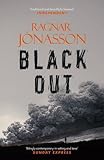
“Blackout” (Dark Iceland) by Ragnar Jonasson – Saved from run-of-the-mill by atmospheric Icelandic introspection

This is my review of Blackout (Dark Iceland) by Ragnar Jonasson.

When an American student on a visit to the rural north of Iceland discovers the body of what looks like a murder victim, it is obvious that local police inspector Tómas will be involved, along with his competent if erratic assistant Ari Thór. But why does Hlynur, the third member of the team, seem to be “losing his edge”? Also, is there more than simple ambition in journalist Ísrún’s intense interest in the case?

The third novel to be published in Ragnar Jonasson’s “Dark Iceland” series of crime thrillers, “Blackout” is chronologically the second book, so is best read after “Snowblind”.

The series is not as dark as recent televised “Scandi Noir” but still manages to give essentially straightforward detective fiction a different twist by creating a strong, distinctive sense of place. So in “Blackout”, we have the cobalt blue waters of the northern fjords where cruise ships have begun to dock, the surreal experience of rambling along the shore on summer nights as bright as day, while by contrast the capital of Reykjavik languishes under an unfamiliar pall of volcanic dust and families struggle to rebuild their lives after the financial crash.

As in most police dramas, the likeable young detective Ari Thór has problems in his personal life, and undermines a flair for sniffing out the truth with impulsive behaviour and a difficulty in controlling his temper . However, in a book which possibly has too many characters, he is not clearly the main one. The author takes pains both to craft a complicated but coherent plot, and to develop his characters as individuals, giving us detailed insights into their thoughts, even when they prove to be minor players, although he tends to do this through an overuse of lengthy flashbacks and descriptive often rather similar back stories, with a theme of unhappy childhood and unfulfilled adult life. I am not sure how much it is due to the translation, but the style of writing is simple to the point of minimalist like the landscape of an Icelandic lava field. Sometimes the plot seems plodding, at least giving a sense of the tedious and often seemingly fruitless nature of police work, but the pace picks up at the end to give a satisfactory denouement, leaving the details of the aftermath to our imagination.

Even if the author’s main aim is to sell popular fiction, one senses he is a born storyteller, and with a serious, reflective desire to explore the complexity and darker sides of human nature.

⭐⭐⭐⭐ 4 Stars

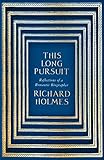
This Long Pursuit: Reflections of a Romantic Biographer by Richard Holmes – A marmite of reflections

This is my review of This Long Pursuit: Reflections of a Romantic Biographer by Richard Holmes.

Having read his two-part study of Coleridge, and “The Age of Wonder” which explores how the Romantics were influenced by “the beauty and terror” of the scientific discoveries of their day, I admire Richard Holmes as outstanding amongst biographers. So perhaps my expectations were too high for “The Long Pursuit”, the third in a series of reflections on the nature of biography, fleshed out with brief portraits of past lives.

Despite attending a lively talk by the author, I remain unclear about the three-part structure of this book: “Confessions” which explores the process of writing a biography, with many digressions, asking to what extent it can be formally taught as a “body of knowledge; “Restorations” which amounts to five short biographies of it would seem arbitrarily-chosen women who mostly formed part of the Romantic period, including Mary Wollstonecraft, already covered in his work “Footsteps”, and finally “Afterlives” which focuses on five “Romantic era” men, mostly poets (Coleridge, Shelley, Keats and Blake) with the at times almost invisible “common thread” of how reputations may fluctuate after death, as individuals are misremembered, judgements alter as society’s attitudes change, source materials are selectively destroyed or discovered, biographers develop rival interpretations, and so on.

The book contains fascinating “nuggets” such as the author’s collection of two-hundred handwritten notebooks, with objective facts on the right-hand page, and subjective responses to the person under study on the left. There are amusing anecdotes such as the fact that, when Richard Holmes- who rightly travels in the footsteps of all his subjects – climbed on to the roof terrace at Greta Hall where Coleridge wrote and observed “the old moon with the new moon in her arms”, he found that the pupils at what is now a girls’ boarding school hid their vodka and cigarettes there. The portraits included as illustrations are also striking.

However, the book contains too much rehashing of “old material”, a patchwork of fragments from works by Richard Holmes which I have already consumed, leaving me with a sense of being cheated. In all the previous books of his which I have read, there has been a strong cohesive theme linking the chapters, providing a clear context for the often minute detail. Here, I felt unengaged by the continual flitting around without a clear purpose. I concluded that the book is best treated as a series of free-standing essays.

“This long pursuit” has a detailed index, and may include points of value to students. It has a “serendipitous” quality by which I mean that reading it, you may discover the odd point of interest by chance, without actively looking for it. This may make it very appealing to some readers, but I suspect others will skip through or abandon it with a sense of regret.

⭐⭐⭐ 3 Stars

“A United Kingdom” [DVD] – A timely reminder that integrity can still win out

This is my review of A United Kingdom [DVD].

This heart-warming story of the power of love and clear-sighted integrity in the face of prejudice and ill-judged political expediency is worth reviving at a time when many people are too young to remember the true events on which it is based.

When London office worker Ruth Williams fell in love with a black African student who shared her love of dancing to jazz music, she did not realise what problems would be posed by his role as future King of Bechuanaland, a British Protectorate on the borders of South Africa, which was in the process of developing apartheid.

The film is effective in showing the flowering of a romance based on deep-rooted love and the couple’s shifting emotions of shock, despair, anger and defiance as the two find themselves caught between racism and hostility in both white and black communities resistant to change. It conveys a strong sense of place in foggy post-war London and the semi-arid African plains. We see how Ruth gradually begins to forge relationships with the local people, who are perhaps a little too good – gentle and law-abiding – to be true.

The drama is less successful in charting a coherent course through the political shenanigans, as entertaining but stereotyped British diplomats try to cajole, bully and trick the pair into giving up a marriage thought likely to stir up local unrest, or worse still threaten UK access to South Africa’s supplies of diamonds and uranium. Since in real life the couple were exiled from Bechuanaland for several years, perhaps the filmmakers feared the narrative would lose pace unless events were concertinaed somewhat. The weakest scenes are those involving poor look-alikes for British ministers gabbling lines at each other to explain complex geo-politics to the audience, on a set which looks nothing like the House of Commons, as intended.

Such a fascinating story does not need much tinkering to hold our interest. If anything, the film underplays Seretse Kharma’s achievement in developing an independent, much more prosperous and relatively free from corruption African country, renamed Botswana, one of the tragic continent’s few success stories.

The film inspired me to familiarise myself with the details of the original true story, is a salutary reminder of the extent to which attitudes have changed over the past sixty years, and reminds one of the overall benefits of a tolerant, open-minded society – also of the important link between individual freedom and democracy of which we may be in danger of losing sight.

⭐⭐⭐⭐ 4 Stars

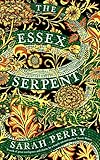
“The Essex Serpent” by Sarah Perry – Cleaving hearts

This is my review of The Essex Serpent by Sarah Perry.

This imaginative yarn set in the 1890s revolves around Cora Seaborne, the unconventional young widow who acknowledges her sense of relief over the death of a sadistic husband. Within days of his demise, she has left the bustle of London with its sharp social divisions for the stark beauty of the Essex coast, often obscured by shifting mists, accompanied by Martha, the competent nanny who never left and son Francis, who would nowadays be considered autistic. With his inability to show the normal affection of a child, and his obsession with collecting objects, Francis is a continual source of puzzled concern, but Cora obtains emotional support from Martha, who manages to combine this with her commitment to persuading wealthy men like her admirer Spencer to invest in the replacement of the London slums with decent housing for workers.

It being the 1890s, Cora is thought to have a “masculine mind”. Although a wealthy woman with the means to dress fashionably, she often tramps the country dressed like a bag lady, in a man’s tweed coat with grimy fingernails. Apart from being practical gear for a geologist, perhaps this is a sub-conscious desire to conceal her femininity, having been so abused by her husband. It is hard to believe that such an independent-minded woman would have submitted to this, but perhaps she was trapped by her initial youth and the social attitudes of the day.

Absorbed in her fashionable pursuit of fossils, Cora is intrigued by the “Essex Serpent”, a creature of local folklore who is thought to have made a recent return to prey on the the inhabitants of Aldwinter, terrifying them in the process. Cora harbours dreams of making her name as a female geologist through the discovery of some giant ichthyosaurus. Frustrated by his parishioners’ superstition, local vicar William Ransome is driven to hac away the carving of a sea serpent which adorns the arm of a church pew. Although holding diametrically opposed views on religion, William and Cora are drawn to each other by a powerful meeting of questioning minds, the joy of conversing and bouncing ideas off each other. But can such a friendship endure in 1890s England, when does friendship become love, and what is to be done since William Ransome already has a beautiful, sensitive wife whom neither William nor Cora could bear to hurt – although she is conveniently frail and consumptive, so perhaps they can have their cake and eat it if their love can survive all the interim setbacks?

At first, I found the characters somewhat unconvincing, such as the brilliant, eccentric surgeon Luke Garrett, and his wealthy friend Spencer. Too often both dialogues and descriptions seem artificial, clunky contrivances for informing the reader about the burning social issues of the day. Yet, the descriptions of the Essex countryside and shoreline, together with the unsettling suspected presence of the serpent, are well-written and evocative, and once William Ransome is established alongside Cora to provide the two most fully developed central characters, I found myself more fully engaged in the story. Sarah Perry is also good at writing about children.

Overall, it is a modern writer’s take on the late Victorian world a generation after the period of Dickens and Wilkie Collins. Written somewhat in their vein, it avoids cloying sentimentality, yet is over-long and repetitious in places, and soft-centred at its core, although these are all features of the writing of this period.

⭐⭐⭐⭐ 4 Stars

Perverted faith

This is my review of The Innocents [Blu-ray].

The setting is rural Poland in the aftermath of World War Two. Unable to bear any long the anguished cries of pain which the pure-voiced chanting cannot drown out, a young nun tramps through the snow to the French Red Cross hospital to seek help, with the insistence that the Polish Catholic authorities must not get to hear of it. When a young French nurse called Mathilde is eventually prevailed upon to drive to the convent, she discovers that not only is one nun in labour, but that several others are heavily pregnant, having been raped by boorish Soviet Russian soldiers. As an atheist from a communist-sympathising background, it is hard for Mathilde to comprehend that, far from being supportive, the Catholic Church would close the convent down, causing hardship to all the nuns, who would also be rejected by their families, if the truth ever became known. A further frustration is that the nuns believe it a sin to remove their clothing, let alone be touched, as part of the essential business of giving them medical aid. If the mothers can be saved, what is to be done with the children? At what price should one place religious belief or duty over acts of basic humanity or the expression of natural human emotion?

What could be an unbearably harrowing tale is made a memorable and thought-provoking film through the well-developed plot, focusing on a few specific, clearly drawn personalities to show different points of view as events unfold. The scenes are very convincing in their apparent authenticity, the French Director Anne Fontaine having undertaken very thorough research of the real-life situations on which the film is based. There is a striking contrast between the convent and the hospital. In the former, calm routine prevails against the odds, with Mathilde finding herself moved by the beauty of the singing, but fear, grief and violence keep breaking through the delusion that rules and rituals can carry on as normal. In the crowded hospital with its makeshift operating theatre, Mathilde and the Jewish doctor who fancies her work to the point of exhaustion, then seek release in dancing, drinking vodka and casual sex in the knowledge that, in a few weeks, they maybe posted on separate ways. Meanwhile, the orphaned street children sell cigarettes for coins and clamber over a coffin for fun. The film may suggest that the flawed, secular world is more honest and humane, but the young nun Maria’s ability to maintain both her faith and her integrity support the other side of the argument.

The direction seems flawless apart from the details of a few scenes which I found confusing since the nuns tend to look so similar in their habits. The film has been criticised for a failure to analyse issues in depth and for a rather saccharine ending. Instead, I felt that the Director takes the mature approach of sparking questions in our minds, but leaving it to us to formulate our own answers, while the ending is merely a convenient stopping point, with much yet to be resolved.

⭐⭐⭐⭐ 4 Stars

Style over substance

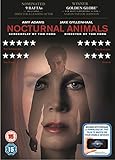
This is my review of Nocturnal Animals (DVD + Digital Download) [2016].

The wealthy and successful owner of an avant garde New York art gallery, Susan Morrow is taking stock of her glamorous life and finding it hollow. She is drifting apart from her husband, who resents the humiliation of her casual offer to buy some new artworks to mask his financial problems. Is he having an affair and does she regret walking out years ago on Edward, the first husband she loved, but who disappointed her by his failure to write a successful novel together with his lack of ambition.

She is in a vulnerable state when, perhaps improbably after a gap of almost twenty years, Edward sends her a proof copy of the novel he has finally produced, perhaps ominously entitled “Nocturnal Animals”, a reference to his old nickname for her habits. As she reads it, at night, of course, her thoughts continually turn to memories of her life with Edward, her belief in his creativity as a kind of substitute for her lack of it, her cynical, materialistic mother’s belief that Susan will end up like her, and Edward’s frustration that Susan seems unable simply to trust in their mutual love. In his novel, Edward has stuck to his belief that all writing is ultimately about oneself, but has taken aspects of their relationship to construct a very different world from their own, in which a family’s road trip to rural Texas leads to a shocking chain of events.

The film employs the device of “a story within a story”, requiring intense concentration to avoid confusion as it flits between the two, with Jake Gyllenhaal playing both Edward the sensitive would-be writer and Tony, his fictional hero who is powerless to protect and perhaps too feeble to avenge his wife and daughter against Texan “white trailer trash”.

This psychological thriller interweaves two tales of revenge: the “fictional”, physically very violent, the other “real life”, providing more subtle forms of emotional pain. Both threads are often humorous, the characters well-observed, and scenes visually striking, be they carefully constructed shots with fashion designer turned film director Tom Ford’s obsessive eye for detail in Susan’s gallery and her ultra-modern glass-walled mansion, or on the other hand, beneath dramatic blood-red clouds at sunset, the stark, arid scrubland of Texas, sparsely inhabited by the decaying shacks of the disaffected Trump-voting poor.

Stylish and quite original, the film holds one’s attention until the abrupt, somewhat ambiguous ending leaves a sense of anti-climax, bringing the first opportunity to take stock as to exactly what the film is about. I have read that Tom Ford wants us to be forced to think, but cannot help feeling that much of the film’s impact is visual, such as the geometric pattern of flights of stairs on which Susan continually fades from view only to reappear as she makes her ascent. I find it hard to believe that such a gentle and perceptive soul as Edward would harbour destructive feelings of revenge for nineteen years, nor that either his book, inspired by but far removed from his relationship with Susan, or his ultimate behaviour towards her in any way amount to devastating retribution. So, perhaps I missed something, but I would describe this film as entertaining, visually striking, but not very moving in Susan’s unreal “real life” although Edward’s fiction is more disturbing.

⭐⭐⭐⭐ 4 Stars

Crazed with guilt

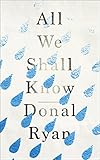
This is my review of All We Shall Know by Donal Ryan.

With a masters in journalism, a frustrated would-be writer, her prose searing and insightful in print, but foul-mouthed in her speech, self-absorbed, quick to fly off the handle, swinging between extreme attachments and violent dislikes, unstable to the point of being a little mad, the inaptly named Melody is difficult to like. Donal Ryan contrives to hook us onto this sad, often violent tale, by the power of his quicksilver flow of words, the original, striking descriptions and wry Irish turn of phrase which makes one wonder how such articulate people can so often fail to avert trouble by sheer verbal skill alone.

We know from the first paragraph that Melody has got herself pregnant by seventeen-year-old Martin Toppy, a pupil almost half her age, the handsome, illiterate son of a famous Irish Traveller. Although not prepared to risk telling her husband Pat the truth about the baby’s parentage, it is clear that she expects the pregnancy to bring to an end what has evidently been a tempestuous marriage, with Melody’s unpredictable, unreasonable behaviour the root of the problem . As Melody reveals her past, layer by layer, it becomes ever more apparent that her ability to relate positively to others has been blighted by a profound sense of guilt over her treatment years before of her former best schoolmate, Breedie Flynn. Melody's current striking up of an almost obsessive friendship with the young Traveller Mary Crothery becomes an attempt to atone for the past actions which haunt her. Even in this, she may be accused of a degree of manipulative control-freakery.

Judging by this and Donal Ryan’s first novel, “The Spinning Heart” which I found superior perhaps because less intensely bleak as regards the unrelenting piling up of misfortunes, the author’s central theme is the interplay of dysfunctional families and neighbours in close-knit, claustrophobic small-town Irish communities, riddled with Catholic guilt, struggling to adjust to external pressures for change.

If I had not known to the contrary, I would have said this novel was the work of a woman, as the chapters chart the course of Melody’s pregnancy, week by week. Yet I am not sure a woman would be likely to take with such apparent ease the course of action she takes at the end of the novel, by way of expiating past sin.

⭐⭐⭐⭐ 4 Stars

Those whom the Gods would destroy

This is my review of Clinton / Trump : L’Amérique en colère by Christine Ockrent.

Anyone who has followed the fascinating but appalling path of the US Presidential election over the past year or more will already be familiar with the content of French journalist Christine Ockrent’s analysis of Clinton/Trump, “L’Amérique en colère” – Angry America. Yet there is some value in rereading an account of the overall course of events with the advantage of sobering hindsight. It is a like reading a series of colour supplement articles, with quite an effective analysis of the situation as at the end of August 2016. The personalities of the main protagonists are explored quite fully, although there is a lack of in-depth consideration of the factors which might have induced quite thoughtful and moderate ordinary people vote for Trump, despite his shortcomings.

I picked up a few fresh snippets, such as Bernie Sanders’ respect for Hillary Clinton, well-disguised in his campaigning, and her taking advantage of his hamstringing reluctance to call for gun control, being a representative of Vermont, where hunting is a major pastime. As for the many revealing lesser known anecdotes about Trump, there is his choice of a non-threatening running-mate in the form of Mike Pence, whom he introduced with his typical chaotic style of oratory, in which the only clear thread was praise for his own achievements. I was reminded of Trump’s past support for Democrats, further indicating that he was motivated by the desire for power rather than principle, having calculated that he was more likely to win if he took a stand against Hillary, playing on Republican prejudices in the process.

A point of which the Democrats could perhaps have made more was the suspicious possible link between the Trump team’s move to abandon a Republican-favoured pledge to give arms support to the Ukraine, and the Campaign Director Paul Manafort’s lucrative but undeclared remuneration as a lobbyist for the deposed Ukrainian President Yanukovitch, a Kremlin protégé. Of course, the wily Trump knew there was no need to worry about such a subtle Achilles heel as this, since he could rely on bamboozling his target audience with razzamatazz and crude slogans to chant about building walls to keep out Mexicans, "lock her up" at every mention of Hillary and "Let's America great again" without ever quite explaining how.

No doubt aiming to pip rivals to the post, Christine Ockrent had this book published in mid-September 2016, too late to include Trump's slogan to "Drain the swamp", with the major downside that not only had the three major debates yet to take place, but other major dramas were still to unfold. On one hand, there was the leaking of the tapes demonstrating Trump’s lewd boasting about molesting women, as recently as 2005 . On the other, there was the extraordinary intervention of FBI director James Comey only ten days before the election, raising the spectre of 650,000 emails to be investigated but then announcing there was nothing incriminating against Hillary some forty-eight hours before the main polling day. In omitting the last two months of the campaign, the book was unable to convey their surreal quality, and the oppressive nastiness combined with a sense of foreboding which affected foreign observers in the final stages, and must have “turned off” many American voters.

Apart from those who wish to practise their French, this being a good source of idioms and political vocabulary, the book may now seem as redundant as an old newspaper, unless Christine Ockrent chooses to update it by filling in the gaps, and providing a powerful analysis of the outcome which caught out many pundits and how it was reached.

⭐⭐⭐⭐ 4 Stars

Still beating heart of darkness

This is my review of Notre-dame Du Nil by Scholastique Mukasonga.

The statue of the Virgin at the source of the Nile gives its name to the Catholic boarding school for the daughters of the Rwandan élite, located in the remote highlands to isolate them from any temptation which might jeopardise their destined role as good wives and mothers. Having said this, the spineless Mother Superior and creepy sidekick Père Herménégildé take the easy course of turning a blind eye to a number of dubious activities.

At first, the novel seems like an African take on Enid Blyton’s “Mallory Towers”. As the girls return at the start of a new term, we see a dust-covered Immaculée cadging a lift in her friend Gorettis’s chauffeur-driven car, having thought it best not to ride pillion on her boyfriend’s motorbike right up to the school gate. Frida, daughter of a flashily-dressed ambassador causes a stir with her brutally straightened hair, and full-skirted red dress to match the colour of a long, two-seater convertible in which she lounges, as if in bed. A primitive tribal culture lies uneasily just below the surface trappings of western-style materialism.

The presiding force is Gloriosa, secretly nicknamed “the Mastodon”, the domineering daughter of an important Hutu government minister, brimming with resentment over the enforced quota of Tutsi girls which prevents “the real Rwandis, the majority people, the hoe-carriers” from obtaining their rightful secondary school places.

After losing some thirty-seven members of her family in the appalling Rwandan genocide of 1994, author Scholastique Mukasonga could be forgiven for either rejecting any attempt to write about it, or for creating a novel of unbearable cruelty and violence. Instead, she has chosen to make satirical humour an integral part of her book, telling an interviewer that irony is a fundamental characteristic of her Tutsi culture, even in adversity. Her aim is to act as a “memory bearer”, to help readers understand what happened, as a way of mourning and a “homage to the dispossessed”. In this respect, humour creates a certain distance from the raw horror without belittling the suffering.

Despite the tongue-in-cheek tone, there are hints of menace from the outset. The photographs of the famous inauguration of the Virgin’s statue have been hidden away, the features of most of the dignitaries struck out with red ink – because they were Tutsis. Tension builds towards a final grim climax, as Gloriosa hatches a ludicrous plan to replace the statue’s Tutsi nose with a Hutu one. This reflects the white colonialist’s ill-judged role in emphasising the beauty and past nobility of the Tutsi minority, to the irritation of the majority of more stockily-built agricultural Hutus.

Dialogues often seem unnatural and the storyline to meander in a series of unconnected incidents, some banal, such as the stir caused by a hippy white male teacher’s long flowing hair, others bizarre such as the eccentric coffee planter M. de Fontenaille’s obsession with making Veronique and her friend Virginia, the bright girl from a rural Tutsi background, into reincarnations of former Tutsi queens. There is also a touch of “magic realism” in say, Virginia’s dealings with the sorcerer from whom she seeks advice on how to propitiate the queen whose spirit she is disturbing by assuming her identity.

Although this book “speaks for itself” if one reads between the lines, I would have found a postscript to explain the political and social background useful. I would also have liked a glossary of the Kinyarwandan words used, since the meaning is not always sufficiently clear in context, and I struggled to find definitions on line. Yet despite reservations over the story’s style and structure, the author’s first-hand knowledge and understanding of her culture and the events which led to the crisis give the novel a kind of authenticity and sobering food for thought which cannot be gainsaid.

⭐⭐⭐⭐ 4 Stars

The price of love

This is my review of The Light Between Oceans [DVD].

Traumatised by his experiences of World War 1, guilty to have survived, too repressed by a strict upbringing to express his emotions, Australian Tom Sherbourne escapes to the solitary role of lighthouse keeper on Janus Island. His loneliness heightened by the isolation of its bleak beauty, he decides to accept the bold suggestion of marriage made during a very brief acquaintance by the warm, impulsive Isabel Graysmith, carried away by a romanticised view of life as a lighthouse keeper’s wife. Beneath her vibrant exterior, she is very vulnerable, fragile and immature. Already suffering the loss of her two brothers in the war, the blow of two pregnancies ending in miscarriage brings her to the point of mental break-down. At this point, an unexpected event brings an opportunity for happiness, but raises an intense moral dilemma, and considerable possible long-term costs.

Michael Fassbender and Alician Vikander play powerful, intense leading roles, with a strong supporting cast. The photography of the sea and rocky shoreline in different lights and weather conditions – rarely without wind – is very striking. The screenplay retains the impression of having been created from a novel (Australian best-seller of the same title), which may have led the film to seem too long, with a few scenes which might have been better omitted. It is consistently and unashamedly a tear-jerker. There are some implausible aspects to the plot. Despite all this, it explores quite sensitively the complexity of the human problems of handling guilt, coming to terms with grief, taking responsibility for one’s actions, casting blame and demonstrates the power, both positive and negative, of love.

⭐⭐⭐⭐ 4 Stars