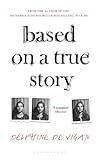
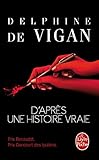
“D’apres une histoire vraie” by Delphine de Vigan – Interesting theme flogged to death?

This is my review of D’apres une histoire vraie by Delphine de Vigan.

Having written a fictionalised memoir of her bipolar mother’s life which ended in suicide, the award-winning author Delphine Le Vigan is well–placed to muse on the borders between reality, perceived truth and creative invention. In “D’Après une histoire vraie”, this theme is interwoven with the psychological drama of a vulnerable author finding her life being insidiously taken over by a charismatic but probably unstable individual who wants to go beyond being a ghost writer to control the life of a successful author. The inspiration for this comes at least in part from Stephen King’s novels, quotations from which, including “Misery”, at the beginning of each section give broad hints as to where matters are heading.

In giving the novel’s narrator her own name of Delphine, the author suggests a degree of autobiography, but although she herself may well have experienced a period of “writer’s block”, it is to be hoped that the bulk of the story is “made up”. Overwhelmed by the success of her novel revealing intimate family details, which has upset some relatives, bombarded at book signing sessions by fans whom she has given the confidence to unburden their own troubles, it is not surprising that the fictional Delphine is finding it impossible to write. With hindsight, she attributes her decline to the malign influence of her enigmatic friend “L” who at first seemed such a kindred spirit, so eager to help manage her life.

The tense, claustrophobic relationship rapidly established between Delphine and “L” is heightened by the absence of other characters. As regards Delphine’ family, this is conveniently explained by her childrens’ studies at distant colleges while her lover spends long periods on work projects in the States. While Delphine initially wants to write creative fiction, the ever more dominating “L” is determined that she should focus on real experiences, however painful, arguing that this is what people wish to read about and now expect from her. This seems a somewhat sterile argument over a false dichotomy, since apart from the facts that most fiction, however fanciful, is triggered by something “real”, and that people see reality very differently, it is inevitably altered through a writer’s descriptions and interpretations into a “form of fiction”. A book may claim to be “a true story”, but even when “inspired by real facts” may in practice be largely invented. The author makes this point several times, and to some extent shows it to be the case in the twists of the plot but this is not enough to carry the novel.

Although this book has been highly praised, neither the ideas about the nature of fiction, nor the psychological drama are handled with the the mind-bending subtlety for which I hoped. The decision to present a retrospective acount of events with indications of what was about to happen may feed a sense of “reality” but combined with excessive repetition makes for an often tedious read. Whenever the suspense does begin to ramp up, it tends to become rapidly over-melodramatic, collapsing all too predictably into disappointingly banal or even ludicrous explanations. Although the novel benefits from a twist towards the end, the author does not seem to know when to stop – the last two chapters in particular seem counterproductive.

This is a relatively easy read in French, with a clear style and many useful idioms and clichés for a student of French – also a good source of discussion for a book group.

I am tempted to see Polanski’s film on this, since I suspect that the director of “Rosemary’s Baby” will know how to create a real sense of menacing suspense, perhaps at the expense of the literary arguments.

⭐⭐⭐ 3 Stars

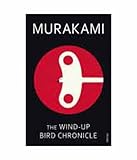
“The Wind-Up Bird Chronicle” by Haruki Murakami – A wind-up in all senses?

This is my review of The Wind-Up Bird Chronicle by Haruki Murakami.

Encouraged by his wife Kumiko’s willingness to support him, Toru Okada gives up his mundane job as a legal assistant to work out what he really wants to do. The quiet life of a “house husband” is punctuated with bizarre phone calls from strange women and encounters which lead to the spinning of some odd tales against the surreal background call of the wind-up bird. Toru’s most obvious trait is a remarkable passivity – possibly the author’s indictment of Japanese men in general. When Kumiko expresses her detestation of beef stir-fried with green peppers, Toru dumps the offending mixture in the garbage, not out of pique but pragmatically because it is not required. Yet the incident leads him to wonder if it is possible “for one human being to achieve perfect understanding of another”. If he will die without ever really knowing her, what is the point of a life confined to living together? His job-free existence gives him the freedom to philosophise in this way for the first time – a comment on the pressurised Japanese society of the 1990s.

Kumiko seems withdrawn, and may be unhappy or concealing something from Toru, as he admits he is doing in turn. Is he depressed, going a little mad, or utterly sane in stepping off the Japanese treadmill of hard work, conformity, keeping face, and pursuing a veneer of westernised culture underlain by oriental traditions. Before Kumiko was allowed to marry, for instance, she and Kumiko had to pay regular visits to a medium, to gain a favourable assessment from him. Similarly, Kumiko’s obnoxious brother consulted a clairvoyant on the whereabouts of her missing cat, named Noboru Wataya after him.

At first I was carried me along effortlessly, sucked in by Murakami’s plain, very readable style with a touch of wry humour which has been retained in Jay Rubin’s skilful translation. Then I began to sense that the interweaving of mundane daily life, unlikely events and implausible tales might simply trail away or prove to have no meaning, rather as one might define life in which one cannot be sure of reality, or of achieving outcomes which, if not satisfactory, are at least certain.

The repetition of domestic tasks, and recurrence of erotic dreams, began to bore me. I believe the translator has omitted some chapters and reordered others, which suggests a lack of editing, even self-indulgence on the part of the writer. Without knowing about the translator’s changes at the time, I had an increasing desire to skip pages, even reading the end to see if the book justified the effort of slogging through the 607 pages of the paperback version – both a bad sign.

I am ambivalent about this book. It has clearly become a “cult classic”, prompting widespread praise for its originality, surreal brilliance and philosophical insights. Yet, I cannot help suspecting it is simply an over-ambitious shambles which Murakami wrote for his own pleasure, with, of course, the added bonus of profit guaranteed by his fame.

⭐⭐⭐ 3 Stars

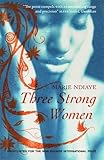
“Three Strong Women” by Marie NDiaye -Is originality enough?

This is my review of Three Strong Women by Marie NDiaye.

Set mainly in Senegal where the author’s father, absent from her infancy, was born, the novel’s three untitled sections of varied length are very tenuously linked – for instance Khady, who makes a brief appearance in the first part is cast as the main character of the final section, making the perilous attempted migration to a better life in Europe. Apart from Senegal and women who have been deserted or wronged by men, all the sections seem to have in common are originality in plot and style, with a frequent surreal, dreamlike quality.

In the first part Norah, qualified as a lawyer despite her upbringing in an impoverished single parent family, has responded to a mysterious summons to visit her father, who abandoned his family years before to make a fortune from running a Senegalese holiday village. He demands her help in representing Sony, the son he took with him when he left. Despite his intelligence and new-found wealth, Sony seems as damaged by past events as the mother and sisters from whom he was abruptly separated as a five-year-old.

At first, I was irritated by the long, complex, often repetitive sentences forming a stream of consciousness which requires intense concentration, plus the image of the father perched like a bird in the branches of the flamboyant tree growing by the porch is a little hard to take. My interest was caught when Norah begins to agonise over her relationship with the charming but irresponsible Jakob, berating herself for having allowed him to infiltrate her life. However, as with the drama involving Sony, none of this is ever fully developed. The denouement seems abrupt and ambiguous – perhaps it is the author’s intention to leave matters open to several interpretations.

In the middle section, it gradually emerges that the main protagonist, an incompetent kitchen salesman called Rudy, has been forced by a scandal to quit a teaching post in Dakar to return to France. His selfishness is apparent not only in his self-absorption, but also in misleading his Senegalese wife Fanta into thinking she will be able to teach in France. Her anger with him is symbolised by a menacing buzzard which continually haunts him: the author seems very keen on metaphorical birds.

Another obsession is with physical ailments: Norah is incontinent when embarrassed, Rudy suffers from piles and Khady is lamed by an injury too grave to heal without medical care.

The final part is the shortest, most conventional and best constructed of the three, but perhaps the bleakest in its theme of the exploitation of migrants, with the casually brutal treatment of women in particular.

Although there are some striking images in this book, the disconnected nature of the writing meant that I did not feel fully engaged with the characters. Nor was it clear to me in what ways Norah who seems to fall under her father’s spell, Fanta who makes so small an appearance, and Khady, buoyed up by the mantra-like sense of “being herself”, yet passively enduring the most appalling hardship, can be described first and foremost as “strong”.

The task of translating this unusual book seems particularly challenging, so it seems best read in the original French if possible.

⭐⭐⭐ 3 Stars

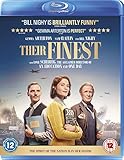
“Their Finest” [Blu-ray] [2017] – Morale under fire

This is my review of Their Finest [Blu-ray] [2017].

Although you may think that every possible angle on World War Two has been covered on screen, “Their Finest” builds an entertaining, humorous yet at times poignant drama round the to modern eyes corny but evocative propaganda films produced to raise morale.

Gemma Arterton plays “Mrs Cole”, the irrepressible young woman hired to churn out “slop”, or women’s parts in film scripts. She is soon involved in the major project of an “authentic and optimistic” film extolling the bravery of two Cornish sisters who use their father’s fishing boat to help evacuate soldiers from Dunkerque. There is a topical note in what proves to be the “fake news” which Catrin Cole artfully conceals, in an initial example of the steely determination beneath her demur demeanour. The job is made harder by continual government interference, such as the requirement for the film to include a major part for a real-life, highly decorated American serviceman, in a ploy to help lure the US into the war.

The film continually reminds us how much progress has been made in equality for women, as Catrin meets blatant chauvinism at every turn, not least the angry response of her husband, a struggling artist who feels humiliated at the thought of her paying the rent. In addition to the injustice of earning less because she is female, Catrin has to endure the dismissive contempt of Buckley, the arrogant young scriptwriter in residence, who grins maliciously as he watches her squeeze round furniture to reach her desk in a dark corner.

Bill Nighy steals the show as the impossibly vain, ageing actor, querulous over the lack of good parts after the past glory of his leading role in a popular detective series. Although it seems a little too slick at first, the dialogue sustains a witty pace. As Catrin wins the men over, this film could have descended into a bland, sentimental treatment of the last war, but some dark incidents, even if a little too coincidental, give the drama more depth.

⭐⭐⭐⭐ 4 Stars

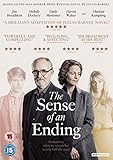
“The Sense of An Ending” [DVD] [2017] -When capturing a book on screen may prove harder than it seems

This is my review of The Sense of An Ending [DVD] [2017].

Amicably divorced, running a small camera shop as a retirement hobby, Tony Webster is jolted out of his superficially pleasant existence by an unexpected bequest from Sarah, mother of Veronica, the girlfriend from his student days. Memories come flooding back of his elitist secondary school where, in a clique of pretentious, precocious yet immature boys, he looked up to and befriended Adrian, the new boy who dared to spar intellectually with the teachers. He also has vivid recollections of Veronica, provocative but always holding back, and the excruciating visit to her wealthy but decidedly odd, perhaps emotionally warped family, not least her flirtatious mother.

What has become of Veronica over the decades? Why, as executor, has she destroyed Adrian’s diary, which is what the bequest proves to be? Why did Adrian commit suicide in his youth, and how did Sarah come by the diary anyway? What part did Tony play in all this, and to what extent is he to blame for any tragedy? Has a sense of unfinished business and his own culpability, real or imagined, for past events stunted his own emotions over the years, undermining his marriage and turning him into what his ex-wife and daughter describe as an old “curmudgeon”?

To the horror of his barrister ex-wife, who may even be a little jealous, Tony virtually stalks Veronica in his attempt to discover the truth, Even when he thinks he has found it, there is a further poignant twist.

Although true to the original plot, the Director felt the need to flesh out the details of Tony’s family life far more than in the original book. So, the birth of his daughter’s first child becomes one of the most moving points in the story, whereas it does not occur at all in the book. Similarly, the spiky but affectionate relations with his ex-wife are an entertaining aspect of the film but not the book. This may be because, without these embellishments, the book has a kind of detached, emotionally cool quality which may not make for “good box office”. What the book does possess, of course, is the distinctive, highly articulate, insightful, at times philosophical style which is what won it the Man Booker. Although the film tries to retain some of this by using Tony as a voice-over narrator at times, it obviously cannot capture all Julian Barnes’s wry wisdom.

I remember that the book was a page turner as regards finding out what happened, creating the sense of the need to reread it to get the full meaning, although this did not happen in my case because I felt “let down” over the denouement, which seems somewhat contrived. So, it is perhaps unsurprising if the film has the same flaw.

This film is essentially about the need for closure, which may become more urgent towards the end of our lives. It is well-acted, with Jim Broadbent as a sound anchor, but the storyline seems too undeveloped and fragmented in places, with some scenes, such as the classroom teaching, or encounters with Veronica’s family cringe-making in their falsity – although perhaps that is part of the point.

⭐⭐⭐ 3 Stars

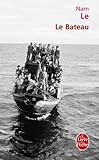
“Le Bateau” by Nam Le – Daring to fail

This is my review of Le Bateau (Litterature & Documents) by N Le.

Originality is the common theme in this collection of seven stories, varied in length, which range widely over different countries, cultures and themes, boldly shifting viewpoints by gender and age as if to “try them all out”.

The the last and most powerful story is “Le Bateau” which gives its name to the entire book Although the author Nam Le was only a baby when he made the perilous journey to Australia as one of the Vietnamese “boat people”, tales of this harrowing experience must have fed his vivid account of a young woman’s attempt to survive life on board as the ship is lashed by a storm and the stores of food and fresh water run out. She is befriended by a capricious woman, whose son, although disturbed by the effects of war, and possibly autistic, fascinates her and arouses in her a maternal love which the mother seems at times to lack.

This and the first story struck me as the most authentic and well-structured, perhaps because they are connected to the family culture and history with which Nam Le identifies, despite his absorption into life in Australia and the US. With its indigestibly long title “Love, honour, pity, pride, compassion, sacrifice, the opening story has aspects of autobiography in describing a young writer struggling to meet deadlines, ambivalent as to whether he should focus on “ethnic literature” to earn money. His dilemma is increased by the ethical question of whether he should use as a theme his father’s experience of a massacre at the hands of brutalised American GIs. Even if the older man is prepared to recall it in detail to iron out the “errors” in his son’s story, does that mean he is prepared to see it sold and read by westerners who will soon forget it? Although the ambiguous ending feels like a let-down at first, on reflection it is interesting to debate the various interpretations one can make.

Nam Le’s upbringing in Australia may have given a particular genuine and moving quality to the almost novella-length “Halfhead Bay”, in which teenage Jamie steels himself to face up to the school bully Dory after daring to make a play for his girlfriend. Should he be protected from Dory’s fists so that he can once again strike a winning goal for the school team, or for the sake of his dying mother? The subtle and complex “coming of age” drama takes place in the context of a family’s inability to face up to the reality of a crisis.

Despite the varied themes, the essential style remains the same. Each story develops gradually, so that the reader has to work out what it going on, and it is impossible to predict the outcome. Heavy use is made of flashbacks, which sometimes disrupt the narrative flow, although they could also be said to reflect the way the mind works, drifting back to past events triggered by experiences of the present, or perhaps as an escape from it. Nam Le creates some fascinating dilemmas, as when a young gangster is ordered to kill a friend to save his own life. He knows how to create page-turning tension, but the endings are often disappointing, an abrupt anti-climax. “Tehran calling” was so nebulous as to leave me completely unengaged.

Overall, Nam Le is a gifted writer, with a plain, clear style which draws one in. It is an effective vehicle for conveying subtle nuances in people’s relationships with each other, and descriptions filled with vividly striking images.

I agree with reviewers who feel that he is better at writing prose than structuring a short story. Each one is mined from a rich enough seam to fuel a full-length novel. He reminds me somewhat of Alice Munro’s short stories with their deceptively simple prose and sometimes meandering, unpredictable storyline.

I read these short stories in the French translation, which I would not recommend since the original English seems more suited to Nam Le’s style.

⭐⭐⭐⭐ 4 Stars

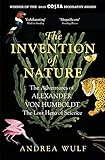
“The Invention of Nature: The Adventures of Alexander von Humboldt, the Lost Hero of Science”: Costa & Royal Society Prize Winner by Andrea Wulf – Could any book do greater justice to its subject than this?

This is my review of The Invention of Nature: The Adventures of Alexander von Humboldt, the Lost Hero of Science: Costa & Royal Society Prize Winner by Andrea Wulf.

It is hard to think of a more impressive book than this – gripping, entertaining and informative as the author marshalls with great skill a mass of facts and ideas.

Although largely forgotten now, with his unflagging energy and curiosity, Humboldt achieved widespread fame during his long life (1769-1859) as a traveller, explorer and writer. Fortunate to have been born before it was necessary to be a specialist, Humboldt was influenced by Goethe to view the world as a unified whole, consisting of multiple interactions. Although, as a scientist, he continued to believe in the importance of close observation and precise measurement in understanding the world, he also grasped the need for imagination. “Nature must be experienced through feeling” and those who limit themselves to the simple classification of plants, animals and rocks “will never get close to it”.

Humboldt was a visionary thinker, ahead of his time. He suggested that creatures had evolved years before Darwin, in turn inspired by Humboldt’s writing, began to think about natural selection. He conceived the idea of an ecosystem, or groups of organisms coexisting in the same environment, decades before another disciple, Haeckel, coined the term “ecology”. Always looking for patterns, Humboldt was quick to notice how plants seemed to differ according to climate, in turn linked to latitude. In the same way, mountains, like the dramatic snow-topped Chimborazo which he climbed in Ecuador, demonstrated predictable zones of vegetation according to altitude, ranging from the tropical palms of the lowland, through the oaks and ferns of temperate climates up to the barren surfaces above the treeline. Through observation, he developed ideas of human-induced climatic change, as in the case of excessive clearing of forests in both Europe and South America. He even invented isotherms.

He realised that the nocturnal outbreaks of cacophony in the South American forests were not, as the natives claimed, the animals’ way of worshipping the moon, but “a long-extended and ever-amplifying battle” as the jaguars chased the tapirs, whose flight scared the monkeys, who disturbed the birds” and so on.

Unable to travel outside Europe before gaining his inheritance at the age of about thirty, Humboldt found the added difficulty of obtaining passage on a suitable vessel when most ships were needed for the Napoleonic wars. Then there was the further risk of being attacked by British warships when he eventually sailed to the South American colonies on a Spanish frigate.

His jouneys were full of bizarre incidents: the natives of the South American Llanos drove a herd of wild horses into a pond to drive up to the surface the electric eels that he was keen to study. Not only did some of the horses perish, but Humboldt and his colleagues made themselves ill from the shocks which could still be generated by the weakened eels. Years later on a trip to Russia, in defiance of the authoritarian government which sought to control his movements, Humboldt took his party on a 2000-mile detour at lightning speed to see the Altai Mountains where Russia, China and Mongolia meet. When their route was blocked by a major outbreak of anthrax, the ruthless Humboldt simply stocked up with uncontaminated food, and dashed through the affected area with all the carriage windows closed.

In the quarter-century gap between a five year odyssey in South America, often totally cut off from events in Europe and his visit to Russia, it is initially surprising to realise that he spent much of the time in Paris, which he loved for its cultural opportunities, or serving through gritted teeth at the court of the King of Prussia, where he disparaged Berlin as “little, illiterate and over-spiteful”. Yet he was far from idle, being prolific in writing detailed, often richly illustrated books about his journeys and ideas on nature in relation to man, lecturing and corresponding with other scientists and thinkers. Having impoverished himself through his travels, publications and supporting young scientists, he was forced to endure a tedious court post humouring the king, when his preference was for democracy, along with his condemnation of slavery.

He longed to travel to India, but was blocked by the all-powerful East India Company’s refusal to grant permission for this, despite his fame.

This is not merely the biography of a hyper-active, charismatic, workaholic genius, liberal-minded, often generous, yet sharp-tongued and dominating conversations in his unconscious assumption of superior knowledge, even talking over a piano specially played for his benefit, only to astound students by quietly taking notes alongside them when he knew there was something new to learn in chemistry or geology.

The final chapters also cover some of the gifted environmentalists who were inspired by him, such as George Perkins Marsh who in “Man and Nature” assembled comprehensive evidence of the destruction of the earth by human activity. “The Old World had to be the New World’s cautionary tale”. But, with the 1862 Homesteads Act which gave every loyal American over 21 the right to 160 acres, how could the march of change be prevented? Another example is John Muir, who set up the Sierra Club, now the largest grassroots environmental organisation in the US, and who was responsible for the establishment of the Yosemite National Park.

This is a fascinating book to encourage others to read, and return to again.

⭐⭐⭐⭐⭐ 5 Stars

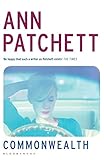
“Commonwealth” by Ann Patchett -Family fate

This is my review of Commonwealth by Ann Patchett.

When LA cop Fig admits uninvited guest Bert Cousins to his daughter Franny’s christening party, little does he realise that this will trigger the break-up of his marriage to the beautiful blonde Beverley. One cannot know to what extent this is autobiographical, but Ann Patchett’s personal experience of parental divorce and remarriage leading to the sudden acquisition of step-siblings and enforced living with strangers must provide plenty of material to develop this aspect of domestic drama. A further twist is Franny’s eventual marriage to a famous writer who sees the potential of her family story to create a bestselling novel, leading to further reactions of hostility, resentment or guilt over the exploitation of family members.

I was hooked by the kaleidoscopic impressions of the first chapter, as the party begins to spin out of control under the influence of Bert’s inappropriate gift of a large bottle of gin, inevitably prompting the opening of others. I could appreciate the author’s much-praised gift for using small often banal incidents to reveal much about situations and characters, seen from different points of view.

The nine chapters, some quite lengthy, may seem like linked short stories, relying heavily on flashbacks to reveal the chain of events, including a tragedy with the power to destroy the family. I regret that in the second chapter, I felt an abrupt loss of engagement. This is partly due to the grim setting of a cancer ward where Fig is to be found receiving chemotherapy, accompanied by an adult Franny. I was continuously distracted trying to work out how many decades have passed since the christening in 1964. The flitting sequence of reminiscences and thoughts felt quite contrived, a device for filling the reader in, but it is hard to keep track of all the characters mentioned – which of these have we already heard about or met in Chapter 1? It is disconcerting, for instance, to find that Albie, not yet born in Chapter 1, has become a delinquent arsonist, while Bert and Beverley have divorced before one knew for sure they had ever married. It is hard to relate to comments and anecdotes about characters before they have been clearly established in a story.

What seems like a promising theme therefore comes across as a bit of a mess in its execution. I wanted to like the novel, but too often found it boring and “spread too thinly” across an excessive number of largely underdeveloped characters. To be fair, perhaps the fact I had just read the exceptional “The Invention of Nature” made me set the bar too high, meaning I was not in the mood to make the effort to connect with this novel. I certainly admire the author’s desire to broach diverse, complex topics from different angles, having read “Bel Canto” , inspired by the hostage-taking of the President of Peru, where she explores the views of both terrorists and captives, revolving round the charismatic persona of the opera singer who is one of the prisoners. Very different again was “State of Wonder” in which a pharmaceutical researcher braves the remote Amazonian rainforest to discover what happened to her lover who had gone to work there.

In short, this is a book which divides opinion and promotes discussion.

⭐⭐⭐ 3 Stars

“Prisoners of Geography: Ten Maps That Tell You Everything You Need to Know About Global Politics” by Tim Marshall -Prisoners of hype and soundbite


This is my review of Prisoners of Geography: Ten Maps That Tell You Everything You Need to Know About Global Politics by Tim Marshall.

The “bestseller” status of this book suggests a widespread desire to make sense of a troubled world without having to invest too much time in this. A paperback compact enough to read easily on a commuter train, which takes less than three hundred pages to divide the world neatly into ten major areas (with the odd omission of Australia and New Zealand), each covered in a freestanding chapter, seems like a relatively easy, painless means of getting up to speed.

So why, despite the undeniably fascinating subject matter, did I find this book so hard to read? It is partly because the “unifying theme” of “prisoners of geography” proves so woolly when applied to such “broad brush” chapters. The author continually refers to physical geography to explain differences between areas – why some have prospered while others are poverty-stricken, some stable while others are torn apart by conflict, some fragmented while others united, but many of his statements are open to challenge as being fatuous or contradictory. He cannot avoid slipping into the historical and cultural factors which affect global politics, and often they seem to outweigh geography in their influence. The term “prisoners” also seems a misnomer in more prosperous parts of the world like the US which he is adamant remains “the planet’s most successful country” without addressing its high levels of inequality, some of which are the result of geography.

So, because the book is so wide-ranging, it becomes oversimplified to the point of distorting facts, and arbitrary as regards the points selected so that important factors are omitted or not given due weight. Too often, the author drifts into a dry recital of facts, with a lack of analysis, which he has to lighten up with verbal gimmicks: “How do you solve a problem like Korea?”

“The ten maps that tell you everything you need to know about global politics” prove to be nothing of the kind: just location maps to remind you where the countries covered by a chapter are. Also, why does the untitled map of Western Europe include an undifferentiated Eastern Europe, and why does the latter receive so little coverage as an area in which people have been affected so much over the centuries by their geographical location?

Journalists often make a better job of explaining a country or region than specialists, because they do not get bogged down in detail, and know how to present information and ideas in an accessible way. An example of this is Martin Sixsmith’s recent “Russia: A 1000-Year Chronicle of the Wild West”. The problem with “Prisoners of Geography” is that it is too superficial, and does not have a sufficiently coherent theme or framework to hold a wide-ranging approach together. This book has been well-promoted, but is in fact much less insightful and enlightening than it could have been.

⭐⭐⭐ 3 Stars

“Chaleur du sang” by Irene Nemirovsky -Writing full of poignant insight puts others in the shade

This is my review of Chaleur du sang (Collection Folio) by Irene Nemirovsky.

After years of wandering in exotic places, dissipating his inheritance on unsuccessful schemes which leave him unable to repay debts to his kindly relatives Hélène and François, and forced to sell land to the miserly old Duclos who has married the young, penniless possible gold-digger Brigitte, Silvio has returned to his home village of Issy-L’Évêque in Burgundy, where the author herself once lived briefly in the 1930s.

Observing the world with a shrewd and cynical detachment, Silvio suspects that Colette, the vivacious young daughter of Helene and François may regret her marriage to Jean, the sensitive young miller. When Jean is found drowned after an inexplicable accident, a chain of events is set in motion, revealing the passions which lie beneath the surface of a closed, conservative community whose members maintain a rock-like solidarity to suppress any whiff of scandal: keeping up appearances, guarding one’s privacy and leading a quiet life are more powerful driving forces than admitting the truth and ensuring that justice is done.

This short novel hooked me from the first page. It is a psychological drama written with great clarity, which I believe has been retained in the English version. Irene Némirovsky is remarkable both for her insight into human nature and her acute sense of culture and place. Without having experienced life in a French village, one is convinced of the truth of her perceptions, as when Silvio describes how the bourgeoisie, from which he comes do not stand out from the ordinary people in their attitudes, working their land and not giving a fig about anyone else. Living behind their triple-locked doors, their drawing rooms may be stuffed with furniture, but they live in the kitchen to save on fuel. In another evocative scene, Silvio captures the beauty of nightfall – the subtle change and reduction in colours, “ne laissant qu’une nuance intermédiaire entre le gris de perle et le gris de fer”. But all the outlines are perfectly sharp: the cherry trees, the little low wall, the forest and the cat’s head as it plays between his feet and bites his shoe.

Laden with nostalgia, the story contrasts mature, companionable love with “the fire in the blood” of youthful passion, posing the question as to which of these states is more “real”, and necessary for us to have lived to the full. How often does love make us lie to each other, and delude ourselves? When reminded in old age of past passions, how can we deal with feelings of regret and jealousy.

It was neither the somewhat stereotyped characters nor some contrived incidents that disappointed me initially, but rather the abrupt and unexpected ending. However, since the novel was not discovered until 2007, decades after the author’s tragic death in Auschwitz which denied her the opportunity to edit and complete it, we should be thankful that it survived at all and be impressed that what is probably a “first draft” should be so well-written and tightly structured, and have the power to absorb and move us so strongly. Also, the ambiguity of the last sentence leaves us free to speculate on the final outcome, on what the author intended to write next and adds to the sense that we may never fully know and understand each other in our complex and fluid emotions.

⭐⭐⭐⭐ 4 Stars