Le Premier Homme

This is my review of  “Le Premier Homme” by Albert Camus .

When forty-year-old Jacques visits his father’s grave, he is taken aback by the realisation that he was only twenty-nine, far younger than his son is now, when killed in the First World War. The compulsion to find out more about his father takes Jacques back to Algiers where he was brought up, but the visit fails to provide many clues as to what his parent was really like. Jacques realises that he will never know his father, who will remain a mystery resulting from his poverty, being one of the anonymous masses despatched in waves to develop North African territory between the sea and the vast expanses of desert. So Jacques must be self-sufficient, “le premier homme”, learning to grow up without a sense of roots and recollections from the past.

The book develops as a moving account of Jacques’ childhood in a close-knit but impoverished family, starved of opportunity, lacking books, newspapers, even a radio, too busy in the struggle to survive to communicate much or reflect life. He craves the affection of his widowed mother who is clearly proud of him, but cannot express her emotions. Isolated by her deafness and illiteracy which means she can only earn a living as a cleaner and washerwoman, the nearest she gets to escape is to sit by the window, watching the world go by. A brief attempt at romance is destroyed when her brother beats up the suitor who threatens the family unit. Jacques’ formidable grandmother’s belief in character- building includes sending him out at the night to catch a chicken in the coop before forcing him to watch its execution. At thirteen, he is denied the pleasures of roaming free in his summer holidays by her insistence on his earning money in the accounts office of a hardware store.

At first I was disappointed to find that this fictionalised autobiography of Albert Camus, in which he sometimes reverts to the characters’ original names, is incomplete – an unedited stream of conscience found at the scene of his fatal car crash, a draft which so dissatisfied him that he intended to burn it. My initial impressions were of a disjointed, often banal and indigestible read, with long sentences in interminable paragraphs of I counted up to eight pages.

I became hooked at the point where Jacques is taken under the wing of primary school teacher M. Bernard, the father figure when he needed one, who sees the boy’s potential and goes out of his way to prepare him for the entrance exam for the lycée, his escape route from a life of grinding poverty, not to mention charming the boy’s grandmother into letting him continue his studies when he could be contributing to the family’s meagre earnings. It is fascinating to see how schools have changed: overhearing Jacques called a “teacher’s pet”, M.Bernard readily admits this, announcing it is the least he can do for comrades killed in the war to favour one of their deserving offspring. When, as honour among pupils requires, Jacques beats up the boy who has mocked him, and the parents complain, Jacques is mortified to be forced to stand in the corner of the school yard for a week with his back to the ball games he loves. M. Bernard sidles up and gives him permission to look across to where the other boy is being punished in the same way.

There are wonderful descriptions of the oppressive, prolonged heat of Algiers in the long summer months, suggesting the germ of the idea for “L’Étranger”, or the joys of childhood, as when Jacques brandishes a palm branch to revel in the feeling of the wind vibrating through his body. A recurring background theme is the effect of colonisation where a centralised French cultural curriculum is imposed without any concessions, together with the uneasy relationship between Arabs and residents of French origin. Also, Jacques’ intense introspection, examining issues from all angles foreshadows Camus’s philosophical writing in later life, as in “La Chute”. In short, this book is not only a vivid portrayal of the life of a bright but emotionally repressed boy in a poverty-stricken but close-knit family, but also a key to the literary works which brought the author fame and criticism.

It repays rereading to tease out the mass of insights and ideas. Invaluable for any student of Camus and his work, the power of its spontaneous flow compensates to some extent for the lack of editing.

Le Grand Meaulnes – Caught between dream and reality

This is a review of “Le Grand Meaulnes” by Alain-Fournier

Some of the cult status of this classic must stem from the poignancy of the author’s death at the outset of the First World War, aged only twenty-seven.

The autobiographical aspects are spread between the two main protagonists. The narrator François Seurel is, like Alain-Fournier, the son of teachers in rural Solonge. Augustin Meaulnes, the charismatic, shambling, undisciplined youth awash with adolescent hormones who falls obsessively in love with Yvonne de Galais, the young woman he has met only briefly in a remote country estate to which he is subsequently unable to find his way back, mirrors Alain-Fournier’s fateful chance meeting in Paris with the “young woman of his dreams” who was to haunt him for the rest of his life. Alain-Fournier’s additional troubled liaison with another young woman, a seamstress living in Bourges, portrayed as a bleak place in comparison with the magical estate, also provides material for Meaulnes’s later escapades, and a contrast to the purity of his idealised relationship with Yvonne. .

“Le Grand Meaulnes” is often cited as the ultimate novel on adolescence, the irony being that the generations of teenagers reading it at school will probably not appreciate this at the time. As a pre-boyfriend girl with no brothers, I could not understand Meaulnes at all. Forty plus years on, I recognise at once the truth of his moody, restless nature, continually testing boundaries, quite beyond the capacity of schoolmaster Seurel to control, so he simply resorts to overlooking Meaulnes’s misdemeanours. Meaulnes brings excitement into the dull, lonely life of the much more sensible and considerate François. Yet Meaulnes in turn suffers from the even greater follies and fantasies of Yvonne’s over-indulged, unstable brother Frantz. Meaulnes is self-absorbed, in love with the idea of being in love rather than with a real person, bound by a sense of honour without being able to see how this may hurt the one he claims to love the most.

When obliged to read this for A Level, I found it intolerably sentimental, wallowing in romanticism, perhaps an inevitable postscript to the style which dominated the C19. Decades on, I am still irritated by the continual implausible coincidences and improbable plot contrivances, although these may seem permissible in what amounts to a fairy tale grounded in the reality of French rural life which itself was about to be disturbed by a major war, and destroyed by C20 change. Yet I also now appreciate the poetic clarity and exquisite fluidity of the writing, the vivid evocation of the countryside and the simple, at the time no doubt seemingly unchangeable, long vanished way of life. Alain-Fournier has succeeded in his desire to create a dreamlike quality, particularly evident during the fateful wedding party which Meaulnes gatecrashes by chance at the mysterious estate .

Recommended to read in French, perhaps a little disappointing in English.

Keep the Aspidistra Flying: Look back in anger 1930s style

This is my review of  “Keep the Aspidistra Flying” by George Orwell

Since history repeats itself, Orwell’s caustic parody of capitalism in 1930s London still seems remarkably relevant in our post-financial crisis, commercially manipulative world of making people want things and often paying them too little to produce them.

Orwell’s anti-hero Gordon Comstock is not just trying to escape the clutches of what he calls “the money god” but is also a mouthpiece for the author’s own pet hats and self-doubt over his ability to succeed as a writer. In the first chapter which could stand as a short story in this own right, Gordon painfully perfects the first verse of a poem during a boring shift in a bookshop, in between raging at the adverts in the street which remind him of the better paid job in copywriting which he has abandoned on principle to get out of what he regards as a corrupt system. He despises most books on sale for being “turned out by wretched hacks at the rate of four a year, as mechanically as sausages and with much less skill.” With only twopence halfpenny left until the end of the week, not enough for the cigarettes he needs – like Orwell? – to be able to write, he is beginning to realise that “you do not escape from money by being moneyless. On the contrary, you are the hopeless slave of money until you have enough of it to live on”.

Gordon is frankly rather tedious and unlikeable in his negative view of the world and borderline mentally ill in his desire “to lose himself in smoke-dim slums of South London sprawling on and on, a huge graceless wilderness… great sluttish underworld where failure and success have no meaning; a sort of kingdom of ghosts where all are equal.” Yet it is revealing to be transported back to the 1930s, beginning to emerge from a deep Depression, with the poignant wisdom of hindsight that the destructive war which Gordon claims to welcome is in fact imminent.

People tolerate appalling bedsits with repressive landladies, but expect to receive in the evenings letters posted earlier in the day. It’s a remarkably cheap world to modern eyes, where Gordon can take his girlfriend Rosemary on a trip to the country for only fourteen shillings (seventy pence). But it’s also riddled with social divides and casually-voiced prejudices that make us wince: Gordon comes from one of “those depressing families, so common among the middle-middle class, in which nothing ever happens”; his landlady is obsessed with “mingy lower-middle-class decency”; a poverty-stricken old couple, in a society with no proper pension system, are “the throw-outs of the money-god. All over London, by tens of thousands, draggled old beasts of that description: creeping like unclean beetles to the grave”.

Gordon’s upper class friend Ravelston is unusual that “in every moment of his life” he is “apologizing, tacitly, for the largeness of his income” but still adores his girlfriend Hermione who remarks, “Don’t talk to me about the lower classes….. I hate them. They smell”. As narrator, Orwell often seems guilty of unconscious flashes of snobbery and prejudice – anti-semitic comments or cruelly amusing descriptions of a dwarf, but all this seems part of what was acceptable at the time. Ironically, advertising of specific brands, mention of real people or companies and “alleged obscenities” all had to be edited out at the last minute, leading Orwell to resist reprinting of a book he felt had been “garbled”.

There is in fact a good deal of humour in the book, not least in the aspidistras, symbols of “lower class decency” which refuse all Gordon’s efforts to kill them off. When Gordon stops moaning there are some striking descriptions: “the mist-dimmed hedges wore that strange purplish brown, the colour of brown madder, that naked brushwood takes on in winter.”

Apart from hoping that the likeable Ravelston and Rosemary might “get together”, there is the impetus to find out whether the book will end in tragedy or something will make Gordon surrender to “the money-code”.

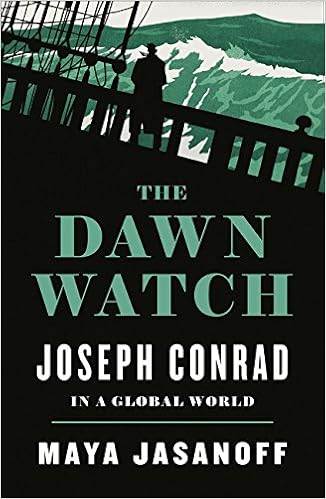
The Dawn Watch: When fiction trumps history?

This is my review of The Dawn Watch by Maya Jasanoff.

Beneath Maya Jasanoff’s breezy style, stuffing cash into her shoes for safety as she retraces Joseph Conrad’s route along the River Congo, lies a perceptive portrayal of “what made the writer tick”, although of course we can never really know. She succeeds in distilling from clearly thorough research a telling selection of incidents, quotations, and her own insightful conclusions in a biography of only 315 pages, rather than the ever more frequent 800 plus page doorstopper.

It is unnecessary to have read much Conrad to be fascinated by him: the author admits to having struggled to read what some regard as his work of genius, “Nostromo”, and what most struck me when first reading Conrad is his remarkably fluent grasp of the English language, which he only began to learn when he went to sea as a young man.

What is really interesting about Conrad is his acute observation of human nature in a changing world where the romantic hardship of sail was giving way to the more profitable transport by steam, while European powers and the United States vied for control of resources in “less developed” areas, bringing the hell of exploitation, destruction and corruption with their good intentions to establish Christian culture, education, law and order. Maya Jasanoff finds in his life and fiction, “a history of globalisation seen from the inside out”, a grappling with “the ramifications of living in a global world”.

Conrad’s cynical, questioning approach must have been shaped by the hardship of early childhood in the exile to which his Polish parents, members of the landed gentry, were sentenced for his idealistic and unworldly father’s political activism against Russian domination. Yet it was typical of Conrad’s contradictions that years later he refused to sign the petition against the execution of his onetime colleague the Irishman Roger Casement for his part in the Easter Rising: “by emotional force he has made his way and sheer emotionalism has undone him”.

Being orphaned very young, a solitary only child with no stable home, may have triggered Conrad’s wanderlust, the desire to get as far possible from landlocked eastern Europe onto the open sea. Perhaps because his father had been a writer who taught him reams of patriotic Polish poetry, he developed the motivation to jot down stories about places “beyond the end of telegraph cables and mail-boat lines”…”among human outcasts such as one finds in the lost corners of the world”.

Since Maya Jasanoff is a historian rather than a literary biographer, her main interest is in how he dealt with “the moral and material impact of dislocation, the tension and opportunity of multi-ethnic societies, the disruption wrought by technical change”, with only passing reference to his writing style or any real literary evaluation of his work. Two interesting maps, which could have been superimposed, show the clear overlap between the far-flung countries he visited as a seaman and the settings for his novels: five months spent as captain of a steamship on the Congo inspired “Heart of Darkness”; service as first mate of the steamer Vidar plying between the ports of Borneo and Sulawesi led to “Lord Jim”. Yet, “Nostromo”, set in the imaginary South American republic of Costaguano, was based totally on the knowledge of an obliging friend.

Conrad was a man of strong opinions: although his son only once saw him pray over his own father’s grave, Conrad believed that “even the freest” is to some degree hemmed in by “fate”. Sickened by the fact that his later work, which he regarded as “second rate efforts”, which are no longer read, earned him so much more than such works as “Heart of Darkness”, he refused honorary degrees or a knighthood, but would have valued the reward of the international Nobel Prize, which was never offered. Even his humour was caustic: in his final years of belated fame after years of struggling as a writer, he remarked that Esperanto was “a monstrous jargon” but people could translate his work into it if they so wished.

Despite the earnest bleakness of much of his work, his periods of depression as a struggling middle-aged writer and his frequent illnesses, he clearly possessed a charm which drew a wide circle of friends, including well-known authors. After years of desultory flirting on shore-leave with attractive, highly respectable young women, and an intriguing correspondence with a widowed aunt only a few years his senior, he married a “to tell the truth rather plain” teenage typist called Jessie, perhaps as ever shrewdly realising how she could support him on a practical and emotional level – yet he clearly developed a strong affection for her to the end.

Minor criticisms: most of the historical maps included are too small-scale to be legible, the evocative photos embedded in the text would have been better if larger. Maya Jasanoff’s long, somewhat clunky resumés of Conrad’s better known works seem like padding, questionable since they include too many “spoilers” for those wishing to go on to read them. Although the chapters are mainly in chronological order, the thematic approach fragments Conrad’s life story so that a time-line would be useful. Despite all these reservations, this is an absorbing and very readable treatment of a complex and interesting man, flawed yet impressive.


Mountain: In thrall to indifferent mountains

This is my review of Mountain directed by Jennifer Peedom.

Stunning photography – was it made with the aid of drones or intrepid helicopter pilots? – reveals the stark beauty and vast scale and complexity of landscapes most of us will never be able to see close at hand. Time lapse photography to show clouds moving to obscure huge peaks, the plethora of stars in a night sky free from pollution, white valleys rising and falling as the snow builds up and melts, add dynamism to landscapes we may previously only have seen in static pictures. Suddenly one realises that two dots in a vast expanse of ice are in fact human- mountaineers planning an ascent. Then, with nail-biting tension, we see rock climbers high up on sheer faces, hands bare as they feel for invisible finger-holds, apparently unroped and alone. Footage of skiers weaving down near vertical slopes through trees, or surfing avalanches; mountain bikers hurtling along narrow winding ridges hundreds of feet above rocky valley floors; a tight-rope walker suspended between two pinnacles above a void, all capture the addiction to the adrenalin rush which must drive some to risk their lives for an experience which they cannot really share with the “normal world” from which they must feel disconnected on their return to it.

Accompanied by some freshly composed atmospheric music and beautiful classical pieces, Dafoe’s commentary – sometimes needlessly overblown – traces the short history of mountaineering, since for centuries local people treated high places as the land of gods and devils, to be avoided by ordinary mortals. We see clips of some of the intrepid C19 travellers who began to explore the mountains, totally under-equipped by our standards. The ascent of Everest triggered the growing stream of climbers, assisted by technical aids, often swinging from their belts like a kind of ceremonial metallic skirt, who now form a snail-pace queue up to the world’s highest peak.

This film is a totally absorbing work of art, with many memorable scenes and will appeal not only to mountaineers but people like me who are terrified of the idea of climbing but fascinated by the scenery and why people risk their lives in this pursuit. Yet I agree with the reviewer who would have liked more information on the location of the shots with a little cultural detail e.g. on prayer wheels and flags, explanation of some of the equipment used, the identity of some of the historical characters and events shown. As it is, the film assumes perhaps a little too much prior knowledge.

⭐⭐⭐⭐ 4 Stars

Les Parisiennes: How the Women of Paris Lived Loved and Died in the 1940s – Less would be more

This is my review of Les Parisiennes: How the Women of Paris Lived, Loved and Died in the 1940s by Anne Sebba.

Although much has been written about France under German occupation in the 1940s, “Les Parisiennes” takes a fresh angle on how women in particular were affected, describing the part they played in resistance, collaboration, or simply “getting on with life”.

The book is thoroughly researched with a six page “cast of characters” at the front, detailed notes on each chapter and an extensive bibliography at the end. However, I felt bludgeoned by the unrelenting spate of prose, since the basically chronological approach not only flits breathlessly between characters, but keeps digressing into a flood of often gossipy and gushing details or condensed potted biographies which seem of only marginal relevance.

Perhaps inevitably in view of the author’s interest in fashion, there is a clear preoccupation with the wealthy and glamorous who could afford to patronise the fashion houses which managed to flourish under Nazi rule. I suppose it is mildly interesting that gas mask holders were made into fashion items (but for how many women?) or that designer clothes had to be purchased under a “couture ration card” system with Balenciaga forced to close for exceeding the quota of seventy-five outfits (a year?) imposed to ration the amount of fabric used. It is made to sound like “a good thing” that of the 20,000 passes issued to attend fashion shows during the Occupation, only 200 were given to the wives of German officers, but weren’t the French women who attended to some extent collaborating? There is too much emphasis on people having a good time when for others basic food was in short supply and Jews were being dragged off by French police to the Vel d’Hiv (Vélodrome d’Hiver) en route for concentration camps. Also, can one really believe the example of so called “refugee-chic” in the tale of a woman fleeing from the fall of Paris who left her vehicle in search of petrol to remove the nail varnish which did not match the colour of her hat? Wouldn’t she have worried more about the smell and risk of catching fire?

The effect of this emphasis on celebrities and the privileged, is to trivialise events and create a sense of unease over being compromised oneself as a reader. In just one paragraph, we are told how “by the end of the forties”, the Marshall Plan had improved conditions, but not exactly how, except that a New Yorker journalist’s “Parisian friends had stopped griping about the black market (which they could presumably afford).. but are back to discussing passionately….the heady mysteries of La Grande Cuisine which, next to women, has always been their favourite topic of conversation”. The paragraph ends as follows. “Not only were the Parisians eating well again, but Wallis, Duchess of Windsor and her friends were buying jewels and couture clothes once more.”

If this book is best read by “dipping in and out”, there is the danger of missing some of the best passages, as in the chapter “Paris Returns” on the immediate aftermath of war, which actually includes some analysis, such as whether the death penalty was too harsh for the anti-semitic literary critic Brassilach (who gets very little mention elsewhere in the book, much less than Wallis Simpson). Simone De Beauvoir supported the punishment, perhaps swayed by De Gaulle’s view that “in literature as in everything, talent confers responsibility” but Anne Sebba points out with uncharacteristic tartness that De Beauvoir was also complicit, having claimed to be an anti-Nazi whilst eating well because her lover’s mother Jean-Paul Sartre took pains to obtain the best black-market foods. There is effective coverage on the practical problems of returning from the hell of the concentration camps and the guilt of those who came back alive: as a memoir recalled seventy years later, “”to survive it was necessary to destroy memory”. The author also considers the complicated relationship between the women who risked their lives in the resistance and were later rewarded as heroines, and those like the equally courageous Simone Veil who felt great bitterness over the lack of recognition of her suffering as a victim, deported to the camps.

Yet overall I was disappointed by the oppressive weight of excessive detail and too often superficial approach to a potentially fascinating subject matter – but the photographs are evocative.

⭐⭐⭐ 3 Stars


IYUTtech Hair Styler Professional Hot Round Brush and Hair Curling Wand Styling and Massage Tool (Black).Compact for travel

This is my review of IYUTtech Hair Styler Professional Hot Round Brush and Hair Curling Wand Styling and Massage Tool (Black).

Compact for travel but does take longer to heat up than I expected – then have to be careful not to scorch hair because too hot. I would prefer a styler which emits hot air, but could not find this feature in a heated travel brush.

⭐⭐⭐ 3 Stars

Happy End – Heartless in Calais

This is my review of Happy End [DVD].

One often hears of the minutes if not hours of film discarded on the cutting room floor to extract the essence of what the director aims to convey. In this case, it is as if Michael Haneke has perversely challenged us to make sense of a film largely constructed from the shots which would normally be edited out. We hear about a character taking an overdose, crashing a car, even dying, but rarely witness these dramatic incidents. Often we do not realise that we have seen a significant event until its effect becomes apparent later. The scenes of glacial slowness, require great concentration, not only because they are mostly in French with subtitles, but also because one is continually trying not to miss the vital piece of action which may in fact not occur in a situation where basically not much is happening.

Despite its bleak theme, which appears to be the director’s stock in trade, the ironically-titled “Happy Ending” is leavened by moments of dark humour and has the ingredients for a gripping and moving psychological study of how we may damage each other. It involves the Calais–based Laurent family, their wealth made from the construction industry and other businesses, who all follow the bourgeois conventions of polite society in public, but seem incapable of real warmth, natural affection and normal emotion in private. They live out their dysfunctional relationships against the background of the impoverished black migrants who haunt the port town.

We initially experience their formal bourgeois life from the viewpoint of the approaching teen-age Eve Laurent who receives a somewhat reluctant welcome when she comes to stay in the extended family home with her father Edward, after her mother, his ex-wife, takes a lethal overdose of antidepressants. Eve appears outwardly to be an innocent, sensitive young girl, but from the outset there are signs of a troubling darker side to her character, leading one to speculate to what extent she may have been damaged by her self-absorbed parents’ neglect, or possibly inherited some of the family’s less appealing personality traits.

There is a cast to raise expectations high, with Jean-Louis Trintignant in the role of patriarch sinking into senility, from which he seeks to escape through suicide – unless he can find someone prepared to put him out of his misery– and Isabelle Huppert as his ambitious daughter Anne who is romantically involved with her British lawyer, played by Toby Jones. Anne’s important business deals are undermined by a serious accident on a building site for which her son Pierre may be to blame. Rejecting his mother’s love and her plans for him to take over the business, are his drunken outbursts due more to his sense of inadequacy than to a genuine anger over his family’s lack of concern for the poor as anything other than a source of cheap domestic labour?

For me the film does not work partly because it is like a single-phrase tune. As indicated already, the work is so fragmented, with long shots and overlong, disjointed, initially incomprehensible scenes and sociopathic characters, that I rarely felt engaged, was often frankly bored, only continuing to watch in the forlorn hope of an effective denouement which I never expected to occur.

⭐⭐⭐ 3 Stars

Howards End (DVD)”It’s the rich wot gets the pleasure”

This is my review of Howards End – TV Mini Series [DVD] [2017].

In what was to prove the end of an idyllic period for the leisured English middle classes just before the outbreak of World War One, E M Forster captures the tensions and lack of “meeting of minds” between the intellectual Schlegels, idealistic within their cocoon of unconscious privilege, who live comfortably on inherited money, and the much wealthier, pragmatic, materialistic Wilcoxes who have built a fortune “in trade” and have no compunction about “keeping the workers in their place”. Through a chance meeting of the Schlegel siblings with the bookish, music-loving clerk Leonard Bast, Forster explores the class divide of the early 1900s. Apart from his prickly dignity and the sense of obligation to the lover who is holding him back, we are never shown exactly what is going on in Leonard’s mind, although perhaps it is more effective for us only to see him from the viewpoint of the Schlegel sisters, keen to help him but not knowing how.

Some reviewers have dismissed this serialisation as a picture post card/chocolate box dumbing down primarily intended as a BBC export which will also boost the tourist trade. I admit that the sunlit green English countryside, vistas of grassy expanses above white Dorset cliffs against a backdrop of cloudless blue skies and calm blue seas are at times almost implausibly idyllic, together with an improbably clean white-stuccoed London, for the wealthy at least. Likewise, the exquisite attention to Edwardian detail is fascinating, although the clothes are in general too evidently well-fitting and brand new to be quite convincing. I also found unnecessary and slightly irritating the “political correctness” of a multi-racial cast which does not reflect accurately either Forster’s book or the reality of the society he was portraying.

None of this bothers me unduly, since the production seems true to the spirit of the novel, retaining the original dialogue, so that it sometimes seems stilted but is often sharp and expressive. Howard’s End itself appearing in the form of a rambling, characterful red brick dwelling surrounded by greenery and approached by a lane with magnificent overarching trees. The acting is excellent, although Michael Macfadyen seems too young a forty-something in the role of the patriarch Mr. Wilcox who falls for Margaret Schlegel, the serious-minded elder sister who has devoted herself to her orphaned siblings to the point of risking becoming an old maid. Not surprising then that she seeks “a real man” in the form of Mr Wilcox, even though the two are clearly fundamentally different in their attitude to life. The main characters, at least on the “middle class” side, are well developed. Margaret’s younger sister Helen, impetuous with a hint of instability, plays the role of the character prepared to challenge the system, but unequipped to cope unaided when “it comes to the crunch”.. Brother Tibby provides a further contrast as the hypochondriac, wimpish bookworm cosseted by his sisters, who do not seem to resent the fact that, being the male child, he is the one to go Oxford.

The story proceeds at a slow, almost dreamlike pace, but with moments of humour and a sense of real connection between the characters. The dramatic build up in the final episode seems too rapid, and somewhat disjointed, although this may reflect the structure of the original novel. It seems to me that the story is an intriguing family drama, without providing much profound insight, but I would need to reread the novel to decide whether the short-coming lies with Forster of the film-makers.

Although everyone may be a little wiser at the end, the wry truth remains that in any crisis the poor and the underdogs will tend to be the ones who lose out, but hints of the approaching war suggest that the idyll of Howard’s End may not last.

⭐⭐⭐⭐ 4 Stars

Love in a Cold Climate – “Having our lovely cake and eating it too”

This is my review of Love in a Cold Climate (Penguin Modern Classics) by Nancy Mitford.

Nancy Mitford applied a sharp wit and first-hand experience of eccentric aristocrats to this well-known parody of upper class life. Palmed off on upper class aunts and uncles who have “relieved” her “divorced parents of the boredom and the burden of bringing up a child”, narrator Fanny recalls the quirky conversations and unperceived bubble of inter-war privilege in which they float She is preoccupied with the lovely Polly, daughter of the caricature of an earl, Lord Montdore, who, in his ageing ineffectiveness “might just as well have been made of wonderful old cardboard, and his wife, whose “worldly greed and snobbishness, her terrible relentless rudeness..formed the subject of many a legendary tale”. Expected to make a great marriage, Polly’s total lack of interest in any eligible suitors puzzles Fanny and drives Lady Montdore to despair which turns to rage when she discovers the true object of her daughter’s affection.

Many readers still appear to find this book highly entertaining, a harmless piece of escapism, although it is likely to seem dated to younger readers. Opinions will differ as to what is most amusing in Fanny’s inexhaustible gushing flow. I laughed over the ludicrous digression into “the Chubb Fuddler”. “He came. He walked along the river bank, and sowed upon its waters some magic seed, which soon bore magic fruit, for up to the surface, flapping swooning, fainting, choking, thoroughly and undoubtedly fuddled, came hundreds upon hundreds of chubb, The entire male population of the village… fell upon the fish….and the contents were taken off to be used as manure for cottage gardens or chubb pie, according to taste”.

There is a gossipy bitchiness which I disliked, such as the description of Lady Montdore’s curtsies which “owing to the solid quality of her frame, did not recall the graceful movement of wheat before the wind” as she “scrambled down like a camel, rising again backside foremost like a cow, a strange performance….her knees crackled like revolver shots but her smile was heavenly”. Descriptions of the formal socialising are quite tedious as it may well have been in reality, as when, for instance, everyone waits for the guests of honour at a dinner party, “a very grand Sir and Ma’am indeed” ,which can only be trite code for royalty.

In the current climate of concern over sexual harassment, some passages may reflect Nancy Mitford’s times, but arouse a sense of unease: it seems to be common knowledge that Polly’s uncle, “the Lecherous Lecturer” preys on his young female relatives, but everyone turns a blind eye. Nancy’s precocious cousin Jassy says, “The fascinating thing was that after the lecture he gave us a foretaste of sex, think what a thrill. He took Linda up on to the roof and did all sorts of blissful things to her, at least, she could easily see how it would be blissful with anybody except the lecturer. And I got some great sexy pinches as he passed the nursery landing.”

Many of the characters seem to be caricatures of the author’s relatives and acquaintances, living in a world of froth, with no real emotion beneath brittle, articulate facades as they drift to an abrupt, contrived and somewhat unsatisfactory ending.. The most extreme example of this is the male heir to Lord Montdore’s Hampton property, the Canadian Cedric, who hales from Nova Scotia –clearly Nancy Mitford’s idea of the back of beyond, who turns out to be a highly manipulative, flamboyant gay, apparently modelled on the famously decadent socialite Stephen Tennant, one of the “Bright Young Things” along with the Mitford sisters.

Obliged to finish this for a book group, I was resentful over the time diverted from a more worthwhile read. In yet another case of truth being better than fiction, I would have preferred an intriguing biography of the Mitfords and their circle.

⭐⭐⭐ 3 Stars