The President’s Hat – The power of suggestion, or something more?

This is a review of “The President’s Hat” by Antoine Laurain

When President Mitterrand leaves his distinctive hat in an upmarket Parisian restaurant, the mesmerised diner at the next table cannot resist the temptation to steal it. In a “La Ronde” type occurence chance events, the hat falls into the possession of a sequence of very different characters: a line-toeing manager who is bullied by his boss, a would-be writer who has drifted into being the mistress of a man eternally promising to leave his wife, a famous creator of perfumes who has lost his capacity to recognise scents, let alone create a best-selling new one, and so on. Despite having so little in common, thanks to the hat, each experiences the same sudden burst of confidence and creative impetus to act differently which radically alters the course of their lives.

The end, although essentially predictable, has enough ingenious twists to leave the reader satisfied. Despite a loss of momentum at times, as if it could just go on adding temporary owners of the hat until the author tires of the device, the plot is saved by the sheer pleasure of reading his polished, gently ironic prose. Even if one dislikes oysters, his description of eating one is so vivid that one can see and taste it. He also introduced me to some interesting buildings which can be looked up online, such as the courtyard of the Palais Royal in Paris with its “Colonnes de Buren”, the controversial installation of black-and white striped, columns resembling liquorice allsorts. Another example is the Palazzo Contarini del Bovolo with its stiking multi-arched spiral staircase, which sounds worth visiting on a trip to Venice.

Set in the 1980s, before the world of mobile phones, the internet and social media, the novel risks being dated by the reference to celebrities now long gone or forgotten, which may limit its appeal to younger readers. The cultural references sometimes feel a little contrived as if culled from a checklist of items researched to give the story an authentic setting. Antoine Laurain has said that he avoids reading modern novels, being depressed by their focus on violence and suffering. This novel, which flits like a butterfly over deep The President’s Hat by Antoine Laurain and real problems, dripping nostalgia for a more innocent, less fraught era which never quite existed, can be enjoyed as an ingenious, entertaining piece of escapism from grim reality.

The final sentence may provide the key to the novel, or the idea that inspired it, namely François Mitterrand’s intriguing conclusion of his last address to the public: “Je crois aux forces de l’esprit et the ne vous quitterai pas”. C’est-à-dire: I believe in the strength of the spirit, and will never leave you”

“The Lie of the Land” – “Who least hath some; who most hath never all”

This is a review of The Lie of the Land by Amanda Craig


Unable to accept her journalist husband Quentin’s philandering, architect Lottie’s desire for a divorce are scuppered by the financial crisis which leaves them both unemployed, and the value of their London home falling fast. Her solution is to rent it out, and uproot her three children to a surprisingly cheap house in the depths of rural Devon for a year, with the penniless Quentin in tow, tolerated only for his strong bond with their two daughters, precocious Stella and Rosie, and for his culinary skills.

It is of course much more plausible that Lottie would move into in her mother’s large six million pound London house, where she lived for years as the single mother of Xan before falling for Quentin, that she would get some kind of employment, and boot Quentin out. The relocation in Devon is simply a device for an exploration of family relationships and of our fractured society in C21, with a slow-burn murder mystery flickering away in the background. The pampered Xan begins to learn how the other half lives through his night shifts at Humbles pie factory, which will seriously make me think twice about ever buying a ready-made meat pie again. Quentin is brought to reconsider his attitude to life by the slow and painful death of his father – a gifted but underestimated poet and brilliant teacher, but also vicious-tongued and a flagrant, serial adulterer, to provide a life-time excuse for Quentin to follow suit.

Although the family members are quite well-developed as personalities, I agree with reviewers who describe the characters in general as stereotyped. Despite the carefully revealed plot, I found aspects of the denouement quite unconvincing or flawed, not to mention a point which bothered me more – a kind of ethical double standard in which it seems that men should be punished for lying, but women should be allowed their secrets.

I liked the wry humour, was impressed by the amount of wide-ranging topical social comment the author managed to shoe-horn in without sounding too contrived, and was continually struck by the vivid visual descriptions of a rural Devon through the changing seasons which she clearly knows well. “Frosts turn long grass the colour of old hair,”….”A veil of rain hangs in the west”…..at one point “flocculent clouds” are even “herded by the moon”. I also have to thank the author for introducing me to Robert Southwell’s wonderful C16 poem “Times Go by Turns” which begins, “The loppèd tree in time will grow again” ending, “Who least, hath some; who most, hath never all”.

Occasionally, paragraphs seem disconnected from the text, as if there has been a lack of editing after removing or altering a previous passage. The novel also sometimes feels a little too wordily repetitive and over-long.

Despite some reservations and disappointment at the end, I found this tragi-comedy a page-turner, likely to prove an absorbing yarn for a long journey or a wet week-end.

The Sheltering Sky – The point when there is no longer any turning back


This is my review of  The Sheltering Sky  by Paul Bowles.

In post-war North Africa, three young Americans, Port Moresby and his wife Kit with friend Tunner playing gooseberry, travel somewhat aimlessly to remote towns in the Algerian desert. Port is introspective, self-absorbed, fascinated by the desert, holding himself distant from others even in his promiscuity, whereas Kit is frightened by insecurity, dislikes being made too think too hard, rejects Port’s quest for meaning in the world and is passive and needy in her sexual adventures.

Although closely tied by a bond which is hard to understand, the marriage is clearly in trouble. The two occupy separate rooms, are casually unfaithful to each other, and have incompatible views. As Kit reflects, it “made her sad to realise that in spite of their so often having the same reactions, the same feelings, they never would reach the same conclusions, because their respective aims in life were almost diametrically opposed”.

It is only some way into the book that background details are provided on, for instance, how Port manages to support himself during his lengthy travels. I am not sure we are ever told how or why the couple left their social circle in New York to end up in Africa for an unlimited period. I concluded that it was the author’s intention to pare details down to focus on the remote beauty of the desert, and the isolation, disorientation and exposure to danger of westerners who leave their own culture to enter it. The fragility and irrelevance of a civilisation they have taken for granted as superior is suddenly revealed. Perhaps at a deeper level the aim is to show how to understand the true nature of our existence we have to be uprooted from familiar territory. As Port tells Kit, “The sky hides the night behind it and shelters the people beneath from the horror that lies above.” Bowles aims to fracture the protective sky to reveal the loneliness of living, and the delusory nature of our preoccupation with time – from which Kit is released eventually by the loss of her watch.

Paul Bowles was apparently a gifted composer, and there is a kind of poetic musicality in his writing: “the ereg with its sea of motionless waves”; at night “the brightness was intense; each grain of sand sent out a fragment from the polar light shed from above”; “the pale infected light of daybreak”, “the insistent wind”; the “sun-drugged stupor” of the towns with their “haphazard design of towers”; how the “angry lamps of the stallholders gutter and flare; the detritus of “fish skeletons and dust”.

For Bowles, speaking through Port, “the desert symbolises freedom, but it is also savage and arouses savagery in the characters who must choose their own bleak fate”. The author also has a gift for getting us inside the minds of his characters at critical points in their lives, however little we may engage with them.

A strong illustration of the author’s skill is in the following description of approaching an oasis , which reminded me of a striking scene in Lawrence of Arabia:

“Soon a solitary thing detached itself from the undecided mass of the horizon, rising suddenly like a djinn into the air. A moment later is subsided, shortened, was merely a distant palm standing quite still on the edge of the oasis. Quietly they continued for another hour or so, and presently they were among trees. The well was enclosed by a low wall. There were no people, no signs of people. The palms grew sparsely; their branches, still more grey than green, shone with a metallic glister and gave almost no shade.”

I understood the book better when I read that the author Paul Bowles and his wife Jane provide the models for Port and Kit. He wrote: “I wanted to tell the story of what the desert can do to us. . . . The desert is the protagonist. . . . It is an adventure story in which the adventures take place on two planes simultaneously: in the actual desert and in the inner desert of the spirit. The occasional oasis provides a relief from the natural desert, but the sexual adventures fail to provide relief”.

Paul, who spent year living in Tangier and wandering in North Africa was charming, self-controlled but essentially somewhat aloof, remaining discreet about his sexual adventures and regarding the use of hashish as essential to his creative writing, which may account for some of the more mind-bending passages, such as impressions at the point if death, or the experience of madness. Mainly homosexual, he amazed friends by marrying the extrovert, childish, attention-seeking, overtly promiscuous and heavy-drinking, essentially lesbian Jane. A close friend “was absolutely dumbfounded by the intimacy and closeness between them, more so than any two people I’ve ever known. They had remarkable, unique rapport”. This helps to explain why the marital relationship between Port and Kit is so outside the norm, and hard for the reader to empathise with and understand.

Overall, this is a bleak yet original novel, which Inspires admiration for its descriptions and insightful observations rather than a true liking or enjoyment.

Universal harvester: chaffing over the grain

This is my review of  Universal Harvester  by John Darnielle

I never came to understand why this novel is called “Universal Harvester”. It is well-written and original, but with its unresolved ambiguities, lack of development of the key characters apart from motherless Jeremy Heldt and his bereaved father, and rather limp conclusion, it left me feeling somewhat dissatisfied.

Part One of this short novel is very promising, a page-turning psychological drama  which subtly develops a sense of unease, even menace in a small Iowa town where nothing much happens and men pass the time of day talking about fishing. In danger of sinking into a rut at the local video rental store (VHS tapes because it’s the end of the 1990s),  Jeremy Heldt begins  to receive complaints about videos with “something” on them, and then becomes obsessed himself by  the unsettling shots someone has managed to insert into certain films.  The spare prose is effective not only in its vivid evocation of rural/ small-town life, creating a strong sense of place, but also in the portrayal of the relationship between Jeremy and his father as they try to provide mutual support and respect each other’s grief.

The second part dispels  the illusion that this is  working up to being a tale of horror or detective thriller, rupturing the narrative drive with an abrupt switch back to the 1960s with the focus on a different set of characters. The style become more “exposition” rather than reveal what goes on in Irene Sample’s mind to cause a dramatic  and life-changing action on her part.

Although it seemed clear who was responsible for altering the tapes, in the last two sections, my frustration grew over  the unresolved ambiguities as to why and exactly how this was being done, including what induced, even forced, others to take part as  “actors”.  The author begins the acknowledgements with:  “This is a book  largely about mothers”.  The only reason I can see for inclusion in Part Four of  the Pratts, who come to rent the house where the tapes were altered  some years previously,  is to introduce a “normal happy family” of comfortably off Californians to provide a contrast with those rendered dysfunctional by the loss of a mother. With perhaps rather thoughtless complacency, the Pratts display the confidence and resilience borne of good fortune that is only mildly or temporarily thrown off course by a troubling sense of other people’s distress. They also demonstrate how differently, partially and inaccurately strangers may view a place compared with previous occupiers unknown to them.

Having just read William Faulkner’s “As I lay dying”, I noted some similarities in the frequent focus on small details rather than the main issues, which one often has to deduce,  in the switches in viewpoint and in the idea that mystery of the altered tapes, even the effects of losing one’s mother, are not the essence of the story.  This seems to lie in the nature of being, in which, for instance, people may cease to exist for us when they move out of our lives,  or the difficulty of knowing what went on in a house or place before one lived there.

“She wondered what had gone missing from Iowa before she ever got there. There is no way of knowing. That’s what pictures are for, after all: to stand in place of the things that weren’t left behind, to bear witness to people and places and things that might otherwise go unnoticed”.

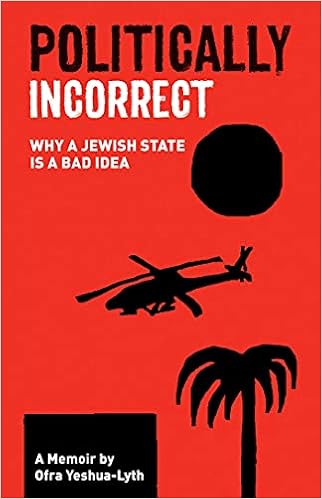
Politically incorrect: Why a Jewish State is a Bad Idea

This is my review of  Politically Incorrect: Why a Jewish State is a Bad Idea  by Ofra Yeshua-Lyth

I came to read this book through being so intrigued by a third generation Jewish Israeli journalist who felt impelled to write such a provocatively titled memoir. Her assessment of the errors which she believes will cause the ongoing “inner crumbling” of Israel in its present form are refracted through article-like chapters on her life and that of her family members back to  the economic need or desire for freedom from religious control which led them to emigrate to the land of Israel before it became an independent state.

Ofra Yeshua-Lyth does not  condemn the existence of Israel as such. Two weeks after the end of the Six Day War, she set off without a qualm on a family tour of the newly occupied West Bank. When Egyptian President Sadat  recognised Israel in his historic meeting with the right-wing leader Menachem Begin, she wrote optimistically of her country finding “its true vocation, which is to become an integral part of the Middle East” without the intercession of “meddling” foreign diplomats, distorting issues and restricting “the power of the imagination” through translating Hebrew and Arabic via the medium of the English language. These views are not surprising, since as a child she was taught how her grandparents  had come to the country and built it up from nothing, and that she had a responsibility to continue their work in a unique but vulnerable Israel. “The only Jewish state in the world was small but brave, poor but just”.

Perhaps the experience of being half-Yemeni, in a racially prejudiced Israel initially dominated by white east European Ashkenazi Jews, made the author more sympathetic to the growing plight of the Palestinian Arabs dispossessed  of the their lands. Certainly, by the end of the book she is advocating dismantling unauthorised settlements in more than a cosmetic exercise and getting out of lands illegally settled under international law. In what she insists is “not mission impossible”, the author argues that the land which Ariel Sharon claimed could take 15 million residents should be one where Jews and Palestinians agree to “live in a normal state as equal citizens living in one territory”, rather than one reserved for those with “the right religion as an entry card”.

This is why her initial and most polemical focus is on the negative implications of the alliance which has grown between the government and deeply religious Orthodox Jews who maintain the raison d’être for an exclusive and expansionist state.  She describes the heavy state support for the lifestyles of the Haredi, whose menfolk devote their lives to studying religious texts, exempt from national service, and massive subsidies for the settlers of the occupied territories, “easily identifiable by their uniform of yarmulkes and bearded faces and by their battered vehicles overloaded with children”. In addition, she lambasts the increased Orthodox influence on state education,   and its controls on marriage to non-Jews, weddings, funerals, and the practice of circumcision even for secular Jews, not to mention kosher food, all of which serve to maintain a sense of  inward-looking separation and superiority.

This book is often wordy and long-winded, assumes a good deal of prior knowledge, sometimes seems too subjective, slapdash or stilted in style. I imagine it will enrage many of the author’s compatriots, but in its  frankness and heart-felt sincerity, it is also a very informative, thought-provoking, insightful with wry humour, evocative, fascinating read.

The Long Hangover: Putin’s New Russia and the Ghosts of the Past

This is my review of The Long Hangover: Putin’s New Russia and the Ghosts of the Past

With the chilling downward spiral back into Cold War politics, it seems more vital than ever to understand why the Putin regime operates as it does and most Russians accept it.

This impressively clear and insightful analysis gains authenticity from the journalist author’s fluent grasp of Russian, his study of the country’s history, and time spent living and travelling widely in the Former Soviet Union (FSU). He has sought a fresh perspective in his focus on “the ghosts of the past”, which in various ways cripple and distort the current state of society.

As a student, Shaun Walker saw first-hand the “poverty, widespread squalor and rampant exploitation” in Moscow a decade after the collapse of communism, which left many Russians feeling disoriented and rootless. In the vacuum created by the sudden break-up of the USSR, Putin was resolved not merely to stabilise the economy but to establish Russia in what he saw as its rightful place as a “first rank” global power.

Shaun Walker repeatedly returns to the “memory politics” which Putin has used to raise morale and forge a sense of unity: at the heart of this is the continued celebration of Russian victory in “saving the world from fascism” in World War Two, without any admission of Stalin’s tyranny, such as the mass deportation to remote labour camps of hundreds of thousands of ethnic minority villagers for alleged collaboration with the Nazis. Walker cites the headteacher in a rundown Irkutsk suburb where some families have had to cut back on food recently. “Patriotism is the most important thing” she declares, having reintroduced the old Soviet uniform for her pupils, to improve morale. The parents approve of Putin’s efforts to fight corruption, probably unaware of the extent of his own unreported wealth together with that of his cronies.

As suggested by these examples, Shaun Walker proceeds through a series of case studies mainly based on peripheral regions closer to Western Europe where there is more history and risk of uprisings: Georgia, the Ukraine and Chechnya. In the latter, generous investment for the reconstruction of places like Grozny combined with the desire for stability, have encouraged people to treat as “an inconvenient and ignored detail” the fact that their leader Ramzan Kadyrov’s father led Chechens to fight the Russians in the 1990s. Grozny’s central avenue has been renamed from “Victory Avenue” to “Putin Avenue”. The author writes of how Chechens “build walls around certain events in their lives, so that they can often only speak in half-memories and platitudes” and quotes Koestler: “If power corrupts, the reverse is also true: persecution corrupts the victim, though perhaps in subtler and more tragic ways”.

We are shown how Putin’s attitudes have evolved. Initially wishing to be a respected and reliable ally of the west, even suggesting that Russia might join the EU or NATO, he began to feel cold-shouldered and threatened by western support for rebels in Georgia and Ukraine. This pushed him towards a kind of continuation of the old tsarist empire, supported by a mixture of renewed religious Orthodoxy, political autocracy with a “window-dressing” of democracy and pride in nationality. A “natural state of confrontation” with external powers has now “won the day” as illustrated by the annexation of the Crimea, justified by the need to “right the wrong” of Krushchev’s relinquishment to Ukraine of an area which was historically Russian until 1954.

There is passing reference to the distorted reporting of foreign affairs and failure to investigate and bring to convincing justice the murderers of journalists who threaten to “rock the boat” by probing the system too deeply, but this grim legacy of a ruthless authoritarian past is not explored in great depth. Although fascinating, the analysis seems incomplete in its neglect of other major relevant aspects, like Putin’s suppression of true democracy in the form of Alexei Navalny, a potentially major opponent denied from standing for election on what sound like bogus charges of embezzlement. The same applies to the implications of the suspicious death in custody of the tax lawyer Sergei Magnitsky, alleged moves to undermine western democracy by influencing elections, and renewed assertiveness in bombing Syria.To be fair, Putin’s recent vaunting of “new weaponry he claims will render NATO defences completely useless” and the bizarre poisoning of the Skripals in Britain came too late for this book.

As I lay dying – challenging read after which “ordinary” novels seems lacking


This is my review of As I lay dying by William Faulkner.

In the fictional county of Yoknapatawpha, based on Faulkner’s deep knowledge of Mississippi in the Great Depression, wife and mother Addie Bundren lies dying for only the first fifth of this modern classic, to the hypnotic mantra of sawing as her son Cash painstakingly constructs a coffin within sight and sound of her bed . The rest of this short but dense novel is taken up with the fateful Odyssey borne of Anse Bundren’s stubborn to the point of foolish insistence on taking his wife’s body on a ramshackle cart over routes where road bridges have been swept away in the floods, to “lie with her own people” in the town of Jefferson. As it turns out, both he and his daughter Dewey Dell have an ulterior motive for getting there at all costs.

To achieve this, Anse needs the assistance of his children, in particular his three very different adult sons. It is a continual puzzle as to how this pathetic, incompetent man manages to use his wheedling guile to hold them to their thankless task, which brings each of them long-term suffering of a different kind. Only Anse comes out of the situation with any advantage – clearly, the cynical Faulkner did not believe that people get their just desserts. Yet there is a bond between the often hostile brothers, as shown by the risks taken to salvage Cash’s precious carpentry tools from the river-bed.

The unrelenting, macabre and bleak theme is rendered tolerable, even gripping by the remarkable style, the wry black humour and quirky Southern speech. The book requires intense concentration with its multiple points of view, each chapter representing by turns the thoughts of a different character, expressed in a stream of consciousness that is part literary, even poetical, part pithy, part convoluted colloquial dialogue. On occasion Faulkner even invents words for want of an existing one that suits – “uninferant”, “uncurried”.

It helps to know that Faulkner disliked the “normal” style of straightforward explanation, preferring to leave major events merely implied or hinted at, rather in the style of the film scripts which he took to writing in later life. He enraged Ernest Hemingway by observing that he “lacked courage”, by which he meant, not in a physical sense, but as regards being prepared to “get out on a limb…risk bad taste…overwriting….dullness.” Faulkner himself took all these risks in spades in this novel. Apparently written in only six weeks, it has a raw, unedited feel at times, as may have been his intention. It is debatable whether this is a strength or weakness. I found myself rereading some passages because they are so stunning, others in a vain and tantalising attempt to make sense of them. Sometimes, the brilliance seems to slip into pretentiousness or tedium.

Some of the most powerful passages describe Jewel Bundren’s sadistic passion for his “pusset-gutted bastard” of a horse. “Enclosed by a glittering maze of hooves as by an illusion of wings”, Jewel “moves with the flashing limberness of a snake….for an instant… whole body earth-free, horizontal, whipping snake-limber….Then Jewel is on the horse’s back. He flows upward in a stooping swirl like the lash of a whip, his body midair shaped to the horse” and so on. Later we see the horse “dancing and swirling like the shape of its mane and tail and the splotches of its coat had nothing whatever to do with the flesh-and-bone inside them”.

There is humour in Darl Bundren’s acutely droll assessment of his father. “He got sick once from working in the sun when he was twenty-two years old, and he tells people that if ever he sweats, he will die. I suppose he believes it.”

Irony marks the portrayal of the preacher who rushes to Addie’s bedside in an attempt to pre-empt any deathbed confession with one of his own, complacently concludes that his efforts in battling through the floodwaters are sufficient to obtain God’s mercy, “He will accept the will for the deed” and enters the “house of bereavement” with a mere sanctimonious “God’s grace upon this house”.

There is menace, not to mention an indictment of Anse’s inappropriate behaviour, in the continual references to the ever-present vultures which obsess Addie’s youngest son Vardaman: “Now there are seven of them, on little tall black circles”.

At one extreme, Vardaman and his teen-age sister Dewey Dell seem handicapped in their ability to communicate by their limited speech. At the other, the sensitive, perceptive Darl is often used as the mouthpiece for the author’s most sophisticated verbal pyrothechnics. Yet even the tortuous southern speech can be surprisingly telling as when bemused neighbour Tull observes, “The Lord aimed for…a fellow… to do and not to spend too much time thinking, because his brain is like a piece of machinery: it won’t stand a whole lot of racking”. Likewise, Cash’s final observation, “ But I ain’t so sho that ere a man has the right to say what is crazy and what aint. It’s like there was a fellow in every man that done a-past the sanity or insanity, that watches the sane and the insane doings of that man with the same horror and the same astonishment”.

There are also deeper levels of meaning to this book about, say, Addie role as a wife and mother, or the language of religion used to as a form of social control in a deferential rural community which defy inclusion in a short review without “spoilers”.

Sworn Virgin


This is my review of Sworn Virgin  by Elvira Dones.

According to the “Kanun”, “a set of traditional, orally transmitted laws which have persisted for centuries in the remote mountain valleys of northern Albania, a woman who feels the need to assume an independent male role in society must live as a “sworn virgin”, adopting the dress and behaviour of a man. When teenage Hana who has somehow managed to escape to Tirana to study literature feels obliged to return to her village to care for her dying Uncle Gjergi, rather than accept his insistence on the “security” of an arranged marriage, she impulsively resolves to become “Mark Doda”, rapidly learning to walk, swear, smoke and drink like a man. The irony is, of course, that a woman’s gaining of liberty in this way is at the price of the freedom to express her true self.

We first encounter Hana some fifteen years later when, in her mid-thirties, she has decided to take the drastic step of returning to life as a woman, making the transition in the family of her supportive cousin Lila who has emigrated to America. Proceeding in a series of lengthy flashbacks, the narrative explores with some empathy the practical and emotional difficulties of adapting back to life as a woman, particularly in a society in which this means being much more fashion-conscious and sexual, but glosses over why Hana did not simply return to Tirana after her uncle’s death, and over the process by which she began to change her mind about how she wants to live. Also, I may not have read carefully enough, but how did she manage to get access to the United States to both live and work there, it would seem indefinitely?

Although the theme caught my attention, I was initially put off by the clunky style, uncertain whether this was due to the Albanian author, writing in Italian, or the translation into English. It seems to flow better as the story progresses, perhaps as the author “gets into her stride”.

Some of the most vivid, authentic and moving sections are the descriptions of life in the enclosed, traditional mountains where songs and flowers are mixed with betrayal, wounds and brutality, “mountains made of eyes that observe and forbid”. The caustic comments on Orwellian life under communism, in which failings of the system were denied with hypocrisy and corruption rife amongst those in charge, have the bitter ring of personal experience. There is also a strong portrayal of the young Hana, hungry for learning, unable to deal with the fact that men find her attractive, and hampered by her sense of being an outsider, different from other more privileged students.

The scenes set in America seem weaker, verging at times on “chick lit” as, having acquired an impressive grasp of English at great speed, Hana experiments with makeup and women’s clothes, agonises over sex, periodically escapes into the masculine refuge of strong liquor, and banters with her Americanised niece Jonida, who I appreciate may have been included to show the life Hana might have led in different, freer circumstances.

Lila’s Albanian husband Shtjefën seems too good to be true, and a little hard to visualise: “He’s part bear, part butterfly, this man. He goes on slurping his bean soup. ‘What about you, Mark? Did you get some rest? You look a bit lost, brother.’ (Hana is still dressed as a man)…. Before asking for Lila’s hand, Shtjefën had been wiry and blond. His head was like a sunflower. The girls in the village said it was because of his height: he caught the sun as soon as it came out, long before the others, and was the last to lose it before sundown. His speech sounded rare and distant, like the glory that cloaked his family”. Perhaps this is intended to imply the incongruity of living in bland, standardised, materialistic urban America with unexpressed, dreamlike memories of life in the harsh but beautiful mountains.

The super-understanding journalist Patrick O’Connor plays a somewhat contrived role in a story which seems to end too abruptly. Overall, it’s a patchy novel, compelling at times, but some parts could have been developed better.

Tanna – a remarkable film

This is a review of the film Tanna

On the South Pacific island of Tanna (part of the Vanuatu archipelago), the women of the Yakel tribe are joyfully preparing for the initiation of the beautiful young Wawa as a woman.  She is turn is delighted by the return to the village of Dain, the chief’s grandson, a Pan-like figure with his pipes and head-dress of long, green leaves. The carefree tropical forest idyll of rhythmic communal dancing and song is shattered by an attack by the neighbouring Imedin tribe, in what has become an ongoing feud. It is decided to cement peace by invoking the tribal laws of Kastom, which advocate arranged marriages between tribes. What will be the outcome of the refusal of the young lovers Wawa and Dain to give each other up?

Based on a true chain of events in the 1980s which led to the recognition of love marriage as a part of Kastom,  this film makes a powerful impact not only through the stunning photography, but also the acting ability of a cast of native tribespeople with no prior knowledge of cinema, or life beyond their village, and also the clear evidence that an apparently primitive residue of “uncivilised native life” may in fact be a cohesive society, based on well-developed values which  can make our media and celebrity-dominated culture seem rather hollow.

The film’s authenticity stems from the fact that at least one of the directors lived with the tribe for months, observing their customs and winning their trust.  Unselfconscious in their semi-nakedness, they go  about their work and communal celebrations, moving with a striking grace or dignity, not to mention their fitness in covering miles of rough terrain. We see how they are at one with the lush forest, weaving skirts and cloaks from grass, twisting leaves into headbands and necklaces, using a small inverted tree as a broom to sweep clear the forest floor around their huts, clearing the ground efficiently for planting aided only by a pointed stick.

When in need of advice they ascend a nearby continually active volcano to sit at the crater rim where the erupting lava is linked to the spirit of the goddess Yahul.  This is not some sugar-coated Rousseau fantasy of life as a savage,  but a convincing portrayal, by turns humorous, violent or poignant, of a vulnerable way of life. This deliberate rejection of colonisation and conversion by missionaries (the background history makes interesting reading) is unlikely to survive much longer, but one understands the desire to preserve it in preference to one in which the villagers  have exchanged their native skills of self-sufficiency for a life of poverty in a money-based economy corrupted by the worst aspects of “civilised western” life, or of parroting some debased form of Christianity. As Dain says of a group of happy-clappy evangelised tribespeople, “These Christians freak me out”.

“Mrs Osmond” by John Banville – over-egged pastiche when would have preferred author’s own voice

This is my review of “Mrs Osmond” by John Banville

John Banville’s sequel to “The Portrait of a Lady” by Henry James develops the plot further to explore Isabel Osmond’s response to the bitter realisation that her husband has married her solely for her money and has been concealing from her a sordid and humiliating secret. I felt at a disadvantage at first in not having read “The Portrait of a Lady”, since this would have enabled me to gauge the degree of Banville’s success in attempting to mirror James’s style. Yet, knowing the details of the original would have spoiled my enjoyment of the way John Banville gradually reveals the details of what has led to Mrs Osmond’s distress.

Although it seems acceptable for a writer to produce a prequel or sequel to a deceased author’s work, I am less sure about artistic method of trying to imitate his style – a painter who tried to produce pictures in the style of Monet would after all be condemned as “derivative”. I agree with reviewers who feel that Banville has “over-egged” his efforts to emulate James – his convoluted flights of fancy often weighted down with unrelenting alliteration and jarring metaphors, to the point of seeming ludicrous and digestible only in small quantities, unrelieved by James’s subtlety and excuse in having been born in an earlier age when what we now regard as flowery speech and excessive refinement were the norm for the privileged classes: “Her thoughts moved in large, loose loops, but at least once every round they revisited, like a planet at its perihelion, the question of what precisely Miss Janeway’s portentious remark might have been meant to mean”.

Or to take a more irritating overworked passage: “Europe had been her fate, and so it was still. Yet she should not have allowed her aunt to thrust her upon that fabled continent so precipitately, as a free-trader’s posse might snatch from the doorway of a dockside tavern some poor young hearty fuddled on rum and press him into a captive life on the roiling ocean; indeed, she should not have allowed it. Her aunt was not to blame that she was lashed by unbreakable bonds to Europe’s mast”. And so on.

I would have preferred this novel written more in Banville’s is own dry, pithy style which kept sprouting through the verbiage to hint at what might have been. There are some strong dialogues, as in the scene where Isabel confronts her reptilian husband, with detailed descriptions which almost read like stage directions. The portrayal of Isabel’s mental confusion, her veering between weakness and decision, her desire for revenge but shrinking from descending to the level of Gilbert Osmond and his mistress are often well expressed. There is some humour, as in the portrayal of Isabel’s maid Staines, or the daunting lunch served by the vegetarian suffragist Miss Janeway: “boiled broccoli, boiled beans and boiled spinach” eaten “in silence save for irrepressible herbivoral crunchings”. On the other hand, too many characters, like the unscrupulous Madame Merle seem like caricatures or appear two-dimensional.

I wanted to know what would happen, uncertain whether the outcome would be tragic, or not amount to much at all, but found it hard to cope with more than a few chapters at a time. In fact, the ending was as abrupt as James’s and even less conclusive, to the extent of seeming “a bit of a cop out” on Banville’s part.