Howards End by EM Forster: accepting our differences

In what was to prove the end of an idyllic period for the leisured English middle classes just before the outbreak of World War One, E. M. Forster captures the tensions and lack of “meeting of minds” between two middle class families with very different roots and attitudes: the Schlegels and the Wilcoxes. The intellectual Schlegels get away with appearing a bit unorthodox since they are half-German, that is “foreigners”. They are idealistic within their cocoon of privilege, living comfortably on inherited money. The much wealthier, pragmatic, materialistic Wilcoxes have built a fortune “in trade” and have no compunction about “keeping the workers in their place”. As Henry Wilcox observes,
“You do admit that, if wealth was divided up equally, in a few years…the hard-working man would come to the top, the wastrel sink to the bottom”.

Through a fateful meeting of the Schlegel siblings with the bookish, music-loving clerk Leonard Bast, Forster portrays the rigid class divide of the early 1900s. Too poor even to afford a decent umbrella, too decent to abandon the ageing, former prostitute lover who has latched on to him, unable to regain a foothold on the ladder of respectability when he loses his job through no fault of his own, it proves too hard for him to win acceptance and pursue his interests.

Howards End seems an unlikely place for the Wilcoxes to live, being a somewhat unfashionable place in the depths of the countryside, based on Forster’s own childhood home, “Rooks Nest House”. It turns out that this belongs to Mrs Wilcox, a rather unsatisfactorily vague, two-dimensional character, dismissed as “uninteresting” by Margaret Schlegel’s chatterati friends. She exerts a calming influence on her family, but is not the woman one would expect Mr. Wilcox to have chosen for a wife. It seems that she is the “guardian” of a house which is the almost mystical symbol of an idealised way of English life that is fast disappearing at the turn of the C19 century. Knowing that she is terminally ill, she appears to hold, but never clearly expresses, the belief that Margaret Schlegel is more suited to own the house than the soulless, capitalist family into which Mrs Wilcox has married. The implications of her decision form an important part of the plot.

It may be surprising that, when widowed, the patriarch Mr. Wilcox falls for Margaret, the plain, serious-minded elder sister who has devoted herself to her orphaned siblings to the point of risking becoming an old maid. It is understandable that she seeks “a real man” in the form of Mr Wilcox, even though the two are clearly fundamentally different in their attitude to life.

The main characters, at least on the “middle class” side, are well developed. Margaret’s younger sister Helen, impetuous with a hint of instability, plays the role of the character prepared to challenge the system, but ill-equipped to cope unaided when “it comes to the crunch”. Brother Tibby provides a further contrast as the hypochondriac, wimpish bookworm cosseted by his sisters, who do not seem to resent the fact that, being the male child, he is the one to go Oxford.

Written at the end of a prolonged period of social stability and convention, but foreshadowing some dramatic changes, this stands out as one of the first “modern” novels, quite radical and original in certain respects. The story proceeds with some unexpectedly humorous moments and a sense of real connection between the characters in the form of conversations to which one can relate. Forster focuses on the relevant scenes, confidently omitting any superfluous “linking” chapters. Perhaps he can be forgiven for drifting occasionally into overblown Victorian-style philosophising.

This is an engaging family drama, with some profound insights which repay rereading. It can be read at two levels: either an Edwardian soap opera, or a quite complex amalgam of Forster’s deep reflections on the nature and future of English society, the differences between people and the ultimate need for tolerance. Although the characters may be a little wiser at the end, the wry truth remains that in any crisis the poor and the underdogs will tend to be the ones who lose out, but hints of the approaching war suggest that the escapist paradise of Howard’s End may not last.

“The Sea” by John Banville

“A poet is, before anything else, a person who is passionately in love with language.” W.H.Auden

By coincidence, I read this novel immediately after Virginia Woolf’s groundbreaking stream of consciousness, “Mrs. Dalloway”. Despite many differences, and being written close to a century apart, there are striking similarities: both consist largely of flashbacks and reminiscences, with nostalgia for something lost. Although both lead up to a sudden tragedy, it is described more briefly, even casually than many minor incidents and this is because the act of writing about how one observes and experiences the world, and captures thought processes in words, is more important to both authors than plot.

John Banville can “do” plot, since he also writes crime fiction under the name of Benjamin Black, regarding it as a “craft”, “cheap fiction”, but uses his own name to create, as an “artist” works like “The Sea” for which he won the 2005 Booker Prize. His prose is more conventionally structured than Woolf’s but very lyrical, even poetic, original, sharply observed with touches of black humour, and peppered with unfamiliar words like leporine, losel and mephitic as in “blue shale giving off its mephitic whiff of ash and gas”. Some I had to underline to look up later rather than disrupt the flow. Now “mephitic” means foul-smelling or noxious, so why not use a term everyone will understand? I concluded charitably that this was not a sign of pretentiousness, but a genuine fascination with rarely used words.

The novel is narrated by Max Morden, the pseudonym of a man probably in late middle age who has somehow escaped his working class roots, married a woman who inherits the fortune her father made in perhaps questionable business, and become an art historian. None of this rings quite true but what is important is Max’s grief over his wife’s recent death from cancer. Unable to find much solace in his prickly relationship with his daughter, who is also grieving, he seeks relief by taking refuge in “Ballyless”, a small Irish coastal resort. This is where his parents took him to stay every summer (until his father left the family home), and Max made the acquaintance of a more affluent family, the Graces, who rented a house called The Cedars, where rooms are now let out by the landlady, Miss Vavasour.

Aware of the difference between his parent’s cheap wooden chalet and The Cedars, Max is soon infatuated with Mrs. Grace who “walked at a languorous slouch”…and “smelled of sweat, and cold cream, and faintly of cooking fat. Just another woman, in fact, and a mother at that. Yet (to him) in all her ordinariness as remote and remotely desirable as any painted lady with unicorn and book”. He is wary of Mr. Grace who is portrayed as a kind of middle-aged Pan, and “fascinated and at the same time slightly repelled” by the children, because of their relationship as twins, intimate, “like magnets” even when at loggerheads – Myles, who is mute and irritating in his attention-seeking, and Chloe, assertive and unpredictable. Then there is the young woman Rose, employed to keep an eye on the pair.

Apart from Rose, none of these characters is very appealing but Max analyses them and himself, very expressively. You could say that this is like the earlier part of a “coming of age” novel, which carries the reader along, free of any division into chapters. It is not until less than twenty pages from the end that we reach the event, reminiscent of L.P Hartley’s “The Go-Between”, which we realise has haunted Max, all his life, perhaps even more than the death of a wife he did not feel he really ever knew.

As is often the case, the most significant event has an unreal quality,
“All that followed I see in miniature, in a sort of cameo, or one of those rounded views, looked on from above, at the off-centre of which the old painters would depict the moment of a drama in such tiny detail as hardly to be noticed between the blue and gold expanses of sea and sky. I lingered a moment on the bench, breathing.”

So, a novel to be admired for its style, the quality of the writing, the insights which express thoughts one has been unable to articulate so well oneself and the evocative power of past memories. Yet somehow, it may leave one unmoved, I think because one does not relate to the characters sufficiently, and some of the situations seem too contrived.

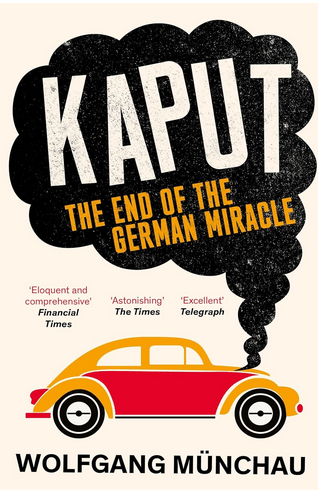
“Kaput” by Wolfgang Münchau: Looking under the bonnet

Half a century later, matters look a little different, with such warning signals as the rapid rise of the right-wing AfD, and the over-reliance on gas produced, piped into Germany and stored under the control of the state-owned Russian Gazprom. For German journalist Wolfgang Münchau, the root of the problem is Germany’s fixation with the out-dated export-driven business model of “neo-mercantilism”. In essence, Germany’s “super-cycle” has come to an end, but that, unlike for instance the Nordic countries, it is has chosen to invest its surpluses in “the same old technologies and underinvested in digitalisation”. Meanwhile, the growth of “green energy” has been hampered by excessive bureaucracy.

Münchau cites many examples of the self-serving complacency and lack of vision with which influential politicians have colluded with state banks to invest in long-established engineering rather than the riskier small innovators and in particular digital technology which would provide so much future wealth. The failure to install sufficient fibre-optic cables has resulted in very poor mobile phone reception and slow internet (as recently as 2024) – leading to the anecdote of the horse which delivered some photos over a distance of 10km faster than a computer could upload them!

At least initially, the German teachers’ association supported an academic’s view, expressed in books like “Digital Dementia”, that schools should not use computers, to avoid damaging their pupils’ concentration.

Münchau claims that, from the late 1990s, the German government was “in the pocket” of major car firms like VW and Porsche, which clung to the production of fuel-driven cars. At VW, the CEO who wished to focus on electric cars was fired, and there was the scandal of VW ironically installing software to reduce automatically emissions when being tested in a fuel-driven car.

The “modernisation partnership” with Russia which involved importing cheap gas from the latter in order to export machinery in the opposite direction has proved a miscalculation. The decision to phase out nuclear power, and limited capacity to produce green energy increased the dependence on gas. The partnership was, as it turned out naively, promoted as helping to “democratise Russia”. In fact, the sanctions imposed when Putin invaded the Crimea in 2014, meant a sharp fall in exports of machinery from Germany and increased unemployment which in turn increased support for the AfD.

Germany profited from exporting the equipment needed for the Chinese to industrialise, not foreseeing how quickly they would turn the tables and undermine the economy with cheaper manufactured imports, using “smart technology”, internet-connected machines to increase productivity. The Chinese are rapidly gaining an increasing share of the growing e-car market, developing a very efficient supply chain, copying what the Germans did for the fuel-driven car. China has taken over the German solar panel market and robotics, while Germany is dependent on China for the import of laptops, mobile phones and rare earths.

So Germany has met its match in a superpower which is also focused on export surpluses. Economic relations with China are complicated by, for instance, the need to comply with EU sanctions in response to Chinese breaches of human rights.

Although very informative and thought-provoking, at times “Kaput” seems repetitious, and peppered with the names of too many transitory politicians, business leaders and companies for a non-German reader to keep track. Barely a year after publication, some facts have been superseded and in the final two chapters Münchau seems anxious to finish, and slips into over-condensed economic theory e.g. regarding the operation of “the debt brake”.

The gist is that necessary government investment is the first casualty when spending has to be cut to comply with keeping debt relative to GDP within a certain tight limit e.g. 0.35% of GDP. Although this rule could be relaxed in the case of a national emergency, the government was found to have misspent funds meant for COVID “by funnelling them into the climate budget”.

Then there is the shortage of skilled workers, with vocational training struggling to keep up with the creation of jobs in “new” industries, and the declining number of young Germans entering the labour market. The controversial and not entirely altruistic welcoming of a million Syrian refugees may have boosted the supply of workers, but also fed the rise of the AfD.

Le Serpent majuscule (The Grand Serpent) by Pierre Lemaître – Should fictional cruelty be kept within certain limits? Discuss!

Pierre Lemaître became an internationally bestselling author on the basis of his ingenious if far-fetched, macabre, “romans noirs” crime fiction. So his switch to historical novels via “Au revoir là-haut” (The Great Swindle) did not please all his fans. The decision to publish in 2021 Le Serpent majuscule (The Great Serpent), his first novel, written in the nineteen eighties, is apparently an attempt to make amends.

With only minimal editing, this “rings true” for its period. It’s a world without mobile phones, social networks, surveillance cameras, centralised computer records and advanced use of DNA: in short all the sophisticated technology now available to trap a serial killer.

The interest in psychology which runs through Lemaître’s work is already evident in this first novel, focused on the two main characters, Mathilde and Henri. These are psychopaths who applied their skills to a noble cause in the French Resistance, but whose ruthlessness in peacetime is channelled into contract killing for financial gain. For some, the suspense lies in whether and how Mathilde, with her alternating periods of mental astuteness and signs of dementia which make her an increasing liability for Henri to employ, will emerge triumphantly, escaping her just deserts.

Promoters of the book have no trouble in culling phrases from reviewers, like Le Figaro’s, “Délicieusement immoral”, but as his “Avant-propos” or foreword shows, Lemaître is keenly aware of many readers’ reservations over his casual erasure of characters to whom they have become attached, and he seems perhaps surprisingly anxious to defend himself. I take his point that misfortune and bad luck are “what happens in life”, so why fight shy of including them in a novel? He also argues that since it’s predictable that crime novels will contain bloodshed, perhaps sensitive readers should simply avoid them.

Overall, Le Serpent majuscule repelled me with the sheer degree of its clinically described gratuitous violence, wreaked not only on fellow-villains but also on the few decent and potentially interesting characters. The dispatch of individuals by shooting or bludgeoning, be it for unexplained reasons, in error, or as “collateral damage” in the course of pursuing another target, became tedious. Mathilde’s confused and contradictory thoughts became repetitive. Between the bursts of brutality, the narrative drive often seems plodding.

Apart from the obligations of a French book group deadline, what kept me going was the chance to learn some more of the idioms and ”argot” with which this novel is peppered in the French version.

I may persist with the historical trilogy, “Les enfants du désastre” which starts with “Au revoir là-haut” set in the First World War and its aftermath in France. This would seem a less unedifying use of one’s time, also displaying better Lemaître’s development as a writer.

Mrs Dalloway by Virginia Woolf: provoking thought

Published a century ago in 1925, “Mrs Dalloway” may sound too dated and trivial, in describing a day in the life of Clarissa, a privileged, upper class woman who is preparing for an evening party. With an army of servants to do the actual work, she has time to wander round Bond St. and St. James’s Park, observing with fascination the world recently restored to peace after the ravages of the First World War, yet feeling invisible, continually drifting into nostalgic flashbacks. When young, should she have married Peter Walsh, who challenged her to think and take risks in life, or was she right to become the wife of conventional, materially successful Richard? Had her intense early friendship with a charismatic girl called Sally Seton really been her only experience of true love?

Virginia Woolf has attracted interest as one of the pioneers of “the modern novel”. Certainly, her writing is experimental, varied and original, run through with a common thread of “stream of consciousness” or what she called “free indirect discourse”. Written through a third person narrator, this is the attempt to capture a person’s often unexpected and confused train of thought, the sudden leaps, blank spaces and interruptions. Reading Woolf requires continuous concentration to avoid spinning out of mental control, a passenger clinging on without a seatbelt only to land back unexpectedly on a track of clear, down-to-earth prose. One striking example of this is where Peter Walsh hears a “bubbling, burbling song…. like water spouting…. from a shape like a rusty pump” which turns out to be an old beggar woman to whom he gives a coin – yet this small incident is expanded over several pages to trigger, no doubt, a great variety of responses in different readers.

Woolf liked to complicate the issue by switching the point of view without warning, which serves to supply different interpretations of the same situation. So, partly during a chance visit from Peter Walsh, we see him and Clarissa observing each other, on the verge of regretting what might have been, yet probably indulging in self-delusion. It seems that Woolf was critical of writers like James Joyce, whom she studied carefully, but found wanting, too “confined to the short-term”, in his focus on the thoughts of a single character.

Plot seems incidental, apart from Woolf’s introduction of another, on the face of it very different, character in the form of Septimus Smith, about whom Clarissa is made aware without ever meeting him. He is a bright young working-class clerk who has survived the First World War physically, but is severely shell-shocked. This was a condition little understood at the time, which aroused her concern, perhaps because of the mental problems which enabled her to portray a psychotic state of mind so acutely. Her experiences fed a strong dislike of authoritarian, opinionated medical men, like the oppressive Dr. Bradshaw. Some of the most moving passages are the relationship between Septimus and his sweet young Italians wife Rezia, uncomprehending but empathetic, whom Bradshaw views as an impediment to the young man’s recovery, when the reverse is the case.

Virginia Woolf wrote later that Septimus was Clarissa’s “double”, and she vacillated as to which one of them would finally give up a life which was both loved and an intolerable burden. While able to understand why what we would now call PTSD might drive Septimus to suicide, I could not identify with Clarissa feeling “glad” that he possessed the courage which she lacked to commit an act of “defiance”, and “embrace” death. I’ve simplified her reaction, but it still seems confused when analysed in greater depth. Yet perhaps the mixture of clarity and misperception in her thought processes is the main point.

The novel culminates in a lengthy account of the party, in which Woolf applies her barbed wit, no doubt parodying many of her well-heeled acquaintances: “She must go up to Lady Bradshaw (in grey and silver, balancing like a sea lion at the edge of its tank, barking for invitations, Duchesses, the typical successful man’s wife)….” This, together with the inconclusive and rather bland ending, further obscure the nature of the connection between Clarissa and Septimus. I would judge this a major shortcoming in the novel, if it did not appear arrogant to criticise such an admired work.

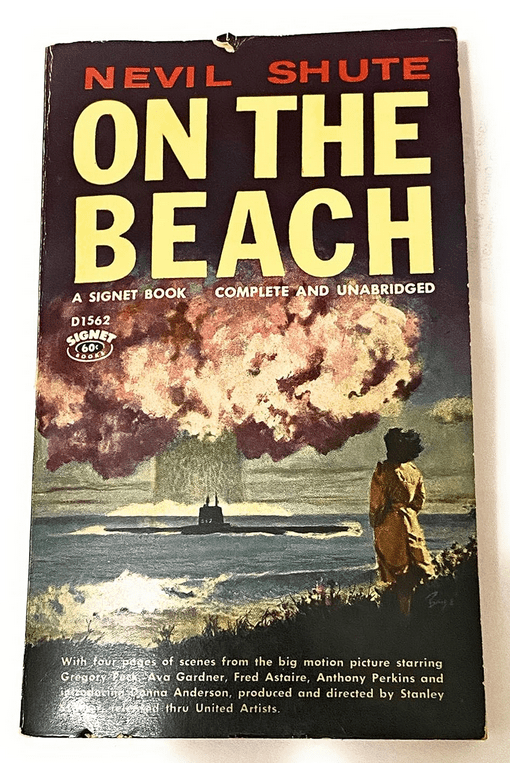
“On the Beach” by Nevil Shute

“This is the way the world ends”

British author Nevile Shute’s classic novel “On the Beach” was published in 1957, the year in which the UK Campaign for Nuclear Disarmament was launched, both reflecting the growing public alarm over the risk of a Third World War likely to involve atomic bombs, as the Cold War came to a head. Having emigrated to Australia, Shute set the novel largely around Melbourne on the far southern coast.

In the opening pages, we may wonder why naval officer Peter Holmes has been unemployed for months, can no longer drive his prized Morris Minor and uses a bicycle with a trailer of his own design to collect milk from a local farm. It soon becomes apparent that during a violent and ill-judged chain reaction in  the previous year of 1962, so many countries  north of the Equator launched nuclear  “cobalt” bombs that virtually no one can have survived in  the entire northern hemisphere. Now there is evidence that massive quantities of deadly radioactive dust are being carried inexorably southwards by the winds – it is only a matter of time before they reach the Melbourne area.

Shute’s style is plain and direct, even plodding, with a focus on minute detail, perhaps a product of his training as an engineer. All of this can combine to create quite a banal effect. However, although perhaps not intentionally, this adds to the sense of people subjected to a threat which often seems unreal and hard to believe.

The novel is essentially about how people react to this type of situation. Peter’s wife Mary lives in a domestic bubble, ever more preoccupied with planning and replanting her garden even when told that everyone in the area has only as a matter of weeks to live. From the outset, her feisty friend Moira seeks refuge in parties and alcohol. Moira’s father continues to spread muck on his farm to make the grass grow evenly and labours to construct a new fence on his land. Peter’s American boss Dwight speaks of his wife and children back home as if they are still alive, buying them presents. Overall, most people seem remarkably passive, perhaps because fatalistic. One could of course argue that to carry on regardless is the best course if there is no alternative. It is only when they actually see others falling ill and dying that some opt to risk their lives in the dangerous sport of motor racing, and the system of law and order finally crumbles

This potentially powerful theme is weakened by being somewhat repetitive, with the lengthy descriptions of the submarine Scorpion travelling thousands of miles under Dwight’s command, tasked with reporting on the scale of visible damage, together with any evidence of human life. Owing to the fear of contamination, only coastal settlements can be viewed through a periscope from a “safe” distance, with shouted messages through a megaphone the sole means of attempted communication.

The sometimes corny dialogue and dated attitudes may be an accurate reflection of life at the time, and inaccuracies over the nature of a nuclear calamity on such a scale are excusable. We may find it implausible that, for months, life in and around the small town of Falmouth seems to carry on much as usual despite a lack of petrol – a shortage of socks being one of the first signs of economic collapse to cause concern.  Yet we need to remember the problems of obtaining information and maintaining communications only a few decades before the largescale development of the internet and mobile phone.

Also, perhaps Nevile Shute’s main concern was to shake readers out of their complacency in ignoring the writing on the wall before it was too late. “On the Beach” has renewed relevance now, when increased instability in the Middle East, and Ukraine and growing tensions between superpowers feed fears of a Third World War and spark concerns over a nuclear calamity.

Despite moments of humour, I found this a depressing read, since from the outset the outcome seems inescapable. It lacks the quality of writing and insights of, for instance, “The Plague” (La peste)  by Camus to which I could relate strongly during Covid, but of course involves a less apocalyptic situation, and concludes on a slightly more hopeful and positive note.

It’s worth knowing that the book’s title was a Royal Navy term to mean “retirement from service”.  It also appears in T.S.Eliot’s poem, “The Hollow Men” which includes the lines:

“In this last of meeting places
We grope together
And avoid speech
Gathered on this beach of the tumid river.                                                                                                                                                                                                     This is the way the world ends
Not with a bang but a whimper”.

Je l’aimais or Someone I loved by Anna Gavalda

A mother of two little girls, Chloé is devastated by her husband Adrien’s abrupt announcement that he is leaving her – taking a flight to be with a mistress of whose existence Chloé has been totally unaware.

Surprisingly, Chloé seeks the support of Adrien’s parents, despite the fact that her father-in-law Pierre seems unlikely to be sympathetic – an undemonstrative man whom Adrien and his sister Christine have always criticised for his harsh, uncaring treatment of them as children. It therefore appears odd that Peter should insist on driving Chloé to the family’s holiday home where she may feel calmer. I suspected that this would be the cue for an imprudent romance between the unlikely pair. Far from this, Pierre uses their seclusion as an opportunity to unburden himself to Chloé. He confesses to a passionate longstanding affair which he had to give up years earlier out of a sense of obligation to his wife, who refused to divorce him since it would have meant a loss of material benefits and status. His message to Chloé is that, in abandoning her, Adrien is not only displaying a courage which his father lacked, but also giving her the freedom to embark on a new life.

It seems that the author had experienced a recent divorce, so that perhaps the writing of the novel was cathartic. However, Pierre’s argument seems both overly simplistic and highly debatable.

This debut novel by Anna Gavalda which has proved the first in a string of bestsellers, is distinctive in being written in a play-like format, almost totally dialogue, with no real plot and little context. The downside of this is that, too often, one has to stop and check who is speaking. Otherwise, it’s a relatively easy read for someone learning French. However, the lack of context and action reduces one’s ability to engage with any of the characters.

Situations are gradually revealed or implied through the dialogue, until roughly halfway through, Pierre becomes the main character, indulging in a monologue of “telling” which becomes tedious in its repetition. Meanwhile, Chloé’s plight recedes into the background and is left unresolved.

Initially, Chloé’s emotions are portrayed realistically, together with her relations with her children. Pierre seems a less convincing character. Many of the situations described seem somewhat clichéd.

Made into a film in 2009, this tale may have found a more effective format, but the novel lacks depth and one does not feel much sympathy for any of the characters when it reaches its limp conclusion.

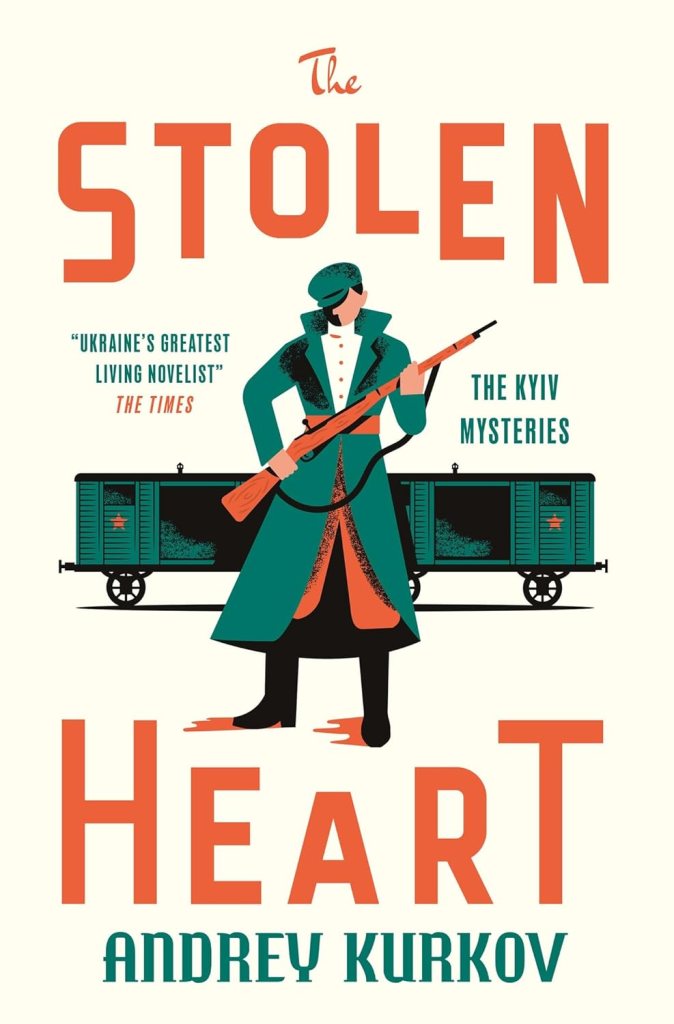
“The Stolen Heart” – The Kyiv Mysteries by Andrey Kurkov: “Why the heart is not meat”

The Stolen Heart” is the second novel in “The Kiev Mysteries” series, set in 1919 in the aftermath of the Russian Revolution. Samson Kolechko is a young detective, tasked with his older colleague, renegade priest Kholodny, to gather evidence of a normal activity which it appears has suddenly been declared a crime: “the illicit slaughter of livestock and violation of the decree of the ExProfFooCom banning private trade in meat.” It seems that Kurkov, with his preference for black humour and farce as a way of debunking authoritarian regimes could not resist using an actual example from the period.

As is often the case with crime novels, the questioning of those who have bought meat from the agent Briskin, held on remand, grows repetitively tedious, yet perhaps this serves to add to the flavour of senseless times, with Kiev increasingly under the control of the Red Army, and sinister Soviet secret police organisation, the “Cheka”, dedicated to combating “counter-revolution and speculation”.

One of the strengths of “The Silver Bone”, which contributed to its longlisting for the International Booker Prize, was its portrayal of life in an atmospheric old city which has been suddenly overturned by uncertainty, arbitrary violence and acute shortages of substances as basic as salt. A scene in “The Stolen Heart” portrays an enraged cabby whose vehicle has just been rammed by a village cart, abruptly withdrawing his complaint in return for a few pounds of the cart’s load of salt. However, by this stage, the reader has “got the picture” and wants something more.

Although “The Stolen Heart” has received some good reviews, I was left with three main reservations. One is the heightened surreal aspect which first appeared in the previous novel: Samson’s severed ear, which mysteriously shows no signs of decay, is kept in a Monpensier (luxury sweets) box which can be hidden in convenient places for eavesdropping on useful conversations audible to Samson despite being some distance away.

Secondly, there are too many incidents which remain unresolved, and it was only on reaching the last page, to “The end. But to be continued”, that I realised that each book in the series is like a long episode, rather than a freestanding tale in its own right. The result of this is that the “denouement” tends to be underwhelming, and aspects remain irritatingly unclear if one has forgotten some detail in the previous novel.

I also found many of the dialogues quite unconvincing, and the descriptions overloaded with banal minor details – while the major ones too often remain obscure, and written in a distracting style which reads like a too literal translation – yet the translator has won prizes for his work, also writes reviews, his own fiction and teaches in university English departments. So perhaps he is retaining the style of the original Russian. The effect of the frequent odd or ill-chosen turns of phrase is that one does not engage so strongly with the characters. But is it meant to be a kind of Eastern European “absurdist” style intended to be part and parcel of the satire?

Just occasionally, there are moments which ring true, generally involving Samson, as when he reflects at a very inopportune moment,

“Could it be said then, that Samson loved Nadezhda in German? Reliably, calmly?

Samson considered this. The idea of loving in German did not appeal to him. The world war that had ended the previous year gave it a cruel, bloody connotation.

No, he decided. He loved Natasha respectfully rather than calmly. While she loved him pityingly”.

Is it a printing error that the map of Samson’s Kyiv, 1919, bears not a single place name apart from the River Dnipro? I would like to have been able to locate the streets and squares named so precisely – perhaps they were too long to fit legibly on the page.

Kurkov’s success as a writer appears to have been enhanced by his courage, albeit through the medium of satire, in exposing the corruption of post-Soviet Ukraine in the 1990s. My admiration for his debut novel, “Death and the Penguin”, inspired me to embark on the current series. I plan to try “Grey Bees”, the tale of a beekeeper living in Ukraine’s Grey Zone between rival forces in the current conflict.

But I don’t think I shall return to find how life works out for Samson and Nadezdha, although their names suggest that it will be well.

This Thing of Darkness by Harry Thompson – A Masterpiece Overlooked as was Fitzroy.

At 750 pages, this is a megatherium of a historical novel, to cite the name of the giant fossilised sloth which Darwin comes across during his five- year exploration of South America while employed as a naturalist aboard the survey ship, HMS Beagle. In the span of almost four decades from 1828, it is hard to keep track of the vast cast of characters, many of whom only appear briefly from time to time. Women play a minor role, and tend to be passive stereotypes, but that reflects life at the time.

Although Darwin is the most famous, the focus is on Robert Fitzroy, appointed Captain of the Beagle at the age of twenty-three, not only for his aristocratic connections, but also his brilliant performance as a student at the Royal Naval College. His first task is to complete the survey of the complex coast of Patagonia, with the harsh climate which drove his predecessor mad. The novel brings home the enormity of the task of mapping a continent with the limited equipment available, the cultural gulf between the Europeans and the various tribes they encounter, and the human cost of the well-intentioned desire to achieve “progress” complicated by the innate human drives of competition, domination and greed.

A central theme is the relationship between Fitzroy and Darwin, forced into close companionship for months on end in the cramped confines of a sailing ship. A bone of contention between them is the explanation of the variations in the creatures observed on their travels, whether alive or preserved in layers of exposed rock. Initially destined to be a clergyman, and troubled by his conclusions, Darwin finds it increasingly hard to deny the existence of some kind of evolution, as we now call it. Fitzroy, despite his analytical mind, cannot give up his belief that surviving species remain as they were first created by God, with only limited changes through adaptation to different environments.

Frustrated by the government’s refusal to fund further voyages of the Beagle, he resolves to finance them himself, running up excessive debts in the process. Constantly dealing with dramatic changes in the weather, he begins to see patterns, and while employed in later life at the Board of Trade sets up a weather forecasting system to issue storm warnings which save lives. Pressure from the owners of fishing fleets, concerned by the loss of earnings when forecasts keep their boats in port, lead to abandonment of then daily weather reports. This proves the last straw for a man who has suffered throughout his adult life from periods of depression.

At times of stress, Fitzroy suffers brief but severe manic episodes, which put both him and his men at risk. At a time of such prejudice against madness, it is surprising that he is not demoted for that reason. The extreme loyalty he arouses in his crew may partly explain this. The practice of sending little boys, as young as ten (or twelve in his case) off to sea to learn the ropes may have aggravated his instability.

Darwin is more balanced, and ultimately more successful. Yet he is presented in an unflattering light. His fellow officers on The Beagle generously bring him examples of unusual creatures they have found, but when these are shipped off to England, it is Darwin who receives all the credit, never acknowledging their contribution.

This novel is based on such detailed research on sailing 19th century ships in often atrocious weather conditions, and on every aspect of the varied landscapes and society of South America at the time, as well as the contrasting vivid portrayal of London and the rural south of England, that I imagined the author must be some nerdish eccentric. In fact, Harry Thompson was a highly successful television producer and comedy writer, who produced, for example, “Have I Got News for You”. His sense of farce pervades this book with flashes of irony and dark humour which lighten the theme.

By the age of 45, he had also found time to write a string of books, including biographies and this debut novel, “This Thing of Darkness”, which arguably deserved to win the Booker Prize rather than merely be longlisted. Ironically, the winner was John Banville’s “The Sea”, so different that the two novels seem to defy comparison in the same contest.

What might Harry Thompson have gone on to achieve, had he not died prematurely of lung cancer, never having been a smoker? It is a pity that many people will lack the time to embark on this book, or be deterred by its length. Reading it proves an absorbing, immersive experience, creating a powerful sense of many different places, and enabling us to identify with characters despite the accepted attitudes, value and knowledge of their day. Admittedly , in some dramatic scenes of near-death experiences, the derring-do may seem overdone; otherwise, the tedium and hardship of long days at sea, or struggling over unfamiliar, harsh terrain feels oppressive, but authentic. The political corruption of the period is all too similar to that of today – plus ça change!

Thompson really succeeds in bringing a fascinating period of history alive. This novel is a remarkable achievement, moving and informative, that will linger in the mind.

Precipice by Robert Harris: A Study of Obsession

The First World War may seem an overused theme for a novel, but Robert Harris approaches it from a fresh angle by portraying the real life situation of a British Prime Minister under great political stress, as strongly resisted demands for Irish Home Rule were eclipsed by the imminent threat of strife in Europe in the summer of 1914. Herbert Asquith found relief in an unwise affair with an aristocratic socialite less than half his age. He was known to enjoy the company of pretty young women, described by his sharp-tongued wife Margot as his “harem”, but Venetia Stanley was different with her obvious intelligence and ability to act as a sounding board for his concerns.

At times it is hard to credit how Asquith was able to walk about without any apparent security guards, or find time for long afternoon drives with Venetia in the countryside, cocooned behind blinds in the back of his chauffeur-driven Mercedes. Most extraordinary, at a time when London households might receive up to 12 postal deliveries a day, as Asquith’s obsession with Venetia grew, he wrote several times a week, on at least one occasion four times in a single day. With an increasing lack of caution, he gave her unique access to classified information, including telegrams, details of military plans or sensitive issues which were being covered up.

Venetia kept more than 500 of these letters, which have survived to be selected for inclusion in a skilful blend of fact and fiction, for Asquith himself later destroyed Venetia’s replies. Robert Harris has also been obliged to invent Paul Deemer, the imaginary policeman who is transferred to a secret team to investigate the apparent security leaks from the Prime Minister’s office. In later chapters, Deemer feels ineasy as a voyeur, intercepting love letters laced with sensitive information which amount to the politician with the highest office in the land committing a serious offence. Why is Asquith doing this, and can Venetia be trusted? What damage will be caused if the situation comes to light? If it remains concealed, what are the unintended consequences?

Certain aspects of the plot, involving Deemer for instance, seem too contrived. Some reviewers have found the pace unduly slow, or felt unable to care enough about the main characters: a self-indulgent older man and pampered, aimless younger woman. There are moments of high tension, although inevitably sapped for readers wise after the event, such as the disastrous Dardanelles campaign which portrays Churchill in a poor light.

The plot may be thin, but the author is probably more concerned to capture a sense of time and place: a deferential society in which wealthy, privileged people were above the law, protected from the need to face up to their actions; a world where intelligent young women were discouraged from pursuing any ambition or self-fulfilment other than marriage to suitably rich man. Yet an unexpected tragic and pointless war gave them the scope to do “men’s jobs” and widen their horizons.

This is essentially a psychological study of obsession, in which, while seeing their flaws, we can feel some sympathy for Venetia, Asquith, and even his wife Margot, clearly wronged, but portrayed as irritating and unpleasant. We may feel relief over the shift in Venetia’s thinking as she begins to find Asquith’s neediness oppressive, but her decisions at the end seem highly questionable.