“Reservoir 13” by Jon McGregor: all in one’s nature

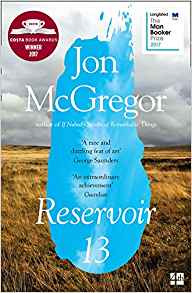
When thirteen-year-old “Rebecca, or Becky or Bex” goes missing from the National Park (probably Peak District) village where her family has been staying, police, helicopters and volunteers are deployed to comb the area, with frogmen searching the nearby numbered reservoirs, all to no avail. Ordinary life goes on, but even more than a decade later people continue to speculate as to what may have befallen her, and the story of her disappearance is sufficiently well known for the young friends who knew her in the village to be quizzed, much to their discomfort, when they go off to university.

As I believe has been the case in his early novels, Jon McGregor seems less concerned with the conventional plot-line of revealing how and why a crime occurred, and more interested in the relationships between his characters, in this case so numerous that it repays the effort of making a note of them from the outset, since they will all reappear at some stage.

In a kind of low key but subtly gripping soap opera, laced with insights, inferences and flashes of humour, he portrays couples getting together, splitting up, sometimes reconciling, people gaining and losing their jobs, dealing with the problems life brings, struggling to communicate, finding themselves, or not. The village customs, farming and surroundings are described in minute detail, on one hand the man-made activities of quarrying and reservoir maintenance which change continually, but also the closely observed world of nature with its seasonal rhythms, as indicated by the continual repetition in the book, and the “red in tooth and claw” violence involving foxes and badgers which goes unpunished, in contrast to the human world where people can only escape justice by concealing it.

I’m not sure whether Jon McGregor spends a long time experiencing the natural world or has done a great deal of research, but there are many beautiful, poetic passages. “The sun didn’t set so much as drift into the distance, leaving a trail of midsummer light that seemed to linger until morning”. “A heron hoisted into the air, hauling up its heavy wings, and letting its feet trail out as it flew” and so on.

Some readers may find the repetition of activities and phrases unendurable, and on occasion I was irked by yet more springtails (insect-like organisms) burrowing into yet another piece of rotten wood, and the reference to yet another “well-dressing”, clearly a tradition that could not be allowed to lapse. But I could see that all this was deliberate and necessary to convey the reality of life as time passed, just as each short section had to be written without paragraphs or speech marks, to avoid disrupting the flow of one’s concentration.

Jon Mcgregor is also very skilful in sustaining the tension, and sense of anticipation. Every walk in the woods with Nelson the dog, or drop in the level of the reservoir, could reveal some vital piece of evidence about Becky, which could of course be tantalisingly missed, or even lead to discovery of a body. His insistence on ambiguity may be hard to accept, but is again an aspect of real life. It also allows the reader who “wants to know what happened” to speculate on the clues gleaned.

“Beloved” by Toni Morrison: the guilt of the innocent

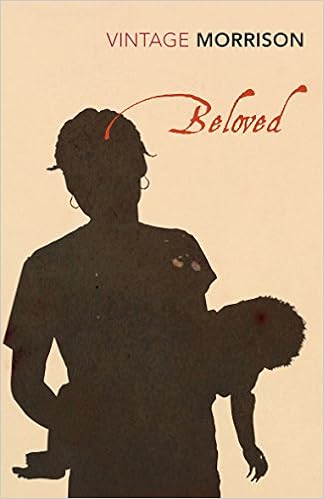
In the aftermath of the American Civil War, former slave Sethe persists in living with her sullen daughter Denver in the Cincinnati house widely believed to be haunted by the angry ghost of her murdered baby, whom she named “Beloved”, having earned the cost of carving this on her headstone by having sex with the engraver, regretting too late not to have spent enough time to pay for “Dearly” to be added first. Her life seems to improve with the arrival of Paul D (so named by his former master to distinguish him from Paul A or Paul F) who breaks a table in his wrestling to cast out the spirit of the furious baby, which has already driven away Sethe’s two sons. Yet her life is at risk of being taken over and perhaps destroyed by a second newcomer with whom she becomes obsessed, the oddly vacant young woman who calls herself Beloved and inexplicably seems to know about aspects of Sethe’s past life without being told.

Toni Morrison was inspired to write this novel by the real-life situation of Margaret Garner, the escaped slave who killed her child rather than have her suffer enslavement in turn. This prize-winning modern classic succeeds in portraying the fundamental evil of slavery, namely in depriving a person of his or her sent of identity. Her characters are bought and sold like objects or livestock, even by relatively humane owners. Relationships are not respected, nor even recognised with small children often unable to identify their mothers, husbands and wives are separated, women violated.

Continually risking bold experimentation in her style, Toni Morrison gave free rein to her vivid imagination and powerful, often poetical prose. Descriptions of childbirth and acts of violence are not for the squeamish. By contrast, the writing is often unexpectedly leavened by observations of wrily humorous clarity.

In the face of strong endorsements by famous feminist writers at the end of my copy of this novel, I hesitate to criticise this book. As an African-American, Toni Morrison was clearly well-qualified and justified in writing impassioned condemnations of the enduring evil effects of slavery long after its abolition. So why did I find it such hard going? This was only partly due to the frequent grimness of the subject matter. Although this will put some readers off, it is clearly relevant to the tale.

Despite appreciating the frequently used device of gradually revealing key facts, one problem for me was the confusing, often repetitive drip-feed nature of explanations for a number of intriguing questions. Why, how, even by whom, was Sethe’s baby killed? What really happened at the inaptly named “Sweet Home” where Sethe and her husband Halle worked for years until the estate was taken over by the sadistic “Schoolteacher”?

The worst aspect for me was what I believe Toni Morrison disliked to hear called “magic realism”. I concede that, being illiterate through no fault of her own, unable to tell the time except for knowing that it was noon when both hands of the clock pointed upwards together, Sethe was likely to be susceptible to superstition. Also, in a deprived slave community, tales of the supernatural passed down from tribal ancestors were all Sethe had of a personal history. However, are readers really expected to believe that the murdered child continues to make her presence felt as a kind of malign poltergeist, and that after being driven away by Paul D she is reincarnated in the body of Beloved who duly appears? Some scenes so resemble corny ghost stories that they seem to me to detract seriously from the calibre of the novel and muddy the “genre”.

I prefer the interpretation that the atmosphere in the house was tainted by Sethe’s sense of guilt and the opprobrium of the local community for what she had done, and that she and the young woman calling herself Beloved by coincidence were both disturbed, confused and wanting certain things to be so, such as having respectively a mother-daughter or a compensating love-vengeful hate relationship.

On reflection, having laboured through this novel, it rose in my estimation, and I should reread some passages to appreciate their originality and worth, but the tendency to melodrama, excessive sentimentality and an overblown style deter me from this.

“The Lost Man” by Jane Harper: the sins of the father

Even a fit forty-year-old like Cameron Bright cannot survive long in the Australian outback without water. So why was his dehydrated body found nine kilometres from his abandoned car, well-stocked with food and water? And why should he choose a painful death at a site which in his youth he had made the subject of a prize-winning painting: the grave of the stockman who had met a similar fate in the wilderness? Why should a well-liked family man with two young daughters and a successful business, with so much to live for, commit suicide? His brother Nathan was much more likely to have done so, being more obviously “ a lost man” struggling with an unprofitable landholding and debts accumulated from an acrimonious divorce.

This gripping psychological drama gradually reveals the truth about Cameron’s death, together with reasons for the intense hostility towards Nathan in the tight-knit, inward-looking local community and the complex way in which the three Bright brothers, Cameron, Nathan and their much younger brother Bub have been damaged by their father’s brutality, and also their mother’s inability to protect them.

Jane Harris puts her past experience as a journalist to good effect, in handling an intriguing plot, developing rounded characters, all flawed yet mostly commanding sympathy, in the fascinating setting of the outback which she appears to know well, yet I believe in fact researched for the purpose of this book. So we learn how people have adapted to living in a harsh, even dangerous environment, to which they have become attached. They must leave a note of their whereabouts every time they travel any distance from home, and failure to comply with certain conventions of mutual support is regarded as akin to a criminal offence. Even the system of home schooling, learning on line with all its potential shortcomings for young, not particularly motivated children with hard-pressed parents, is given a mention.
My only mild criticism of this novel is that, after the unflinching realism of much of the book, the ending seems a little too suddenly bland and “happy ever after feel-good”, which many readers will of course prefer to a more ambiguous “literary” conclusion.

Having found all the author’s first three novels page turners with the potential to be made into films, this seems to me to be the best.

Convenience Store Woman by Sayaka Murato – relative normality

“relative normality”

Logical to a fault, as the other children weep over a dead bird, Keiko appals her mother by suggesting they take it home to cook for her father who has a penchant for eating small birds, grilled Japanese style. This is just one example of the possibly autistic behaviour which sets her apart from “normal people”.  As an adult, despite her university education, Keiko deals with her situation by working for eighteen years in a  clinically bland convenience store, where the rigid routine provides a clear framework to guide her actions, together with the speech patterns and fashion sense of her co-workers for her to imitate. When her small circle of acquaintances begin to criticise her for being unmarried, Keiko comes up with yet another solution which seems pragmatic to her but ludicrous to others.

Although promoted as “hilarious” and “funny”, this book  struck me as quite sad,  in showing how those who do not “fit in” may be  mocked and excluded.  Beneath its quirky approach there lies quite a subtle exposure of the arbitrary, even ludicrous, nature of much accepted “conventional” behaviour, into which people are led by the desire to conform or are conditioned to adopt by, for instance, the promotional offers in the convenience store. Since I believe that Japanese behaviour is more conformist and group-oriented than say, in Britain, a reader may fall into the trap of feeling a little superior, but on reflection, I suspect that  the truth revealed in this book can be universally applied, prompting each of us to question the norms of our own society.

Logical to a fault, as the other children weep over a dead bird, Keiko appals her mother by suggesting they take it home to cook for her father who has a penchant for eating small birds, grilled Japanese style. This is just one example of the possibly autistic behaviour which sets her apart from “normal people”.  As an adult, despite her university education, Keiko deals with her situation by working for eighteen years in a  clinically bland convenience store, where the rigid routine provides a clear framework to guide her actions, together with the speech patterns and fashion sense of her co-workers for her to imitate. When her small circle of acquaintances begin to criticise her for being unmarried, Keiko comes up with yet another solution which seems pragmatic to her but ludicrous to others.

Although promoted as “hilarious” and “funny”, this book  struck me as quite sad,  in showing how those who do not “fit in” may be  mocked and excluded.  Beneath its quirky approach there lies quite a subtle exposure of the arbitrary, even ludicrous, nature of much accepted “conventional” behaviour, into which people are led by the desire to conform or are conditioned to adopt by, for instance, the promotional offers in the convenience store. Since I believe that Japanese behaviour is more conformist and group-oriented than say, in Britain, a reader may fall into the trap of feeling a little superior, but on reflection, I suspect that  the truth revealed in this book can be universally applied, prompting each of us to question the norms of our own society.

Short, neatly plotted, this first person narration in an excellent English translation  proves more thought-provoking than I had expected.

“Mersault, contre-enquête” by Kamel Daoud – just existence. Translated as “The Mersault Investigation”

It is not an entirely original idea to reverse a situation found in the plot of a famous classic, as did Jean Rhys when she wrote “Wide Sargasso Sea” from the viewpoint of Mr Rochester’s wife Bella in “Jane Eyre”, before she married him and was incarcerated in his house as a lunatic.

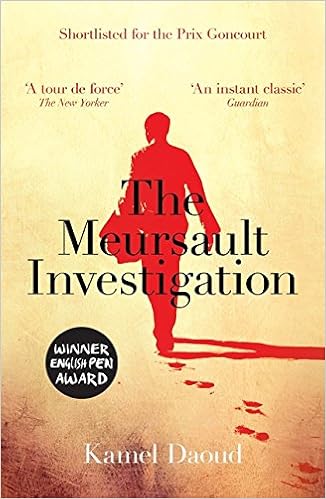
In this novel, the Algerian author has focused on the younger brother of the anonymous Arab shot by the Frenchman Mersault in the disorienting, blinding sunlight over the shimmering sea off an Algiers beach in Camus’s exploration of absurdism in the context of a pointless murder.

Kamel Daoud portrays the victim’s brother whom he names Haroun, to be found, several decades after the shooting, reminiscing in a local bar to the visitor from France who has come to probe him about the murdered Arab in the novel.

Haroun is embittered by the appalling effect of the death on his life. Not only did he lose the kindly young man who supported him after their father had abandoned the family, but their mother was clearly driven mad by the event, continually searching for the body, the lack of which to provide irrefutable evidence of her son’s death meaning that she has been unable to claim a pension. She appears emotionally cold towards the surviving son whom she seems to have resented for being the one to survive. The discovery that the murder has become the topic of a best-selling novel, bringing fame and fortune to the writer, only adds to the sense of outrage. Yet the ultimate insult is the failure to give the victim a name, remedied here by the information that it was in fact “Moussa”. ( It seems that the brothers names are Moses and Aaron in English).

Strictly speaking, this is not a counter-enquiry into a murder, but a somewhat cynical portrayal of Algeria, post the trauma of civil war and independence, casting an absurdist light on the religious bigotry used as a tool of social control, the enduring poverty, stagnation, corruption and betrayal of vision .

It is beneficial to have read “l’Étranger” first because of the frequent references made to it. When I reread it after finishing “Mersault, contre-enquête”, I was struck by how often Daoud mirrors events in the earlier novel: in “L’Étranger” (The Outsider), the opening sentence tells us that “maman” has died today, whereas in the later novel, “maman” is still alive. Just as Mersault describes his close observation of the comings and goings in the street below the balcony of his apartment, Haroun portrays the view from his overlooking the busy square which represents a microcosm of life in Algiers. In this, both create a strong sense of place.

Similarly, Mersault’s expression of his atheism, and his existentialist view of the absurdity of life (although he does not use these terms), reactions which so outrage both his defence and the prosecution, are imitated by the narrator Haroun’s ranting against God and the influence of the mosque. This led to the issue of a fatwa against the real-life author for blasphemy, which rather seems to justify his criticisms.

Note the parallel irony: whereas Mersault’s essential crime seems to be that he did not show grief at his mother’s funeral, for Haroun it is that he killed a Frenchman in symbolic revenge after Algeria gained independence rather than before.

Although this book has won much praise, I was sorry to find it too repetitive and meandering, with a frequently somewhat overblown style as read in the original French. There are a few striking passages such as the description of the narrator’s mother’s face in old age: a kind of amalgam of the faces of all his ancestors, passing judgement on him. Although only about 150 pages in length, the novel at times seems too long for its relatively thin substance.

This novel also reminded me of the much more engrossing “The Reluctant Fundamentalist”, perhaps because it employs the same device of a narrator button-holing someone to unburden himself, Ancient Mariner-wise.

Based on an interesting premise with great potential, this novel could have been executed better. Prompted to reread “L’Étranger”, the clarity of the prose, narrative drive and tighter structure defined for me why that is the superior novel, even though Mersault’s almost autistic lack of emotion and engagement in an absurd world is less explicable than Haroun’s very understandable anger over his lot.

It also struck me that, for Camus, although the book is located in Algeria, his country of origin, existentialism is the main point, whereas for Douad, the tragedy of the failed project of Algerian independence is a major concern.

April Lady by Georgette Heyer: Taking a gamble

April Lady by [Heyer, Georgette]

In Regency London, not quite nineteen-year-old Nell is desperate to obtain the sum needed to pay the bill for an expensive dress which she had forgotten when assuring her husband Cardross that she has no further outstanding debts. She is also consumed with guilt over lying to him over the use of her generous allowance to finance her brother’s losses at the gaming table, which her husband has forbidden her to do. Instead, she lets him think that she has foolishly  taken up gambling herself and incurred losses of her own. All this is making Cardross  regret having ignored the advice of friends who advised against his marrying  the daughter of an inveterate gambler who has ruined his aristocratic family with his addiction. The situation is aggravated by Nell’s concealment of her genuine love for her husband, as she follows her mother’s advice to be compliant at all times but not to appear too needy, and certainly not show any resentment over his mistress. Cardross also has to deal with a spoilt, capricious young half-sister, who is determined to marry a  respectable if dull but poor young man who is not her social equal. As matters reach a head, how will they be resolved?

Georgette Heyer was a prolific author, admired from the 1930s to her death in 1974 for  her immensely detailed knowledge of Georgian culture, even down to the upper class slang in vogue (now quite hard to follow and frankly the most irritating aspect of the novel). Reading this out of curiosity and expecting to find vacuous froth, I was surprised  how much it engaged me. Tightly plotted, it rattled along at a lively pace with well-developed characters.

I believe that Georgette Heyer was influenced strongly by Jane Austen, and  sacrilegious as it may sound, she holds her own in comparison. There is a clear parallel in the wry wit, although Heyer is actually much funnier.  She provides more detail of, for instance, customs which Jane Austen had no need to explain at the time, also tending to focus on upper class families, some even accustomed to socialising with the Prince Regent, whereas Austen’s theme was more often the lives of the country gentry.

Although I am not sure to what extent it is intentional, I like the way the author reveals the flaws in the aristocratic Regency world:  despite an obsession with conforming to expected norms and not lowering “the ton”, the idle rich fritter away their time gambling and flirting, particularly at masked balls. Even a “good”,  generous and loving husband thinks nothing of dominating and infantilising his young wife – also, he does not  apply his high moral standards to himself. A young man wastes his time on silly pranks because he is not expected to work at some activity which would employ his energy and ability, and so on.

If all Heyer’s  books are like this, reading them could pall quite quickly like too much cream meringue, but I would not regret reading her from time to time.

Miss Buncle’s Book by DE Stevenson

When her dividends dry up in the 1930a depression, Barbara Buncle sets about writing a book for publication to make ends meet, using the male pen-name of “John Smith” to cut more ice with the publisher. Since, to use her own words, she has “no imagination” this is inevitably about the doings of the inhabitants of her village of Silverstream, whom she has known for years. Mr. Abbott of Abbot and Spicer agrees to publish the book because the characters seem so real, and is also intrigued by the puzzle as to whether the author is writing subtly “tongue in cheek” or “a very simple person writing in all good faith” based on acute observation. The bestselling “Disturber of the Peace” provokes outrage among those who discover that they have been blatantly parodied in the clearly recognisable village which has been renamed “Copperfield”. They are determined to track down and punish “John Smith”, but even when some suggest that the author may be female, it does not occur to them that she might be the dowdy and insignificant Barbara Buncle. Under pressure from Mr. Abbot to write a second book, what will she reveal next, will she be exposed and, if so, with what outcome?

I was initially reluctant to read this for a book group, expecting it to be dated, trivial and at best provide a bit of escapism from the modern world. On one level, it is all these things, but is also an insight into a past way of life, and written with the same kind of clarity and humour as apparently employed by Miss Buncle, it carries the reader along.

Dorothy (D E) Stevenson wrote stories compulsively from her childhood onwards and became a prolific and successful novelist of mainly romantic fiction, since then fallen out of print for decades. It is interesting to speculate how she would have used her talent in different circumstances: if born a man like her father’s cousin Robert Louis Stevenson, she might have written adventure stories; if born now, she might have applied her fertile imagination to TV drama series. As it was, she followed the conventions of her time in which a widow living beyond her means could not think of finding a job but had to scheme to trap a wealthy husband; a vicar’s wife who found it extravagant to hire a taxi still had three servants and a nanny; men dominated their wives who had to resort to subtly manipulating them without appearing to; the two women who lived together were never explicitly referred to as lesbians, but the intelligent one who had never been allowed to get educated and develop her brain is shown playing the “male” role to support her weak and indecisive partner, and so on.

So, in writing about a world in which “the good ended happily and the bad unhappily – that is what fiction means”, Dorothy Stevenson is worth reading mainly for her humorous observation of human nature.

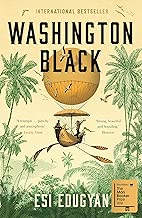
Washington Black by Esi Edugyan: relentless quest

Washington Black: Shortlisted for the Man Booker Prize 2018

Born into captivity in 1818 on the inaptly named Faith Plantation in Barbados, George Washington Black wields a hoe to weed the fields from the age of two, progressing to cutting the sugar cane by the time he was ten years old, with only Big Kit, the tough, superstitious slave woman from Dahomey to look out for him. The arrival of a sadistic new master in the form of Erasmus Wilde brings a turn for the worse in an already bleak situation, Big Kit tells “Wash” of her plan to kill them both, as a means of escape back to freedom in their African “homeland”, but fortunately for him, holds back from committing this extreme act. Wash then catches the eye of the master’s brother Christopher, known as “Titch”, a very different man, liberal-minded and obsessed with scientific discoveries, including the perfection of his “cloud-cutter”, a kind of hot air balloon for which Wash will “provide ballast” but also prove useful as an assistant, with a natural talent for drawing.

When Wash and Titch are forced eventually to escape from the plantation, the book becomes a mixture of adventure yarn and right-of-passage novel. The scene moves from Barbados to England, even Morocco, via America and Nova Scotia. Undoubtedly original and imaginative, the prose includes some striking passages, such as the description of the octopus which Wash encounters and catches when he has somewhat unbelievably dived down to the shallow seabed with minimal training.

I chose to read it partly because I was so impressed by Esi Edugyan’s earlier work, Half Blood Blues, with the added incentive that both books were shortlisted for the Man Booker Prize. However, I have a number of reservations. The plot hinges on some highly implausible dramatic incidents, which I suppose could be accepted on a par with “magic realism”, but there is also a reliance on far too many unlikely coincidences. It is frustrating to know that the book was inspired by real events, without knowing exactly what they were.

I realise that the dialogues may be intended to reflect the speech of the period, but they often seem stilted and artificial, while apart from Wash, the characters are not developed as rounded, convincing individuals. Although Wash is a sympathetic hero, I did not believe that an illiterate and brutalised slave could narrate this tale at the age of only eighteen, using such a sophisticated vocabulary and displaying so great a level of knowledge and understanding, based on perhaps a maximum of four years in Titch’s company, spending the rest of the time in unskilled manual labour. This seems like yet another case of a first person narrator being given the “voice” of the author, a problem which could have been avoided by writing the whole thing in the third person.

In its defence, the book also includes some intriguing themes, such as the extent to which, perhaps because of suffering in early life, some of the main characters cannot sustain or even form relationships, and are driven to wander rootlessly through life, even viewing death as a means of escape to freedom. Another is how, even when he is technically free, Wash may still be exploited by white men who perceive themselves as liberal and anti-slavery.

In the case of this uneven novel with brilliant patches, duller tracts which lack narrative drive, and an ambiguous ending, I was left a little unsure as to what the author was trying to achieve.

“Under the tree” – Hell is other neighbours

This quirky and at times very black Icelandic comedy explores how uneasy relations can deteriorate to a total loss of any sense of proportion and control between suburban neighbours. In this case the contention is over a tree which one couple wants to keep, while the other seeks to have it pruned back sharply if not felled to reduce the excess shade.

The film gradually reveals the underlying psychological tensions which may be causing the characters to behave unreasonably. Has a mother been driven slightly mad by the disappearance and presumed suicide of her favourite son? Does her other son upset his wife to the point of destroying their marriage and losing custody of the daughter he loves because he is also deeply unhappy over the loss of his brother and the sense that his mother wishes he had been the one to die? And so on.

None of the characters is very likeable, apart from the father who takes refuge from problems from going off to sing with his male voice choir. Everyone is flawed, driven to take actions which only compound the problems.

I liked the sense of place, and insights into Icelandic culture.

It is a watchable and entertaining film up to its possibly gratuitously violent and bleak ending.

“Unreliable sources” by John Simpson: Truth to tell

Unreliable Sources: How the Twentieth Century Was Reported

With a journalist’s frequent gift for bringing history alive, John Simpson employs many anecdotes and quotations from newspapers of the day to analyse the reporting in Britain of the major events from the Boer War around 1900 to the controversial Iraqi War of 2003.

I was most interested in the first half of the C20, that is the period I had not lived through so could not recall, and was intrigued to learn that the tabloid “red tops” of today were known around 1900 as the “yellow press” after a US comic strip. The phrase was coined by the New York Press to describe the sensational, exaggerated and often misleading form of popular journalism which was copied in Britain by newspaper owners like the Harmsworth family.

Although not apparently as influential as Murdoch in his heyday, the early C20 tycoons clearly interfered a good deal in the content of the newspapers they owned. For instance, Lord Rothermere, an ardent admirer of Hitler from the 1920s, wrote an editorial for his Daily Mail in 1933 stating, “The minor misdeeds of individual Nazis would be submerged by the immense benefits the new regime is already bestowing on Germany”. Rothermere was “the loudest supporter” in Fleet Street of Franco, announcing before the fateful Spanish Civil War that he was “the bright spot on the horizon”. At the same time, the press baron favoured the rise of Oswald Moseley, personally writing an article for the Mail entitled “Hurrah for the Blackshirts!” without criticising their fascist tendencies. Yet when World War Two began in earnest, the tone changed and a Daily Mail journalist once praised as “the man who knows the Nazi leaders” was writing about the “staggering heroism” of the “weary but indomitable” British soldiers evacuated from Dunkirk in an exercise portrayed positively as an achievement.

John Simpson is scathing about the journalists who, from the safety of hotels well away from the battle lines, invented reports based on second-hand sources, praising the bravery of soldiers in “Boy’s Own” terms rather than recounting accurately the true grim conditions. Admittedly, communication was harder to conduct in the early C20, and throughout there have been the constraints of state censorship, and the need to “maintain morale”, combined with the prejudices of overweaning newspaper magnates as described above. Yet, as recently as 1999, Murdoch’s “Sun”, amongst others, was apparently distorting facts in reporting of the bombing of Serbia in its “Clobba Slobba” articles, in an attempt to keep the public “on side”.

Battles are the dominant theme, with the exception of the Abdication crisis over Edward VIII’s desire to marry the twice-divorced American socialite Wallis Simpson. In this case, while the US press was reporting the scandal in detail, British newspapers were “victims of a more than usually painful attack of discretional lock-jaw” which was self-imposed since neither the government nor the police had applied any ban to reporting of the affair. Although it was asserted some years after the event that the Mirror had dared to break the story of the affair, John Simpson suggests that, despite having accumulated plenty of evidence, every single British newspaper “failed in its duty to tell people what was really going on, because its editor thought it would be intrusive, distasteful , disloyal or damaging to do so”. This may be compared with reporting on the Royal Family since the 1980s, culminating in no-holds-barred criticisms of Prince Andrew and discussion of the future of the monarchy during the December 2019 general election.

John Simpson suggests that it was probably during the Suez Crisis in the 1950s that newspapers began the attempt to analyse events seriously rather than simply outline the facts, or slavishly toe the government line. A surprising number of titles survived the century, with Murdoch playing a positive role in keeping, for instance, the Times going, although his political and commercial interests seem to have encroached on its independence. Simpson condemns the downward drive in standards which misused modern technology from the 1980s, such as illegal phone taps to infringe excessively on personal privacy. He argues that the Guardian and the Telegraph “probably come out of it best” in terms of independent-minded journalism.

I was a little disappointed by the conclusion which seems somewhat rushed, with a last-minute focus on the Iraq War which justifies a chapter in its own right, giving more space to expand on the influence of “spin doctors” and a “dodgy dossier” with the false claim that Saddam Hussein had the power to attack the UK “in 45 minutes”, which misled MPs to vote for war without the approval of the UN.

I would like Simpson to have included more about the role of the more “impartial” BBC, often seen by the printed press as a threat. Published in 2010, the book is now somewhat dated as regards the growing importance of the internet as a source of news. Inevitably, there is not enough space to explain fully the political background to many of the situations covered, but at least it inspires the reader to find out more about them.