This is my review of The Hidden by Tobias Hill.
Hill's prose is unusual, striking and memorable – like poetry, some passages merit rereading. They convey with power and strong visual imagery- the feel and appearance of the landscapes of Greece. I also learned quite a few new words – did you know that "laniary" means canine and "ophidian" indicates "snake" – an apt description for one of the characters? Far from being dull, the inclusion of the anti-hero Ben's "notes for a thesis" are interesting and informative – reminding me of the Spartans' harsh, pragmatic approach to life, and evoking parallels with modern issues of fundamentalism, eugenics and the fanaticism of idealistic groups and cults. The experience of taking part in a dig is described well, again with some interesting insights, such as the fine line between the excitement of a valuable find, and the avaricious desire to possess and profit from it. Some of the dialogue is quite effective in capturing the personalities of the key characters, and their relationships.
On the downside, I agree with those who find the plot a little lacking. Certain critical events seem to happen abruptly, without the potential build up which increase both the tension and their plausibility. Ben seems to make sudden leaps of understanding on evidence which escaped me until then – although I quite enjoy being made "to work" as a reader, and not having everything spelt out too baldly. The final climax is not as shocking as other reviewers have led me to expect. The lack of inverted commas and "he said, she said" etc makes some of the dialogue hard to follow. Even after rereading some passages several times, I was unable to deduce who said what – and some observations seem very obscure. This is at times an unhelpful distraction.
Also, the characters are not developed very fully. and often seem two dimensional or unconvincing. I do not really care what happens to any of them. Some plot lines are left dangling as loose ends, in particular the time Ben spends working in an Athens restaurant, where the tensions built up between his work mates and the proprietor's son do not lead to any dramatic climax.
Overall the quality of the writing is excellent in parts, the story gripped me to the end, but more care over the portrayal of characters and the development of the plot would have made this the outstanding novel, which it falls short of being.
4 Stars
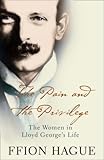
 A serialisation of this book on Radio 4 caught my attention. A storyline intriguing enough to succeed as a novel was made all the more interesting through being based on real events – another case of truth being stranger than fiction. How could Lloyd George maintain the active political and moral support of his wife and his mistress when they were both fully aware of the situation even if choosing to delude themselves up to a point? Ffion Hague interprets in a compelling style the complex motivations and emotions involved. The way in which these two women played complementary roles to meet Lloyd George’s needs made me wonder how consciously he chose these two particular people for long-term relationships in an apparent sea of casual promiscuity.