Striking if Overblown Insight on Life in Trinidad

This is my review of The White Woman on the Green Bicycle by Monique Roffey.

My view of this book see-sawed violently as I read it. Starting with the over-used ploy of the description of a shocking event, in this case the beating of a young boy by corrupt policemen, the novel launches into a study of Englishman George Harwood and his French wife Sabine, who have lived on Trinidad for fifty years. It dissects their rum-fuelled love-hate relationship with each other and the island.

For many pages I read without feeling absorbed, noticing the stilted, banal scenes, characters who did not quite ring true. I was interested to realise that George's interviews for the " Trinidad Guardian" are with real people still living at the time of writing, and wondered if one of them , the famous calypso singer "The Mighty Sparrow" takes exception to being described as the suspected father of a poor, illegitimate Trinidadian boy.

Gradually, I found myself impressed by some of the vivid descriptions, say of the colourful island vegetation, which I found to be very apt when I googled their images. For instance, we see George's favourite month of May described in language which implies his casual promiscuity.

Sabine's habit of talking to the surrounding green hills which she sees as a voluptuous reclining woman seducing George and her appreciation of Trinidad's beauty, contrast with her hatred of the country's corruption and its failure to progress once free from white domination, and the way it makes her feel an outsider.

She hates George too at times for choosing to ignore all this, so that he can exploit the situation, indulge in the free way of life, the scope to grow rich through land purchase, enjoy "the sounds and smells….smiles and shapes", the "bewitching" local women and booze, in a way that would never have been possible in England.

The first part of the book proves to be a novella set in 2006, building up to a dramatic conclusion which I felt for a time should be the end of the whole book. Since the next section moves back in time, to the Harwood's innocent arrival on Trinidad in 1956, I had to force myself to continue because of the numerous hints already provided as to what had happened in the past.

I remain unsure as to whether a structure that moves back in time is a good idea. The reader may gain a sense of "one-upmanship" through knowing more than the characters, but on balance this does not compensate for the loss of suspense.

However, once the narration becomes first person, Sabine's viewpoint from part 2 onwards, it seems to come more alive, grow more moving, and the quality of the writing also improves.

I remain unconvinced by the idea of Sabine loving the unsuccessful leader Eric Williams, the first black leader of an independent Trinidad who promises the people progress, but fails to deliver. I also think the story is not just about the exploitation of Trinidadians first by whites, then by their own leaders. It is also about issues of feminism – the way some women are attracted by powerful men, and allow themselves to be dominated by men, as well as the sense of regret many women have over failing to achieve much in their lives.

The book "goes on too long" and the attempt to create a resounding finale in 1970, after moving back from 2006 to 1956, then forward again, makes for a final chapter with some of the overblown or ludicrous paragraphs which mar an otherwise striking novel.

⭐⭐⭐⭐ 4 Stars

A Wake Up Call or Slick Entertainment?

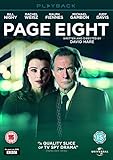
This is my review of Page Eight [DVD] [2011].

Apparently David Hare wanted to "update" a George Smiley-type M15 yarn. Bill Nighy plays an intelligence officer who has spent so many years concealing his feelings that he has become a shell, who finds it hard to give or receive real love or trust.

He is intrigued by a beautiful neighbour (Rachel Weisz) who seeks justice for her brother, killed by the Israelis during a demonstration against their destruction of Palestinian housing: Issue No. 1 on Hare's agenda, an important one, and I was keen to see this aspect developed.

Nighy's boss (Michael Gambon) has discovered that the Prime Minister (a menacing Ralph Fiennes beneath his smooth charm) has collaborated with the US government over the concealing of evidence of torture, but kept this information from his own ministers and intelligence officers, thereby seriously undermining them. It is clear that Gambon wants Nighy to take action over this undemocratic "betrayal" and Nighy feels a belated compulsion to take a moral stand. All this amounts to Issues 2 and 3: shades of Blair's collusion with the Bush regime over weapons of mass destruction, and possible British involvement in torture to get information on terrorists.

I agree that the play is witty and often amusing, a definite TV Saturday night improvement on corny whodunnits. It is slick and well-acted, as one would expect from the all-star cast, with fast-changing scenes and cryptic dialogue that sounds clever, but the issues raised are not fleshed out. The focus is on personal relationships, but these are generally brittle apart from the warm friendship with Nighy's boss. We see Nighy with his daughter, his mistress, his ex-wife, new neighbour, jealous colleague (a splendidly vicious Judy Davis) etc but all this takes up too much time to develop the rest of the plot in depth. This matters since we need to understand why Nighy is so cynical, and what is so serious that it shakes him into "cutting loose". Or is it just true love that galvanises him into using illegal means to a moral end? If so, the relationship with Rachel Weisz is not totally convincing.

Without giving too much away, Nighy compromises on one issue to resolve another. He "plays god" as to which scandal should be suppressed and which revealed, and his choice is based on personal, even self-interested considerations. This could be the intended point of the drama, but I am not sure that it is.

Although I am sure that Hare is keen to engage and enlighten us as regards topics on which he feels passionately, and I share his concerns, I was left quite unmoved by the play, without any fresh insights. The end result is all somewhat superficial and shallow, leaving me thinking "So what?"

⭐⭐⭐ 3 Stars

Impressive Courage or Ignorance is Bliss

This is my review of Wagons West: The Epic Story of America’s Overland Trails by Frank McLynn.

I was inspired to read this after watching the recent film about "Meek's Cutoff" in which a small number of pioneers hire an unreliable guide to show them a short cut on the Oregon Trail. The true story proves to have been much more dramatic, involving more than 1000 people and perhaps 300 wagons. Soon clearly lost, the party ran dangerously low on food and fresh water at times, or found more than they bargained for in the form of torrential rivers which could only be crossed by dismantling their wagons piece by piece. Resentment against Meek rose so high at one point that he came close to being hanged from a gibbet made from raising up the tongues of three wagons and tying them together in the kind of summary justice often practised in a society which had to maintain its own system of law and order. In fact, the travellers were often remarkably lenient. The punishment for killing a man in angry self defence might be expulsion from the group, perhaps to be readmitted fairly quickly.

"Wagon's West" provides a useful history of the background to the great pioneer movement which began in earnest in the 1840s. The young nation of the United States did not yet clearly control the western part of the continent: Oregon was still effectively a British province, and California part of the decayed Mexican Empire. The first pioneers were neither religious refugees – apart from the Mormon trek of 1847 to establish Salt Lake City – nor were they the poorest elements of society. It took moderate means to assemble a wagon and provisions for the trek along the Oregon Trail, or to branch off it at the staging post of Fort Hall to reach California.

I agree that the "blow by blow" account of the first great treks from 1841 is repetitive at times, and includes far too many characters for one to absorb. Clearer, better positioned maps would be helpful, together with a few more photographs, although Google images provide a fascinating accompaniment to descriptions of landmarks like Chimney Rock, or the many rivers, mountains and forts described en route.

McLynn conveys well the courage and resilience of people who would set out with only sketchy knowledge of a route which would cover hundreds of miles and take weeks. It helps one to understand why so many modern-day Americans are so opposed to the idea of relying on state aid. Of course, the travellers were mostly farmers or skilled craftsmen like blacksmiths, and used to living off the land. Descriptions of encounters with vast herds of buffaloes, using their droppings as fuel in the absence of timber for firewood, rattlesnakes bunking with prairie dogs, Indians who wanted some compensation for encroachment on their territory, stole horses or shot at oxen so they would be abandoned to provide them with food, the petty bickering triggered by the sheer boredom of travelling mile upon mile, or the hardship of running short of vital supplies, the crazy jockeying for position to take the lead, rather like the road rage of car drivers today – all this makes for a fascinating read.

Just when you feel that you have had enough, McLynn changes tack slightly, with a chapter on the infamous "Donner Party" who became stranded in snow on a treacherous cut-off, and may have resorted to cannibalism: other sources now dispute this horrific twist which McLynn presents as Gospel. The chapter on the Mormon Trek is particularly interesting, showing how an autocratic, manipulative leader, Brigham Young, maintained discipline to provide an impressive example of rapid colonisation. The Epilogue ends with the Gold Rush of 1848, which disrupted the former relatively orderly pattern of migration. McLynn describes how, in the craze to get to the riches first, people set out with too many goods and abandoned them after only a few miles, littering the landscape, so that the traders who had sold them could easily collect them up again for resale. The Westerns with which we are so familiar do not appear at all far-fetched.

⭐⭐⭐⭐ 4 Stars

Morality is not Clear Cut

This is my review of In A Better World [DVD].

This skilfully shot, well-acted and tightly scripted Danish film deserves its Oscar. It will appeal to people of all ages and nationalities. You can sit back and view it simply as a "good yarn" about a couple of barely teenage boys who slip into delinquency for moral reasons, following a warped logic which may stem from unintentional neglect by their well-meaning, hardworking middle-class parents. If you wish, you can ponder the film's messages on a deeper level, focusing on the issues which strike a chord with your own concerns. In fact, the last thing this film does is preach. Instead, it highlights the complexity of morality.

Is Anton, the idealistic, pacifist surgeon to be admired for devoting his working life to caring for people in what looks like a poverty-stricken refugee camp somewhere in Africa, or is he selfishly avoiding his guilt over his estranged wife and neglecting his two young sons back in Denmark in the process? Is he right to agree to treat the local villain when his black colleagues wish to leave the man to rot? Has he failed morally when he is eventually driven to give way to righteous anger? Is there one moral standard for a brutal, impoverished developing country and another for liberal, affluent Denmark? Is Anton hopelessly naive to insist that "violence only begats violence" to the extent that he literally "turns the other cheek" when an aggressive man punches him in front of his two sons, one of whom is Elias, with his inaptly named friend Christian a sceptical observer?

Christian's fierce sense of justice – his determination neither to be bullied, nor to let a bully go unpunished – seems more realistic, but he takes it too far. To what extent can his behaviour be condoned as a reaction against grief over his mother's death, and his father's inability to communicate honestly with him? How much more harshly would Christian and his tag-along sidekick Elias be punished for their attempts to take justice into their own hands if they were working class kids?

I agree that the ending is a little trite, and for that reason have withheld a star, perhaps unfairly since you could argue that a predictably gloomy Scandinavian ending could "turn off" more viewers than it satisfies. The plot, often shocking and sad, is saved from grimness by frequent touches of humour. After Anton's rather unwise confrontation of a bully in his workshop, to try to demonstrate to the boys how words win out over physical violence, Christian astutely observes, "But he didn't look as if he thought he's lost!" Later, when the two boys construct a potentially lethal bomb, they choose to test it out on the school project over which they have laboured for days. Their excitement over the explosion completely overrides any concerns about the waste of their work, or how they will explain its disappearance. The earnest ineffectiveness of the teachers at the boy's school is also entertaining.

There are moments of pathos, say in Anton's attempts to build bridges with the wife who loves him but cannot accept his past infidelity, or in Christian's father's halting attempts to speak of his complex emotions over the painful death of a wife to whom he may not have been faithful.

I recommend this film as a gripping and thought-provoking human drama – a popular film which stimulates you to work out your own message.

⭐⭐⭐⭐ 4 Stars

Lest We Forget or Never Realised

This is my review of Sarah’s Key [DVD] [2010].

Films of bestselling books are often a disappointment. Although I had already read and been moved by (enjoyed is an inappropriate word for a holocaust theme) the book, I think the film has a better structure, in that it does not allow the "modern" thread of the story to dominate too much or become too trite and sentimental. It is also beautifully shot and very well acted.

A film version may also serve the purpose of bringing to a wider audience the atrocity of the "Vél d'Hiv", or rounding up by the French police of Jewish women and children in Paris for transportation to Auschwitz. The horror is compounded in this story by the "twist" that the young heroine, Sarah, too young to understand the situation, manages to lock her little brother in a cupboard "for his own safety" so that he is not part of the transportation. Much of the ensuing tension in the film rests on the question of whether she will be able to escape and if she will succeed in being reunited with her brother. The drama is intercut with a modern day thread: Julia Jarmond, an American journalist, married into a well-heeled and highly respectable Parisian family, is tasked to produce an article on the Vél d'Hiv. In the process, she discovers that her father-in-law grew up in the very apartment from which Sarah's family was transported, and which her architect husband is "doing up" prior to moving there with her and their daughter Zoe. Julia's growing sense of disquiet and preoccupation with the tragic events she is uncovering begin to affect her relationship with her husband, and her attitude to life.

This is a story about issues of responsibility and guilt, and how these continue to blight – or transform positively – people's lives into future generations. The book raises the question which polarises people: is it better to draw a line on the past and move on or can one only be whole when one has confronted traumatic events, even if the price is that one is permanently changed as a result? I feel that this important aspect was somewhat blurred in the film. For instance, the wrangling between Julia's relatives and their different views on whether or not one should bury the past is largely missing from the film.

I find Julia's husband Bertrand a more convincing character than in the book, although older and less irresistibly attractive than I had pictured. Julia herself seems more likeable whereas in the book she came across as over-emotional, self-absorbed and even selfishly thoughtless in the way she acts impulsively, keeping and breaking confidences on a whim – although all this is of course necessary to the story.

In short, this comes recommended as a well-made, totally absorbing, shocking but "life-affirming" film.

⭐⭐⭐⭐ 4 Stars

An Islamic Morality Tale

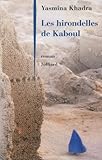
This is my review of Les hirondelles de Kaboul: Roman by Yasmina Khadra.

Although I read this in French – and it is excellent practice for improving one's French – I thought it best to post a review in my native English.

The swallows are the veiled women of Kabul, who flit through the ruined alleys like fugitives in a perpetual "half-life" of oppression.

It is ironical that all the reviews to date have been written on the English translation. The original French version of this tale – which I am sure must be "better" for those who can access it – uses vivid, striking language to capture the atmosphere of a war-torn city under the bigoted rule of the Taliban, which gives free rein to bullies and fanatics: people survive by keeping their heads down.

We see constant examples of casual brutality and sexism which shock our sanitised western sensibilities.

When a man admits to his worries over his sick wife, a friend condemns him for such a display of his own weakness. The remedy is obvious: he should cast his wife aside for a younger model!

A sensitive young man is aroused by the madness of a crowd to join in the stoning of a woman he does not even know, a momentary lapse on his part which costs him the love of his would-be emancipated wife.

As a final irony, men who feel "dishonoured" when a lunatic tears aside their wives' veils trample on the women in their haste to get at him.

This short, simple tale of cause and effect reminds me of a medieval morality play, as the lives of the various characters begin to impinge on each other and events build to a plausible but inevitably tragic climax.

I have no idea as to the authenticity of this story written by an Algerian army officer under a female pseudonym to avoid censorship at the time. Despite its bleak theme, and at times somewhat overblown prose (which somehow seems acceptable in French), the story of the chain reaction of damage wrought by fanatical repression remains in one's memory.

⭐⭐⭐⭐ 4 Stars

The Rites of Ming

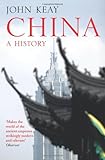
This is my review of China: A History by John Keay.

This thorough, systematic history provides an informative and readable textbook.

I like the introduction which challenges the myths which have arisen over The Great Wall, the Grand Canal, the Long March and even the Giant Panda. Although I appreciate the author's point that a history of China calls for a focus on the distant past because its culture is so "historically conscious" that "the remote is often more relevant", I am not sure that the author actually identifies this relevance very often! Yet it is salutary to realise how relatively advanced the Chinese have been for so long, compared to the west.

However, taking 300 pages to cover the first two thousand years without quite reaching the date of the Norman Conquest of England proved too much detail for me to absorb. My solution as a "general interest reader" was to move to Chapter 14 on "The Rites of Ming", the time span 1405-1620, i.e. contemporaneous with the late Renaissance in Europe. Although the characters do not come alive as individuals like, say, the Tudors, it is interesting to read about the size and scale of the Chinese voyages of the famous eunuch Zheng He with up to 300 ships, the largest over 130 metres long compared with the pioneering voyage of Columbus with only three ships, none longer than 20 metres. Yet, rather than dominate the seas, the Chinese fleets were laid by to rot, after the emperor's decision (or was it that of the scholar-bureaucrat mandarins?) to turn his back on overseas enterprise. The conflicts between the emperor, who despite his "heavenly power" could only "dispose", and the mandarins who "proposed" his actions are also intriguing.

It is hard to keep track of the various states, so that more small maps at relevant points would have been useful.

I recommend this book as a useful text to have on one's shelf for reference, although I am personally more interested in the last couple of centuries of Chinese history i.e. its contact with the west.

⭐⭐⭐⭐ 4 Stars

Powerful Story and Beautiful Prose Marred by Flawed Structure

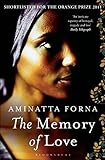
This is my review of The Memory of Love by Aminatta Forna.

This tale of the intertwined lives of three men living through the aftermath of a terrible civil war in 1990s Sierra Leone has the potential for a moving and thought- provoking drama.

It begins with Elias Cole as he suffers a slow painful death, haunted by memories of his obsessive love for Safia, the lovely wife of a charismatic colleague. Driven by the apparent desire to make some death-bed confession, but on his own terms, his calculating and manipulative personality is revealed.

Then there is Adrian, the introspective British psychiatrist with some vague urge to do good in a developing country struggling to recover from its shattered state. In fact, he is escaping from his marriage, for reasons that remain unclear. His affair with the beautiful Mamakay, who makes a sudden appearance well into the book, does not entirely convince me, and the guilt he feels for abandoning his wife and daughter is insufficiently explored.

Thirdly we have Kai, the young doctor traumatised by the horrors of the war, his nightmares alternating with nostalgic memories of his girlfriend Nenubah, whom I imagined for a long time to have perished tragically in the fighting. Kai makes the decision to emigrate to the States, lured by the encouragement of his best friend Tejani, but it is unlikely that he would do this without worrying more about the fate of Abass , the young nephew for whom he acts as a father. I also found the graphic descriptions of Kai conducting operations unnecessary – they serve only to give the author an opportunity to show off medical knowledge gained to give the book an authentic touch.

Forna creates a vivid impression of the scenery and way of life in Sierra Leone. There are many descriptive passages of haunting beauty, but also self-conscious exercises in creative writing. It may be intentional to create a slow pace in which fleeting impressions seem as meaningful as major events, but the constant focus on small details, say of Adrian watching a stranger play with her child on a Norfolk beach, distracts the reader too much from the thrust of the story and blurs the plot. For instance, the arrest of Julius, his subsequent fate, his wife Safia's reaction, and Elias Cole's acts of betrayal should be much more striking events, rather than buried in descriptions of other things. There should be more of a sense of impending unrest, say in Elias's Cole's account of past events.

It is probably quite brave, certainly challenging, for a female author to switch between the viewpoints and complicated lives of three male characters. However, this structure, together with continual moves back and forth in time with the frequent reporting of dramatic events, rather than enacting them "live", further combine to fragment the storyline and weaken the impact of any drama.

There is also the very irritating habit of changing tense from past to present and back. Perhaps the present tense is meant to give more of a sense of immediacy, which makes it odd that it is applied to descriptions, say of Kai scrubbing up for an operation, rather than his dramatic explanation of the reason for his trauma.

There are too many shadowy characters introduced only to drift away or storylines which remain underdeveloped, such as the case of Adrian's patient Agnes, his relationship with his mother, even with Ileana…I could provide many more examples. We seem to be involved in the plots of several novels, tangled together.

For me, the flawed structure became a real barrier to appreciating and admiring the work, which resembles a promising but sprawling draft in need of editing and reorganisation.

⭐⭐⭐ 3 Stars

Inspiration for Reading Groups

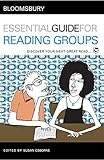
This is my review of Bloomsbury Essential Guide for Reading Groups by Susan Osborne.

This is very helpful for suggesting ideas for books when a group is floundering round for the next set of titles. Classified by theme e.g. childhood, growing up, growing older, death and how we cope with it, friendship, etcetera, it features 75 titles – mostly written during the past 20 years, and safely between pulp fiction chicklit and obscure highbrow fiction. We are given a summary of each book – perhaps a little more info than I would like in some cases, a potted biography of the author, background to the novel, discussion topics and related resources e.g. interviews with the author.

The author has clearly put a good deal of work into this, and it is certainly labour-saving for a reading group organiser, also summarising a range of resources available, such as websites of literary magazines which review books.

I was initially sceptical because the opening advice on setting up a group seems a bit obvious and patronising e.g. “the easiest way to start a reading group is to begin with friends”…”If you have a small group, two missing members might mean that you want to reschedule”

A few useful points have been omitted such as the fact that sometimes sets of books can be obtained through the local library. The University of the Third Age deserves a mention. How to obtain books – e.g. secondhand through Amazon for as little as one penny plus postage is also worth flagging up. Working through local community groups and having a space on a website, or one’s own website is another area to include.

This very useful book lends itself to having an “online” version which can be updated regularly.

⭐⭐⭐⭐ 4 Stars

Still intriguing, but is it going off the boil?

This is my review of The Leopard: A Harry Hole thriller (Oslo Sequence 6) by Jo Nesbo.

Compulsive reading but often distasteful and utterly implausible. The opening pages seem to display the trademark features of a Harry Hole novel: the author enters the mind of a victim about to die horribly by an unusual and horrible device, then switches directly to the mind of, it seems, the crazy serial killer.

Yet I soon began to notice a difference. Perhaps with a film script in mind, or in order to appeal to an even larger international audience – people with a reading age of eight- Nesbo forsakes his customary interweaving of past and present for a straightforward linear plot – less confusing, but also less interesting. The style is slick and thin – short paragraphs, staccato sentences and few of the references to life in Norway that give the earlier novels a distinctive touch. At times, it verges on the cartoonish: "Harry Hole, she thought. Gotcha." There is too much of the corny: one of the first of the rare "lengthy" descriptions is of the improbably beautiful and sensitive new female detective sidekick Kaja.

So, I almost decided to give up on this book which seemed on balance no better than a run-of-the-mill,crudely written, casually brutal pulp fiction pot boiler.

Then, the twists in the plot began to catch my interest. I found myself reading on to discover how on earth Harry would get out of the next hole – is that a reason for his name? – how some fresh conundrum would be solved, or which of the possible villians would turn out to be a red herring, which for real.

As ever, this often crass and amoral tale throws up some intriguing twists such as the murderer who is manipulated out of revenge by a man he has wronged, and touches on philosophical questions, such as whether and when mercy killing can be justified. I just wish these could be developed a little more thoughtfully.

There is clearly space in the overall scheme for at least one more Harry Hole novel, but is it time to take last orders on this series? Is it all getting too formulaic? Also, Harry's liver must be on the brink of giving out. It is increasingly hard to believe that this mutiliated and scarred character can appeal to a string of beautiful woman, and retain the physical strength to escape from tight corners and fight off powerful adversaries.

This overlong novel hiccups to a close with "just one more chapter" to dot another "i" or cross a "t". Nesbo seems too involved in his flawed creation to call it a day…..

⭐⭐⭐ 3 Stars