Ne Lâche pas ma Main – Don’t let go

This is my review of Ne Lâche pas ma Main by Michel Bussi.

On holiday in the French tropical paradise of Réunion, Liane Bellion disappears from her hotel room, leaving only evidence of a struggle. As the damning evidence against him mounts, her husband Martial decides to go on the run with the couple’s pampered but bright six-year-old daughter Sopha. This being a novel by Michel Bussi, Martial is unlikely to have murdered his wife, but is unable to prove his innocence, plus he could well have committed some other crime, or be about to do so.

In the same vein as Bussi’s excellent “Nymphéas noirs”, this novel has a remarkably convoluted plot in which the reader can be sure of nothing, except that the author is capable of switching from corny mawkishness to moments of brutal violence or tragic fate from which no character may be spared. Once again, he develops a strong sense of place, in this case a volcanic island with some striking landscapes of deep craters, lava fields encroaching on fields of sugar cane and palm-fringed beaches, scenic tourist spots, which he describes in detail along with the local vegetation and birdlife – all of which can be checked on google images. Even the route Martial takes can be located on “street view”, and the Hotel Alamanda at Saint-Gilles-les-Bains exists in reality.

Bussi also fleshes the story out with details of the social background: the Créoles, descendants of slaves and still exploited as cheap labour in the hotels, the Zarabes, muslims of Indian origin like the driven police officer, Captain Aja Purvi, and the Zoreilles, the “top dogs” from the French mainland.

This is a page-turner until the accumulation of implausible plot twists becomes too much to swallow and by then it is too late to give up. There is also the odd dud scene, such as the clunky debate on the effects of rum on the local population conducted by the hypocritical drinking mates of unlikely police lieutenant Christos. Even more toe-curling are the sex scenes with his voluptuous lover Imelda.

Most of the characters seem somewhat overdrawn: ageing hippy Christos, with his grey pony-tail, smoking pot he has confiscated from Imelda’s borderline-criminal teenage son Nazir; Imelda herself, a Creole Miss Marple to out-class the detectives, but not wise enough to avoid having five children by different feckless men, nor keep clear of danger in her sleuthing; Aja Purvi, humourless in her single-minded ambition, throwing the furniture round in bursts of unprofessional frustration, exploiting her long-suffering husband’s seemingly inexhaustible good will as he somehow combines a teaching career with caring for their two daughters.

The slightly jokey tone perhaps makes one take the occasional bloody murder too lightly. The strongest aspect of the book is the creation of a sense of tension as Martial and Sopha maintain their freedom against the odds. The only subtle relationship in the book is the complex bond between the two as Martial tries to connect with the daughter whose care has always been provided by his overprotective wife, with the constant nagging suggestion that Martial may in fact be even more of a monster than the police believe.

This reads best in the original French and proves a good source of vocabulary for a foreign reader. For the reasons given above, it is not as effective as “Nymphéas noirs”.

The Wound – The cost of denying the past

This is my review of The Wound by Laurent Mauvignier, a translation of “Des Hommes.

Of all the novels on the fraught topic of the struggle for Algerian independence from France, this is unusual in its focus on the trauma of young men sent out to fight a colonial war without understanding the situation into which they were thrown and unprepared for the violence they were about to witness and perpetrate. The English title of “The Wound” for this novel, to be found in the opening quotation from Genet (“As for your wound, where is it?……”) seems more apt than the original one of “Des Hommes” (“Men”) in that it suggests the long-term mental injury they suffered, but were often unable to relieve by talking about it. Perhaps they felt instinctively that those who had not shared their experiences would never understand, or they repressed memories too shameful, painful or shocking to express, or simply lacked the words to confide in others. Yet “Men” is also a meaningful title in conveying how a group of males may tend to interact, responding to an attack with aggression, also using it as a means of avoiding the expression of emotion.

Starting with “afternoon”, this novel covers a twenty-four hour period split into four sections, but also makes extensive use of flashbacks and recollections to reveal the lives of two cousins from a rural French community: Bernard, nick-named “Feu-de-Bois”, a dishevelled alcoholic who sponges off his long-suffering sister Solange, and Rabut who narrates parts of the story. Both in their sixties, the cousins were called up to fight in Algeria in the early ‘60s, but have never spoken about this part of their lives which clearly haunts them both. For Rabut, Algeria has an unreal dreamlike quality, alien and exotic in its sunshine, scenery and Arab culture, shocking in the incidents of brutality.

The fragmented, stream of consciousness style can be very powerful, but also hard to follow, particularly if one is reading it in the original French as a foreigner. The opening pages are particularly obscure as we see Feu-de-Bois antagonising his whole family by a particularly crass action, before “going off the rails” in what seems like a racist attack. Rabut seems to have some empathy with his cousin, yet it becomes apparent that there is also a deep-seated hostility between the two men. The explanation for all this is gradually revealed in an impressionistic novel with a strong sense of place – one can see the fields in the snow versus the desert barracks – , minute descriptions of physical sensations, snatches of dialogue and intense action, or sharp flashes of insight in all the bleak obliqueness.

I found it necessary to read up some background history to understand the book better, and some aspects could have been developed more fully, like the invidious position of the Harkis, native Muslims who volunteered as auxiliaries in the French Army during the Algerian War. Yet perhaps Mauvignier is more interested in the feelings aroused by a colonial war in which one does not have a stake, rather than the details of the Algerian conflict in particular. This is likely to be a novel which divides opinion over its distinctive style, unusual structure and inconclusive plot. It repays rereading, is somehow absorbing without being a conventional page-turner, but certainly gives food for thought over the psychological impact of the Algerian War, particularly on individuals, ordinary French people caught up in it.

Des Hommes – The Cost of Denying the Past

This is my review of  Des Hommes by Laurent Mauvignier.

Of all the novels on the fraught topic of the struggle for Algerian independence from France, this is unusual in its focus on the trauma of young men sent out to fight a colonial war without understanding the situation into which they were thrown and unprepared for the violence they were about to witness and perpetrate. The English title of “The Wound” for this novel, to be found in the opening quotation from Genet (“As for your wound, where is it?……”) seems more apt than the original one of “Des Hommes” (“Men”) in that it suggests the long-term mental injury they suffered, but were often unable to relieve by talking about it. Perhaps they felt instinctively that those who had not shared their experiences would never understand, or they repressed memories too shameful, painful or shocking to express, or simply lacked the words to confide in others. Yet “Des Hommes” is also a meaningful title in conveying how a group of males may tend to interact, responding to an attack with aggression, also using it as a means of avoiding expressing emotion.

Starting with “afternoon”, this novel covers a twenty-four hour period split into four sections, but also makes extensive use of flashbacks and recollections to reveal the lives of two cousins from a rural French community: Bernard, nick-named “Feu-de-Bois”, a dishevelled alcoholic who sponges off his long-suffering sister Solange, and Rabut who narrates parts of the story. Both in their sixties, the cousins were called up to fight in Algeria in the early ‘60s, but have never spoken about this part of their lives which clearly haunts them both. For Rabut, Algeria has an unreal dreamlike quality, alien and exotic in its sunshine, scenery and Arab culture, shocking in the incidents of brutality.

The fragmented, stream of consciousness style can be very powerful, but also hard to follow, particularly if one is reading it in the original French as a foreigner. The opening pages are particularly obscure as we see Feu-de-Bois antagonising his whole family by a particularly crass action, before “going off the rails” in what seems like a racist attack. Rabut seems to have some empathy with his cousin, yet it becomes apparent that there is also a deep-seated hostility between the two men. The explanation for all this is gradually revealed in an impressionistic novel with a strong sense of place – one can see the fields in the snow versus the desert barracks – , minute descriptions of physical sensations, snatches of dialogue and intense action, or sharp flashes of insight in all the bleak obliqueness.

I found it necessary to read up some background history to understand the book better, and some aspects could have been developed more fully, like the invidious position of the Harkis, native Muslims who volunteered as auxiliaries in the French Army during the Algerian War. Yet perhaps Mauvignier is more interested in the feelings aroused by a colonial war in which one does not have a stake, rather than the details of the Algerian conflict in particular. This is likely to be a novel which divides opinion over its distinctive style, unusual structure and inconclusive plot. It repays rereading, is somehow absorbing without being a conventional page-turner, but certainly gives food for thought over the psychological impact of the Algerian War, particularly on individuals, ordinary French people caught up in it.

Thérèse Desqueroux – Trapped

This is my review of the French novel Thérèse Desqueroux by François Mauriac

Inspired from his youth by the real-life case of Blanche Canaby, accused of the attempted murder of her husband, Mauriac developed the classic tale of Thérèse Desqueyroux, a character who fascinated him so much that she figures in two subsequent novels.

In the opening chapter, the charge of poisoning her husband Bernard is dropped against Thérèse Desqueyroux, after he has lied to “get her off the hook” for the sake of appearances. The rest of this short novel is an exploration of why she committed the crime, and the aftermath of her acquittal. Set in the pine forests of Les Landes near Bordeaux, this is a study of the stifling convention and hypocrisy of bourgeois landowning families in 1920s France. Intelligent and “charming”, if not exactly “jolie”. Thérèse has passively accepted her lot, which is to marry Bernard, son of the neighbouring family and step-brother of the bosom friend Anne for whom she may harbour more than a schoolgirl crush. Prior to marriage, she is quite attracted to Bernard, with the added appeal of his property to be combined with her inheritance. Too late, she realises the extent of his dullness, growing tendency to over-eating and hypochondria, but perhaps worst of all is the sexual contact for which she has not been prepared – in time, his mere physical presence repels her.

Having recently seen the film version of this novel, starring Audrey Tautou, I was reluctant to read this for a book group: although sympathetic to Thérèse’s sense of being trapped, I was alienated by the irrational and excessive nature of her attempt to murder Bernard. Having read the novel, and gained an insight into her thoughts, I continue to regard Thérèse as psychopathic in her coldness, showing a lack of maternal feeling for her daughter Marie, and jealousy towards Anne, stabbing in the heart the photograph of her unsuitable lover and, with an ulterior motive which does not bear close analysis, joining readily in the family plot to separate the pair. When she is driven to contemplate poisoning herself, she is unable to do so, but at least recognises the “monstrous” aspect of this, since she was quite prepared to poison Bernard without compunction.

On the other hand, although I do not think Mauriac adds much to the theme of female repression which has been covered so often – perhaps in part because he finds it hard to get inside a woman’s mind – it is the quality of Mauriac’s writing in the original French, less so translated into English, which impresses me. I like the way he plays with time, mixing together present situations and fleeting thoughts about the past or future in a kind of stream of consciousness which must have seemed quite radical at the time. His portrayal of the pine forests in changing weather, to which Thérèse can clearly relate better than to people, is striking. He tends to write in emotionally violent terms about overwrought dysfunctional characters tied together by social bonds – the title of his famous “Knot of Vipers” being a good example of this. His bitter, vituperative flow, full of images of walking over the still warm ashes of a landscape one has burnt, being frozen in the immense and uniform ice of an oppressive environment or drowning oneself in the crowds of Paris, holds one’s attention, even when having little liking for the characters or even perhaps the author himself.


Three Billboards East of Ebbing, Missouri – A brew of comedy and violence too dark to see the depth

This is my review of: Three Billboards East of Ebbing, Missouri.

Furious over the lack of progress in tracking down her daughter’s brutal murderer, Mildred Hayes spends money she can ill afford to install three huge billboards on the outskirts of the well-named, typical Southern states small town of Ebbing, Missouri. The stark wording reads: “Raped while Dying”;  “And still no arrest”; “How come Chief Willoughby?”  The conservative, gobsmacked townsfolk are understandably appalled and disapproving; not least because Willoughby seems to be a decent man , although lamentably ineffectual in failing to fire his incompetent, racist side-kick Dixon, who is shown at one point torturing black suspects.  Some critics have deplored writer-director Martin McDonagh’s failure to treat race relations more sensitively, but that is not the main point of this film, focused as it is on Mildred’s desire to avenge her daughter’s death. When Mildred’s provocative action arouses an obsessive hostility in Dixon the stage is set for a one-woman feud with the police.

Mildred is a deeply flawed character, almost as bad as Dixon. Aggressive and foul-mouthed, she overacts when her wishes are obstructed. Perhaps she is driven by a sense of guilt over having parted with her daughter on bad terms, but she shows remarkably little concern for her long-suffering and surprisingly pleasant (in view of what he has had to put up with) son – it is the minor characters who are likeable in this film.  Just as Dixon may have been “driven to the bad” by a ghastly, smothering mother for whom he cares, Mildred may have been damaged in ways which are not made clear, apart from the inference that her ex-husband has left her for a teenage bimbo. It is perhaps “out of character” that such a tough, independent-minded woman should have tolerated a partner’s violence, and appear resentful over his departure. In a typical juxtaposition of violence and humour, we see  him one moment with his hands round Mildred’s  neck, the left  colluding with her in a sheepish, eye-rolling glance over his girl-friends inanity.

This film has won many awards and plaudits, audiences may be excited by the violent drama and be entertained by the “no holds barred” interplay of comedy and sociopathic brutality.  Compared to “run-of-the-mill” thrillers and action films, the film has an original take on the theme of victimhood, does not flinch at breaking taboos, and gives a talented and well-cast female actor the chance for a lead part. However, Frances Mc Dormand has the ability to rise to greater challenges than offered here. The film lacks the subtlety and depth to succeed at a deeper level.

In a recent interview, writer-director Martin McDonagh has deflected some critics with the explanation that, “the film isn’t about good or bad, left or right. It’s just about trying to find the spark of humanity in people – all people”. But this is not enough to make a film outstanding or even good. For that, it must enable one to see the world – people or situations – in a different way, which does not happen in this case. The arch-baddie is too exaggerated in his stupidity, bigotry and gratuitous violence to be credible, his dramatic change of heart is implausible. Some characters may indeed  display sparks of humanity, but that does not stop them from planning vicious acts of revenge likely to prove counterproductive, self-destructive or even unjust in being directed against the wrong targets.

Although writer-director Martin McDonagh may simply have run out of steam at the end, at least the ambiguous ending seems well-judged. Defenders of the film may argue that in taking an amoral stance, McDonagh leaves it to us to reflect on the issues involved.

Le Premier Homme

You have the dubious honour of being the first person to visit my brand new web site. I’m interested to know how you came across it! It looks as if you have put a lot of work into your site.

Antenna's avatarAntenna Reviews

This is my review of  “Le Premier Homme” by Albert Camus .

When forty-year-old Jacques visits his father’s grave, he is taken aback by the realisation that he was only twenty-nine, far younger than his son is now, when killed in the First World War. The compulsion to find out more about his father takes Jacques back to Algiers where he was brought up, but the visit fails to provide many clues as to what his parent was really like. Jacques realises that he will never know his father, who will remain a mystery resulting from his poverty, being one of the anonymous masses despatched in waves to develop North African territory between the sea and the vast expanses of desert. So Jacques must be self-sufficient, “le premier homme”, learning to grow up without a sense of roots and recollections from the past.

The book develops as a moving…

View original post 606 more words

Le Petit Piment

This is my review of  “Le Petit Piment” by Alain Mabanckou .

What at first seems like memories of a childhood spent in a Congolese orphanage gradually becomes more surreal, proving by the end to be a kind of fable. A savage indictment of the brutal, corrupt, superstition-ridden and hypocritical regime of Congo-Brazzaville, it employs irony, farce and imaginative, no-holds-barred verve to make its point. The narrator Moïse, nicknamed “Petit Piment” for his unorthodox method of dealing with a couple of bullies, befriends a fellow pupil called Bonaventure in the orphanage that mirrors the failings of the wider society of which they are both victims. Whereas Moses becomes more aggressive over time, pursuing a life of crime in order to survive, Bonaventure remains naïve and detached, yet both are eventually judged mad in a crazy world.

The novel has an authentic ring, perhaps because the author grew up in Pointe-Noire, the coastal town he describes so vividly. I like the flights of fancy as when Mabanckou reeks off a list of particular food preferences by region, each deplored by all the rest: the Lari eat caterpillars, the Vili adore shark, the Tékés go for dog, and the northern tribes consume crocodile, despite regarding the reptile as sacred. Later on, the author’s imagination runs riot with various remedies supplied by a local healer to cure Petit Piment’s mental problems: cricket’s urine, green mamba’s blood, toad’s saliva, elephant hair mixed with kaolin and sparrow droppings.

I found the style hard-going at times: initially slow-paced, with too much repetition and explanation of events in somewhat unrealistic dialogues as when, sent to the school infirmary to give Moses his medication, assistant Sabine Niangui launches into a lengthy, intimate description of her early life. Events often seem disjointed, and new characters tend to be introduced too abruptly only to disappear as suddenly. Together with the casual violence and frank approach to bodily functions, this may reflect the reality of an orphan’s life, or the general state of affairs in the Congo, but the very prolific Mabanckou does not seem to have the time or inclination to fine-tune his work. Towards the end it is as if he has lost interest in the story, bringing it to a rapid, neatly contrived yet also open-ended conclusion.

Some may enjoy the picaresque inventiveness, but having made its point about the Kafka- meets-1984 state of the Congo, it did not hold my interest, as anything more than an opportunity to practise reading in French.

Le Premier Homme

This is my review of  “Le Premier Homme” by Albert Camus .

When forty-year-old Jacques visits his father’s grave, he is taken aback by the realisation that he was only twenty-nine, far younger than his son is now, when killed in the First World War. The compulsion to find out more about his father takes Jacques back to Algiers where he was brought up, but the visit fails to provide many clues as to what his parent was really like. Jacques realises that he will never know his father, who will remain a mystery resulting from his poverty, being one of the anonymous masses despatched in waves to develop North African territory between the sea and the vast expanses of desert. So Jacques must be self-sufficient, “le premier homme”, learning to grow up without a sense of roots and recollections from the past.

The book develops as a moving account of Jacques’ childhood in a close-knit but impoverished family, starved of opportunity, lacking books, newspapers, even a radio, too busy in the struggle to survive to communicate much or reflect life. He craves the affection of his widowed mother who is clearly proud of him, but cannot express her emotions. Isolated by her deafness and illiteracy which means she can only earn a living as a cleaner and washerwoman, the nearest she gets to escape is to sit by the window, watching the world go by. A brief attempt at romance is destroyed when her brother beats up the suitor who threatens the family unit. Jacques’ formidable grandmother’s belief in character- building includes sending him out at the night to catch a chicken in the coop before forcing him to watch its execution. At thirteen, he is denied the pleasures of roaming free in his summer holidays by her insistence on his earning money in the accounts office of a hardware store.

At first I was disappointed to find that this fictionalised autobiography of Albert Camus, in which he sometimes reverts to the characters’ original names, is incomplete – an unedited stream of conscience found at the scene of his fatal car crash, a draft which so dissatisfied him that he intended to burn it. My initial impressions were of a disjointed, often banal and indigestible read, with long sentences in interminable paragraphs of I counted up to eight pages.

I became hooked at the point where Jacques is taken under the wing of primary school teacher M. Bernard, the father figure when he needed one, who sees the boy’s potential and goes out of his way to prepare him for the entrance exam for the lycée, his escape route from a life of grinding poverty, not to mention charming the boy’s grandmother into letting him continue his studies when he could be contributing to the family’s meagre earnings. It is fascinating to see how schools have changed: overhearing Jacques called a “teacher’s pet”, M.Bernard readily admits this, announcing it is the least he can do for comrades killed in the war to favour one of their deserving offspring. When, as honour among pupils requires, Jacques beats up the boy who has mocked him, and the parents complain, Jacques is mortified to be forced to stand in the corner of the school yard for a week with his back to the ball games he loves. M. Bernard sidles up and gives him permission to look across to where the other boy is being punished in the same way.

There are wonderful descriptions of the oppressive, prolonged heat of Algiers in the long summer months, suggesting the germ of the idea for “L’Étranger”, or the joys of childhood, as when Jacques brandishes a palm branch to revel in the feeling of the wind vibrating through his body. A recurring background theme is the effect of colonisation where a centralised French cultural curriculum is imposed without any concessions, together with the uneasy relationship between Arabs and residents of French origin. Also, Jacques’ intense introspection, examining issues from all angles foreshadows Camus’s philosophical writing in later life, as in “La Chute”. In short, this book is not only a vivid portrayal of the life of a bright but emotionally repressed boy in a poverty-stricken but close-knit family, but also a key to the literary works which brought the author fame and criticism.

It repays rereading to tease out the mass of insights and ideas. Invaluable for any student of Camus and his work, the power of its spontaneous flow compensates to some extent for the lack of editing.

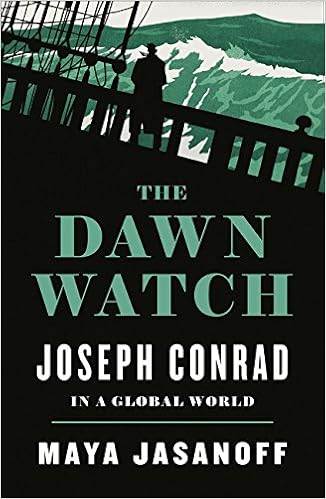
The Dawn Watch: When fiction trumps history?

This is my review of The Dawn Watch by Maya Jasanoff.

Beneath Maya Jasanoff’s breezy style, stuffing cash into her shoes for safety as she retraces Joseph Conrad’s route along the River Congo, lies a perceptive portrayal of “what made the writer tick”, although of course we can never really know. She succeeds in distilling from clearly thorough research a telling selection of incidents, quotations, and her own insightful conclusions in a biography of only 315 pages, rather than the ever more frequent 800 plus page doorstopper.

It is unnecessary to have read much Conrad to be fascinated by him: the author admits to having struggled to read what some regard as his work of genius, “Nostromo”, and what most struck me when first reading Conrad is his remarkably fluent grasp of the English language, which he only began to learn when he went to sea as a young man.

What is really interesting about Conrad is his acute observation of human nature in a changing world where the romantic hardship of sail was giving way to the more profitable transport by steam, while European powers and the United States vied for control of resources in “less developed” areas, bringing the hell of exploitation, destruction and corruption with their good intentions to establish Christian culture, education, law and order. Maya Jasanoff finds in his life and fiction, “a history of globalisation seen from the inside out”, a grappling with “the ramifications of living in a global world”.

Conrad’s cynical, questioning approach must have been shaped by the hardship of early childhood in the exile to which his Polish parents, members of the landed gentry, were sentenced for his idealistic and unworldly father’s political activism against Russian domination. Yet it was typical of Conrad’s contradictions that years later he refused to sign the petition against the execution of his onetime colleague the Irishman Roger Casement for his part in the Easter Rising: “by emotional force he has made his way and sheer emotionalism has undone him”.

Being orphaned very young, a solitary only child with no stable home, may have triggered Conrad’s wanderlust, the desire to get as far possible from landlocked eastern Europe onto the open sea. Perhaps because his father had been a writer who taught him reams of patriotic Polish poetry, he developed the motivation to jot down stories about places “beyond the end of telegraph cables and mail-boat lines”…”among human outcasts such as one finds in the lost corners of the world”.

Since Maya Jasanoff is a historian rather than a literary biographer, her main interest is in how he dealt with “the moral and material impact of dislocation, the tension and opportunity of multi-ethnic societies, the disruption wrought by technical change”, with only passing reference to his writing style or any real literary evaluation of his work. Two interesting maps, which could have been superimposed, show the clear overlap between the far-flung countries he visited as a seaman and the settings for his novels: five months spent as captain of a steamship on the Congo inspired “Heart of Darkness”; service as first mate of the steamer Vidar plying between the ports of Borneo and Sulawesi led to “Lord Jim”. Yet, “Nostromo”, set in the imaginary South American republic of Costaguano, was based totally on the knowledge of an obliging friend.

Conrad was a man of strong opinions: although his son only once saw him pray over his own father’s grave, Conrad believed that “even the freest” is to some degree hemmed in by “fate”. Sickened by the fact that his later work, which he regarded as “second rate efforts”, which are no longer read, earned him so much more than such works as “Heart of Darkness”, he refused honorary degrees or a knighthood, but would have valued the reward of the international Nobel Prize, which was never offered. Even his humour was caustic: in his final years of belated fame after years of struggling as a writer, he remarked that Esperanto was “a monstrous jargon” but people could translate his work into it if they so wished.

Despite the earnest bleakness of much of his work, his periods of depression as a struggling middle-aged writer and his frequent illnesses, he clearly possessed a charm which drew a wide circle of friends, including well-known authors. After years of desultory flirting on shore-leave with attractive, highly respectable young women, and an intriguing correspondence with a widowed aunt only a few years his senior, he married a “to tell the truth rather plain” teenage typist called Jessie, perhaps as ever shrewdly realising how she could support him on a practical and emotional level – yet he clearly developed a strong affection for her to the end.

Minor criticisms: most of the historical maps included are too small-scale to be legible, the evocative photos embedded in the text would have been better if larger. Maya Jasanoff’s long, somewhat clunky resumés of Conrad’s better known works seem like padding, questionable since they include too many “spoilers” for those wishing to go on to read them. Although the chapters are mainly in chronological order, the thematic approach fragments Conrad’s life story so that a time-line would be useful. Despite all these reservations, this is an absorbing and very readable treatment of a complex and interesting man, flawed yet impressive.