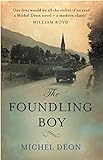
“The Foundling Boy” by Michel Déon – Calm before the storm

This is my review of The Foundling Boy by Michel Déon.

A C20 take on “Tom Jones”, this novel’s original French title of “Le jeune homme vert”, denoting the hero Jean’s initial natural naivety, has been lost in translation to become, “The Foundling Boy”.

Jean is discovered in a Moses basket on the doorstep of a simple, kindly childless couple. The wife Jeanne claims him as her own to bring up, taking a stand against the attempted interference of Mme de Courseau, the imperious lady of the local manor. Jean turns out to be handsome, robust, charming and irresistible to women, yet somehow manages to remain fundamentally decent and unassuming. Despite doing quite well in his school leaving exam, Jean begins to drift through life with no clear aim. He takes the opportunity to travel, mainly to England where he accepts the hospitality of some wealthy or dubious (sometimes both) characters. When he needs money to live, or wishes to stay near his parents in rural Normandy, Jean works at a variety of dead-end jobs of the kitchen porter or nightclub bouncer variety. In the process, he learns a good deal about life, human nature and love. The urge also grows to discover his real parentage: he is not too bothered about the identity of the father which may never be known, but is keen to know who is mother is. The insights jotted in his private journal reveal a certain cynicism. For instance, he notes that keeping friends separate from one another is often a good idea.

The story rambles along with so many digressions that I began to suspect the author of padding out a thin plot. Some of the early chapters are hardly about Jean at all, but rather the local landowner Antoine Courseau. Bored with his cold wife and the duties of his inheritance, Antoine keeps taking off, often at high speed, in his latest Bugatti, drawn inexorably to the warmth and light of the Mediterranean coast and to his waitress lover Marie-Dévote. Perhaps a little shell-shocked by World War 1, Antoine seeks out old comrades-in-arms with whom he has more in common than his family.

The appeal of this book lies its powerful evocation of time and place, in particular France on the brink of World War 2, sleepwalking into disaster with the complacent assumption that, if it comes to it, the Germans will be beaten back in a few weeks. The coverage of events in England is less convincing, as are some of the more exotic characters leading an often extravagant lifestyle such as the mysterious Prince with his black chauffeur Salah, or the conman Palfy.

The author’s tendency to reveal the future fate of a particular character, or to note whether or not he/she will reappear in the story later is an irritating distraction – like having an over-enthusiastic person leaning over your shoulder to tell you what’s going to happen next – and this unnecessary device tends to break any sense of immersion in the story.

Yet, despite this and the occasional “longueurs”, I enjoyed many of the vivid descriptions, quirky characters, wry humour and amusing incidents enough to want to read the sequel, “The Foundling’s War” – “Les Vingt Ans du jeune homme vert” in French. Written very much from a man’s viewpoint e.g. of women, I suspect this is likely to appeal more to male readers.

⭐⭐⭐⭐ 4 Stars

“Le Jeune homme vert” (Folio) (French Edition) by Michel Déon – Une vie pleine de promesses

This is my review of Le Jeune homme vert (Folio) (French Edition) by Michel Déon.

A C20 take on “Tom Jones”, this novel’s original French title of “Le jeune homme vert”, denoting the hero Jean’s initial natural naivety, has been lost in translation to become, “The Foundling Boy”.

Jean is discovered in a Moses basket on the doorstep of a simple, kindly childless couple. The wife Jeanne claims him as her own to bring up, taking a stand against the attempted interference of Mme de Courseau, the imperious lady of the local manor. Jean turns out to be handsome, robust, charming and irresistible to women, yet somehow manages to remain fundamentally decent and unassuming. Despite doing quite well in his school leaving exam, Jean begins to drift through life with no clear aim. He takes the opportunity to travel, mainly to England where he accepts the hospitality of some wealthy or dubious (sometimes both) characters. When he needs money to live, or wishes to stay near his parents in rural Normandy, Jean works at a variety of dead-end jobs of the kitchen porter or nightclub bouncer variety. In the process, he learns a good deal about life, human nature and love. The urge also grows to discover his real parentage: he is not too bothered about the identity of the father which may never be known, but is keen to know who is mother is. The insights jotted in his private journal reveal a certain cynicism. For instance, he notes that keeping friends separate from one another is often a good idea.

The story rambles along with so many digressions that I began to suspect the author of padding out a thin plot. Some of the early chapters are hardly about Jean at all, but rather the local landowner Antoine Courseau. Bored with his cold wife and the duties of his inheritance, Antoine keeps taking off, often at high speed, in his latest Bugatti, drawn inexorably to the warmth and light of the Mediterranean coast and to his waitress lover Marie-Dévote. Perhaps a little shell-shocked by World War 1, Antoine seeks out old comrades-in-arms with whom he has more in common than his family.

The appeal of this book lies its powerful evocation of time and place, in particular France on the brink of World War 2, sleepwalking into disaster with the complacent assumption that, if it comes to it, the Germans will be beaten back in a few weeks. The coverage of events in England is less convincing, as are some of the more exotic characters leading an often extravagant lifestyle such as the mysterious Prince with his black chauffeur Salah, or the conman Palfy.

The author’s tendency to reveal the future fate of a particular character, or to note whether or not he/she will reappear in the story later is an irritating distraction – like having an over-enthusiastic person leaning over your shoulder to tell you what’s going to happen next – and this unnecessary device tends to break any sense of immersion in the story.

Yet, despite this and the occasional “longueurs”, I enjoyed many of the vivid descriptions, quirky characters, wry humour and amusing incidents enough to want to read the sequel, “The Foundling’s War” – “Les Vingt Ans du jeune homme vert” in French. Written very much from a man’s viewpoint e.g. of women, I suspect it is likely to appeal more to male readers.

⭐⭐⭐⭐ 4 Stars

Race to the top

This is my review of UPWORDS. 1996 PARKER GAMES. THE 3D GAME OF HIGH RISE WORD BUILDING..

Having been introduced to this recently as an alternative to scrabble, it takes a while to get used to the different technique of changing words by building them up vertically to a maximum of five tiles in height. This often means changing short simple words in a "race to the top", rather than aiming to achieve long ones with high value tiles on squares giving double/triple word or letter scores. I suspect Upwords is less sophisticated and satisfying than Scrabble in terms of the potential to create interesting words, but it presents a new and different challenge.

⭐⭐⭐⭐ 4 Stars

“The Missing” [DVD] – Missing links

This is my review of The Missing [DVD].

On a carefree holiday in France, Tony and Emily suffer every parents’ worst nightmare when their five-year-old son Olly is abducted. With the heavy use of rapid switches back and forth in time, from the abduction in 2006 to the present day of 2014, it is often only possible to gauge the year from the colour and style of the distraught parents’ hair.

It turns out that the gripping, often unexpected plot twists of a detective thriller are in fact secondary to exploration of the psychology of losing a child. The couple pass through phases of clinging together for comfort, of anger and blame, of being brought together by occasional surges of hope, and of the simple inability to be together as before, with the constant memory of the missing Olly driving a wedge between them. Emily strives to move on and create a new life where she can be happy, but still glimpses the all too flesh-and-blood ghost of her son. Tony stubbornly refuses to give up the search, even at the cost of antagonising virtually everyone and losing his job, with only the bottle of wine he cannot afford to dull his senses.

Most of the characters are quite fully developed, with a subtlety which, for instance, can arouse some sympathy for a man struggling with paedophile tendencies. There is also the irony of the French detective Baptiste having suffered the pain of losing a child, but in a different way.

Overall, the acting, character development and settings are excellent. Although the plot twists are reasonably convincing or coherent in the main, I agree with reviewers who have felt that the drama would have been more effective with fewer episodes, achieved through editing out some of the “longueurs” of sub-plots.

There seems to be a current trend, perhaps set by “The Killing” for long, complex, gripping serials which seek to break the model of a “happy-ever-after-ending-against-the-odds-after-terrible-suffering” with an open or only partially explained conclusion. Apart from disappointing most viewers, this also leaves the cynical thought that the stage is set for another lucrative series, although in this case I have read that Series 2 involves a new, separate case. On reflection, I decided that the ending is quite clever in leaving viewers to argue over the final outcome. Also, is it one step beyond being able to cope with a sad ending to find the capacity to accept that, as in real life, you never discover for certain what happens or that matters do not work out as you might have wished?

⭐⭐⭐⭐⭐ 5 Stars

“Three Men in a Boat” by Jerome K. Jerome – Messing about in boats

This is my review of Three Men in a Boat by Jerome K. Jerome.

When I read this as quite a young child, it seemed hilarious. I’m referring, for instance, to George and Harris rushing round in search of the butter, until realising that one of them had sat in it. Struggling dutifully through it more recently for a book group, it seemed rather silly and very dated, although I could still laugh at the succession of locals claiming to have caught the ever weightier trout encased on a pub wall, only for it to turn out to be made of plaster, when one of the clumsy three accidentally knocked it down.

I found a bit of research on the story much more interesting. Publication in 1889 was earlier than I had imagined i.e. not Edwardian. After the passing of the 1870 Education Act, and the extension of cheap rail fares giving people ready access the Thames, there was a sharp increase in the demand for amusing, easily read books and in the appreciation of boating as a pastime. This was perhaps a comic novel ahead of its time, much Victorian reading matter still being a bit sententious and worthy. So, there was a sharp contrast between the popularity of the book (which has never been out of print), and the snooty response of critics, even in Punch.

The author himself came from a once prosperous middle-class family which had fallen on hard times. So, despite his grammar school education, he had to start work as a young teenager, which obviously gave him a wide experience of life and the ability to relate to ordinary people. His unusual name was partly due to his father Jerome Clapp adding another Jerome to make it sound more distinguished. The “Klapka” came from a Hungarian who lodged with the family for a while.

I can see that what is really a series of amusing anecdotes, observations on daily life and snippets of local history on the areas bordering the Thames is appealing to us now in its innocence and nostalgic portrayal of a lost age. This probably remains a classic which you should read, the younger the better, although I doubt if a tale of three gormless middle-aged men rowing up the Thames more than a century ago would appeal much to this audience.

⭐⭐⭐ 3 Stars

Swallow whole

This is my review of A boy with potential: A choirboy’s sinister discovery (Crime shorts Book 1) by Rosalind Minett.

This well-written and expertly constructed tale sustains a sense of sinister tension to the end, but with underlying poignancy over the extent to which "oyster boy" – who ironically has misinterpreted the one piece of kind attention he receives – is a victim of other people's casual abuse. Although I agree that there is the material here for a novel, it makes a particular impact in its current concise format.

⭐⭐⭐⭐ 4 Stars

Three hundred dollars’ worth

This is my review of The Homesman [DVD] [2014].

In an unusual take on a mid-nineteenth century western, Hilary Swank produces a striking performance as Mary Bee Cuddy, an industrious and competent woman who is making a success of farming in a remote Nebraskan pioneer community. Although men respect her, no one is prepared to take such a bossy and plain woman as a wife. Instead, they trek east to find pretty, submissive women who are often completely unsuited to the hard rural life where there is no social security net to help those driven mad in the face of persistent crop failure, loneliness, infant mortality or perhaps the sheer scale of the treeless landscape which often resembles an ocean beneath the vast skies.

Mary Bee agrees to accompany three such "crazy" women on the demanding five week trek back east to the care of a kindly Iowan pastor. Realising that she cannot achieve this single-handed, she saves from a lynching the disreputable "George Briggs", no doubt one of many aliases, played by Tommy Lee Jones who also directs the picture. The outcome of the journey proves quite unpredictable, with a twist which viewers may find hard to accept, but which makes sense on reflection.

Apart from being well-acted, with superb photography and a haunting opening musical theme, this film has stunning photography of the bleak beauty of the Nebraskan high plains, some moments of comedy, but is essentially a grim tale. At times it regresses into a standard "shoot `em or burn `em" western, and some scenes designed to explain further the women's insanity are hard to take, and a little too disjointed. However, overall, the film's unusual theme makes it worth watching. It made me think more deeply than before about the particular plight of women trapped in pioneering communities about which they must often have been misled in advance. It also presents a somewhat nihilistic view of life in which people nevertheless continue to do good, perhaps in spite of themselves, achieving small successes even if they are soon forgotten. The inconclusive ending is very apt.

⭐⭐⭐⭐ 4 Stars

The Children Act by Ian McEwan: Living by the rules

This is my review of The Children Act by Ian McEwan.

This slim novel is yet another example of “less is more” in that it makes a greater impact than many a long rambling epic. Fiona is a leading High Court judge, specialising in the application of the “Children Act” of the title with its double meaning. Her heavy and harrowing workload leaves little time to deal with the shock of an unexpected crisis in a longstanding and until now apparently happy marriage.

Always keen to be thorough and fair, she decides that the urgent case of a boy, stricken with leukaemia just short of his eighteenth birthday, who has supported his Jehovah Witness parents’ refusal to agree to the blood transfusion that will save his life, obliges her to visit him in hospital to gauge his capacity to make such a decision. Her good intentions are based on the principle that “the child’s welfare shall be the court’s paramount consideration”. In the ensuing drama, she learns more than she has bargained for about the complexity of dealing with a young person’s “welfare”.

Ian McEwan’s crystal prose with never a redundant word or a woolly sentence commands admiration, yet can make human relations seem somewhat clinical. Yet, I prefer this to a mawkish tone and in general his forensic analysis and clarity of writing serve to punch the reader with the raw emotion of a situation. Although everything is written from Fiona’s viewpoint, the reactions of the other players, both major and minor, are portrayed very vividly. I was completely convinced by the beautiful and over-sensitive boy Adam.

Although I understand why some readers have criticised McEwan for his focus on the privileged, upper middle-class world of a Gray’s Inn lawyer, for me this seems part of the point, if unintentionally: Fiona and her colleagues represent the confident, with taken-for-granted superiority, élite who make decisions on legal reforms and play Solomon in the lives of lesser mortals.

If the book has a weakness, it may be the somewhat condensed “telling” of a number of Fiona’s cases, combined with the author’s concern with current issues leading him to overload the plot with the world’s ills. You could of course argue that all this illustrates the almost frantic variety and stress of Fiona’s job. I also found the “climax” of the book is a little contrived, when Fiona receives what seems like bad news, without our being told what it is, just before going on stage for a piano performance, for which McEwan’s writing lost its usual spare precision and became rather pretentious and “knowing” about music.

This is a thought-provoking book on several levels: the right to decide on life and death, the psychology of ageing and the state of Britain. It is serious, compelling, yet lightened with touches of McEwan’s wry wit

⭐⭐⭐⭐⭐ 5 Stars

Dubious means to questionable ends

This is my review of World War Two: Behind Closed Doors: Stalin, the Nazis and the West by Laurence Rees.

This is a fascinating examination of the relations between Churchill, Stalin and Roosevelt. I had always assumed that after the defeat of Hitler it was too much hassle for the Allies to press on and drive the Soviet Communists out of Eastern Europe, particularly since they had shown themselves to be such resilient and determined fighters. It was a shock to realise how readily Churchill accepted the USSR’s retention of eastern Poland which it had overrun during its notorious pact with the Nazis in 1939-41. His glib rationalisation that Poland would simply be taking “two steps westward” was all the more ironical since it was the German occupation of western Poland which had “necessitated” the Second World War in the first place.

Churchill was also devious in appeasing Stalin by implying that he was about to launch a Second Front in France – thereby taking some of the pressure off the Soviets fighting in Eastern Europe – when he clearly had no intention of doing so. Despite his many faults and atrocities, Stalin was justified in resenting how the Soviets ended up bearing the brunt of the bloody battles with Germany, as indicated by the shocking disparity between the Russian and Allied death tolls.

In yet another ironic twist, Churchill and Roosevelt both failed to see how much they were being manipulated by the wily Stalin. They even harboured the illusion that Stalin’s hands were tied by some shadowy Politburo in the background. To observers, Stalin’s mastery was often all too evident. As Eden commented, “If I had to pick a team to go into a conference room, Stalin would be my first choice.” Although the author reminds us of the Kafkaesque repression of free speech in the USSR and punishment of able people who might pose some kind of threat to Stalin, Western leaders turned a blind eye to, for instance, the evidence that it was the Soviets who had massacred Poles in the Katyn area. On the other hand, what else could the West do when faced by the need to stop the Nazis? It is possible that, without Russia as any ally, Hitler would have conquered Britain.

Churchill’s ruthlessness is evident in his political decision to order the despatch of convoys to supply the Russians once they had become allies, even though he knew of the high risk of German attacks in Arctic waters: for him, a 50% or more success rate made it worthwhile. Even more pitiless, Stalin ordered the wholesale and undiscriminating deportation of the Crimean Tatars to the hostile arid wastes of Uzbekistan, because some of them had collaborated with Germans but it was too much effort to identify them accurately.

Although this is an unsystematic and therefore only partial account of World War 2, it is a book well worth reading both for those who thought they knew about the War and for others too young to remember it. The only caveat is whether time would be better spent trying to understand the terrible wars which are still raging at present.

⭐⭐⭐⭐⭐ 5 Stars

Sweet tart with a heart

This is my review of Josephine: Desire, Ambition, Napoleon by Kate Williams.

The unsophisticated daughter of a Creole family whose Martinique sugar plantations ran on slave labour, Josephine was shipped to France for what proved a tragic and short-lived arranged marriage. Widowed with two young children in the dangerous and unstable world of the French Revolution, she soon acquired the requisite skills to become the mistress of a succession of wealthy and powerful men, culminating with Napoleon.

Her extravagance was shocking in its excess, her behaviour manipulative and devious, perhaps the most appalling example being her eagerness to marry her daughter off to one of Napoleon's least appealing brothers, in an attempt to compensate for her own inability to provide the French leader with a son and heir.

Despite all her faults, the author is clearly on Josephine's side, and emphasises the qualities which made her attractive to men and popular with the public: she was graceful, a good listener, and kind to those in trouble. Her main achievements seem to have been providing an attractive figurehead to offset Napoleon's boorish and intimidating image, her public relations role in organising social events and dealing with people, and the private passion for gardens, including, exotic plants, birds and wild animals imported from abroad, which led her to develop the beautiful estate of Malmaison.

This is an entertaining biography with some moments of real poignancy, as when, having at last steeled himself to announce his divorce of Josephine, Napoleon still hankers for her company so much that he cannot resist coming over to Malmaison to walk with her in the rain.

On the other hand, the somewhat tabloid style and focus on the more sensational aspects of Josephine's life made me wince at times, or feel the need to look to other sources to verify the author's interpretations, particularly of Napoleon. She presents him as a capricious and crude megalomaniac, chronically indecisive at times, but over-prescriptive at others, a shameless sexual predator once success provides the confidence to demand "droits du seigneur". I agree with the reviewer who has criticised the "one-dimensional" portrayal, which gives an inadequate impression and exploration of his greatness.

⭐⭐⭐⭐ 4 Stars