Jane Austen’s heroines tend to be very young and destined for love and marriage, Anne differs in being twenty-seven, so considered “on the shelf”, her youthful beauty faded by regrets and resignation, and only the prospect of a dull life, undervalued by her vain, snobbish father and elder sister, and exploited as a convenient companion and childminder by her self-centred younger sibling. Aged nineteen, Anne allowed herself to be persuaded by an older friend to reject the proposal of Frederick Wentworth, a young naval officer whom she truly loved, because he was penniless and socially inferior to her, a baronet’s daughter. His subsequent success in the navy, returning to England with wealth gained from capturing vessels from the French during the Napoleonic wars, causes her to regret this decision.
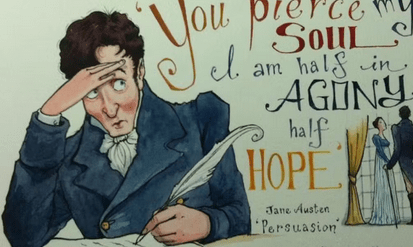
Perhaps more able to empathise with Anne than with her younger heroines, Austen provides a subtle psychological study of Anne’s various emotional stages as she realises that her path is like to cross with Wentworth’s, since he is related to the naval couple who rent the hall which her father is forced to let, as the least embarrassing or inconvenient way of paying the debts he has accrued through extravagance. We see her apprehension that others will know of her past relationship with Wentworth, her feelings when she hears what Wentworth thinks of her – that she has changed beyond recognition, which is hardly a compliment – and how the two manage to maintain a cool politeness in the company of others – and so on. Austen is probably expressing her own views, when she has Anne argue that women are more constant than men in being true to another’s memory.
“We cannot help ourselves. We live at home, quiet, confined and our feelings play upon us. You are forced on exertion. You always have a profession, pursuits, business of some sort or other, to take you back in the world immediately, and continual occupation and change soon weaken impressions.”
In this example of quite a deep conversation with a man, showing mutual respect, when he observes,
“Songs and proverbs all talk of women’s fickleness. But perhaps you will say these were all written by men,”
she replies, “….Men have had every advantage of us in telling their own story. Education has been theirs in so much higher a degree; the pen has been in their hands. I will not allow books to prove anything!”
This sounds remarkably modern.
It is a world of stifling social conventions, underlain by prurient gossip, and frequent scheming for personal gain. There are fascinating insights into Regency life. On the whim of a headstrong daughter, moderately wealthy characters who do not need to work for a living can drop everything for a trip to Lyme (Regis). The journey of 17 miles takes so long that it is worth staying there overnight. The ridiculously vain Sir Walter Elliott looks down on Admiral Croft, his tenant, for his ruddy seafaring complexion, while the latter cannot abide the large mirrors which dominate Sir Walter’s former bedchamber. Two of Jane Austen’s brothers were Admirals, so she had a good understanding of life at sea, if only hearsay, and of the position of naval wives – both in being left alone for months, unsure their husbands would return in times of war, and in making the choice to join a voyage as the only woman on board, in order to spend more time with their husbands.
Despite its rather contrived plot, this novel has more depth than I had remembered, and deserves to be more widely read.
 Antenna Reviews