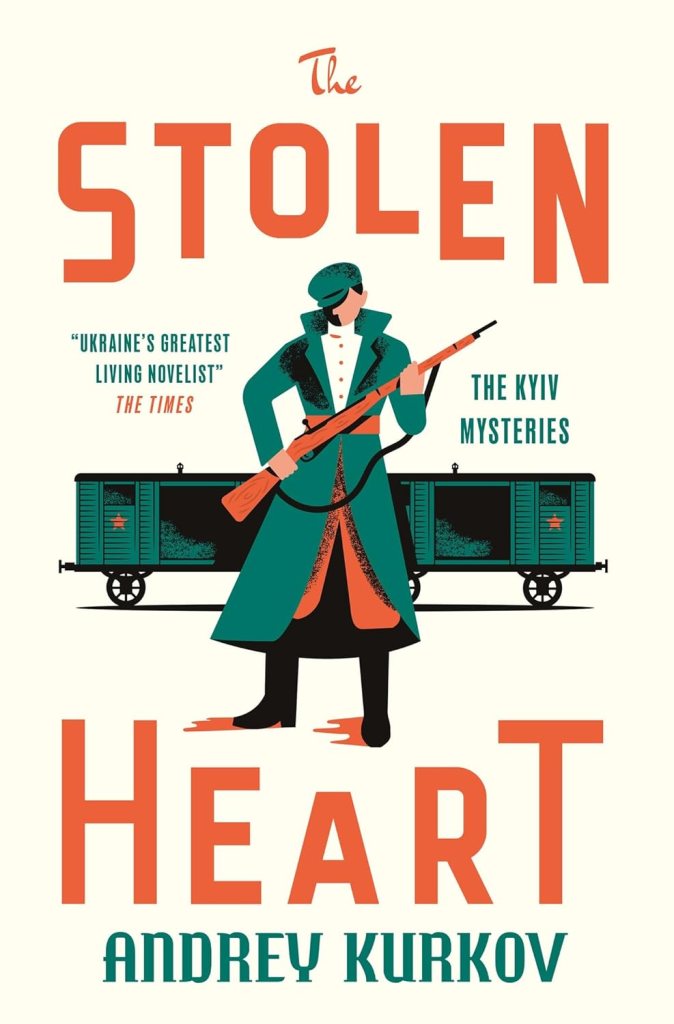
The Stolen Heart” is the second novel in “The Kiev Mysteries” series, set in 1919 in the aftermath of the Russian Revolution. Samson Kolechko is a young detective, tasked with his older colleague, renegade priest Kholodny, to gather evidence of a normal activity which it appears has suddenly been declared a crime: “the illicit slaughter of livestock and violation of the decree of the ExProfFooCom banning private trade in meat.” It seems that Kurkov, with his preference for black humour and farce as a way of debunking authoritarian regimes could not resist using an actual example from the period.
As is often the case with crime novels, the questioning of those who have bought meat from the agent Briskin, held on remand, grows repetitively tedious, yet perhaps this serves to add to the flavour of senseless times, with Kiev increasingly under the control of the Red Army, and sinister Soviet secret police organisation, the “Cheka”, dedicated to combating “counter-revolution and speculation”.
One of the strengths of “The Silver Bone”, which contributed to its longlisting for the International Booker Prize, was its portrayal of life in an atmospheric old city which has been suddenly overturned by uncertainty, arbitrary violence and acute shortages of substances as basic as salt. A scene in “The Stolen Heart” portrays an enraged cabby whose vehicle has just been rammed by a village cart, abruptly withdrawing his complaint in return for a few pounds of the cart’s load of salt. However, by this stage, the reader has “got the picture” and wants something more.
Although “The Stolen Heart” has received some good reviews, I was left with three main reservations. One is the heightened surreal aspect which first appeared in the previous novel: Samson’s severed ear, which mysteriously shows no signs of decay, is kept in a Monpensier (luxury sweets) box which can be hidden in convenient places for eavesdropping on useful conversations audible to Samson despite being some distance away.
Secondly, there are too many incidents which remain unresolved, and it was only on reaching the last page, to “The end. But to be continued”, that I realised that each book in the series is like a long episode, rather than a freestanding tale in its own right. The result of this is that the “denouement” tends to be underwhelming, and aspects remain irritatingly unclear if one has forgotten some detail in the previous novel.
I also found many of the dialogues quite unconvincing, and the descriptions overloaded with banal minor details – while the major ones too often remain obscure, and written in a distracting style which reads like a too literal translation – yet the translator has won prizes for his work, also writes reviews, his own fiction and teaches in university English departments. So perhaps he is retaining the style of the original Russian. The effect of the frequent odd or ill-chosen turns of phrase is that one does not engage so strongly with the characters. But is it meant to be a kind of Eastern European “absurdist” style intended to be part and parcel of the satire?
Just occasionally, there are moments which ring true, generally involving Samson, as when he reflects at a very inopportune moment,
“Could it be said then, that Samson loved Nadezhda in German? Reliably, calmly?
Samson considered this. The idea of loving in German did not appeal to him. The world war that had ended the previous year gave it a cruel, bloody connotation.
No, he decided. He loved Natasha respectfully rather than calmly. While she loved him pityingly”.
Is it a printing error that the map of Samson’s Kyiv, 1919, bears not a single place name apart from the River Dnipro? I would like to have been able to locate the streets and squares named so precisely – perhaps they were too long to fit legibly on the page.
Kurkov’s success as a writer appears to have been enhanced by his courage, albeit through the medium of satire, in exposing the corruption of post-Soviet Ukraine in the 1990s. My admiration for his debut novel, “Death and the Penguin”, inspired me to embark on the current series. I plan to try “Grey Bees”, the tale of a beekeeper living in Ukraine’s Grey Zone between rival forces in the current conflict.
But I don’t think I shall return to find how life works out for Samson and Nadezdha, although their names suggest that it will be well.
 Antenna Reviews