Set in the Kiev of 1919, this historical crime fiction provides a striking portrayal of life in the Ukrainian People’s Republic, newly formed in the wake of the Great War and the Russian Revolution, its independence undermined by a confusing succession of competing Bolsheviks, White Russians, and Hetman-led Cossacks. Perhaps this enables us to identify even more with the perpetual state of uncertainty and disarray which the citizens of Kiev have to endure now.
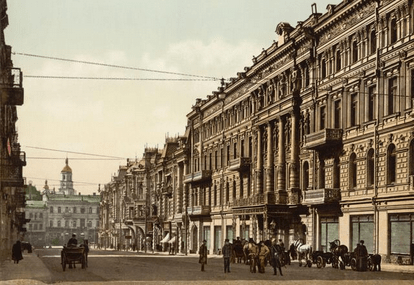
In the dramatic opening pages, former student Samson Kolechko’s right ear is severed by a passing Cossack’s sabre, which also leaves his father lying dead in the street. On returning to the scene, Samson finds that his father’s shoes have been stolen, but his wallet remains, stuffed with banknotes, although some are useless, having been replaced recently by yet another new regime’s currency .
When his flat is requisitioned by a couple of corrupt Soviet soldiers, who use it to store stolen goods, Kolechno fears for this life. By a rare stroke of luck, his ability to write coherent reports gains him employment as a detective at the local police station. Intrigued by a curious silver bone among the stolen items, he embarks on a dangerous investigation.
The first in what promises to be a series of “The Kiev Mysteries”, this novel was longlisted for the International Booker Prize, and has been widely praised. Andrey Kurkov was already well-known for his writing, including “Death of a Penguin”, a satire on the political situation in the Ukraine of the 1990s.
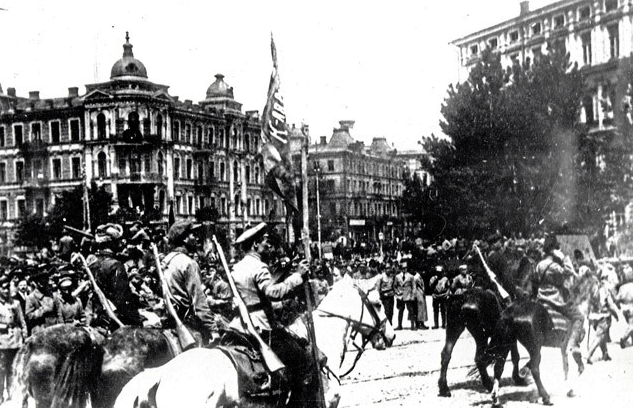
Translated from the Russian, the style is sometimes stilted, but this may enhance the sense of a past age. Based on a good deal of research of the period, including a street map of the main locations, “The Silver Bone” relies on black humour and a touch of surrealism, which some may find unnecessary and irritating, to keep us engaged in a world of arbitrary decisions. People survive by keeping their heads down in a world of sudden violence and niggling deprivation. They’re are beaten if they resist attempts to commandeer all but their most basic items of furniture; they are ordered to remove snow drifts in the streets, without being given the necessary equipment. Power cuts are frequent, goods and services are best paid for using some item in short supply, even as basic as salt, if one can get hold of it.
Unfortunately, apart from a few dramatic moments, and an ironic twist at the end which paves the way for a sequel, the solving “mystery” proves a disappointment- convoluted and unconvincing, weighed down with some unduly long or tedious descriptions. Left with a sense that the denouement doesn’t quite “add up”, one cannot muster the energy to trawl back through the text to work out why.
Apart from Samson, the characters are mainly two-dimensional, with a few exceptions like Kholodny who has abandoned the priesthood to become a policeman. When asked by Samson what people will believe in when they forget god, he meditates, “In themselves, in the future, in the power of nature”, sadly a case of overoptimism.
There are parallels between this and the earlier “Death and the Penguin” but the latter is more subtle and original in its quirkiness, contriving to escape censorship in corrupt regime.
 Antenna Reviews