
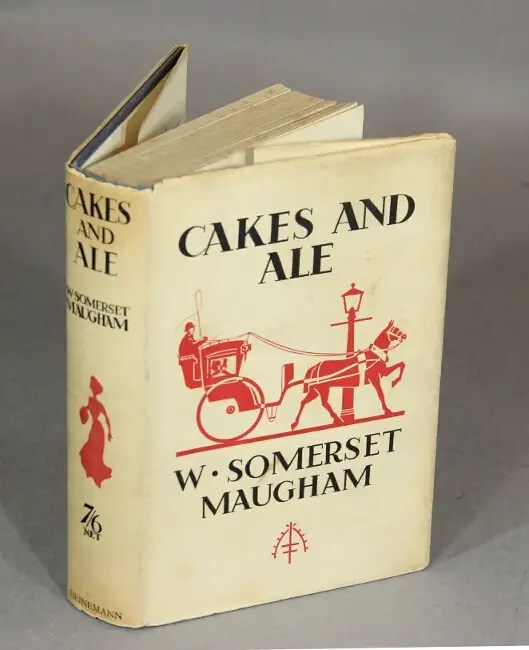
Said to be the most highly paid novelist in the world in the 1930s, W. Somerset Maugham’s popularity has withered to the extent that he seems on the verge of being forgotten. Judging by “Cakes and Ale”, this would not have surprised him, for the novel is a satire on his literary world as he saw it, in which an author’s success depended, not on the merit of his books, but rather the arbitrary support, or rejection, of influential sponsors and critics. The reputation of the most highly regarded writer was likely sink into oblivion on his death.
Published in 1930, when Maugham was in his fifties, “Cakes and Ale” came to be his favourite book, perhaps because of its strong autobiographical element, since he draws on his own experience as an orphan brought up by stuffy relatives in Whitstable, and later as a medical student until his success as a writer enabled him to give this up.
The book caused an uproar when published since it seemed to be a thinly disguised parody of Thomas Hardy and his relations with his first wife, used to portray the fictional Edward Driffield, who comes from humble origins, burdened by an unfortunate marriage to Rosie, a “common” and none too faithful barmaid. For this, he was accused of “trampling on Thomas Hardy’s grave”. He was also condemned for too obviously using the writer Hugh Walpole, supposedly a close friend, as the model for the self-serving writer Alroy Kear, who agrees to write a sanitised version of Hardy’s first marriage for his widow Frances to get published.
Maugham denied that any of this was the case, claiming that Driffield was inspired by an obscure writer whose name he couldn’t recall who came to live in Whitstable. Alroy Kear was a pastiche of several writers while Rosie was a character who developed in his mind over many years, perhaps triggered by the “obscure writer’s” wife, shunned in the prim world of Whitstable, although Rosie seems to have had more of the nature of Maugham’s one-time lover, the actress Ethelwyn or “Sue” Jones, whom he loved mainly because “she was beautiful and honest”.
So the criticism that Maugham was “quite unable to work with someone actual to work upon” seems justified, although the models used may not have been correctly identified.
I found the descriptions of class-ridden, gossipy, judgemental late C19 Whitstable, where everyone knew each other’s business, quite evocative, particularly as Maugham shows how it has evolved over time when he revisits it decades later. Life as a poor medical student in London is also well-drawn. The dialogues reveal Maugham’s sharp, sardonic humour and talent as a playwright, although it is never quite clear to what extent he shares the snobbery and prejudices of most of his characters, apart from Rosie.
By contrast, the lengthy analysis of the literary world seems more like a tedious essay, with Maugham over-grinding an axe in an often pompous and stilted style. Very little happens in a book which would have made more of an impact as a novella, once Maugham decided it could not be contained in his original plan for a short story. Styles have clearly changed, but the plot lacks structure, as Maugham’s creator rambles through his reminiscences.
Yet every now and again, one is struck by some insight into the past: on a visit to Whitstable after decades of absence, “Knowing English inns, I ordered a fried sole and grilled chop”. In a chance meeting with the local doctor with whom he had gone to school, Maugham reveals how the status of the medical profession has changed as he observes: “I judged from the look of him that he had lived, with incessant toil and penury. He had the peculiar manner of a country doctor, bluff, hearty and unctuous. His life was over. I had plans…I was full of schemes for the future…Yet to others I must seem the elderly man that he seemed to me. I was so shaken that I had not the presence of mind to ask about his brothers whom as a child I played with….”

Then there is the crux of the tale in which Maugham “begins to meditate upon the writer’s life”, which in fact he has been doing quite a lot throughout the book. “It is full of tribulation. First he must endure poverty and the world’s indifference, then having achieved a measure of success, he must submit with good grace to its hazards. He depends on a fickle public”. And so on…. “But he has one compensation. Whenever he has anything on his mind…..in short any emotion or any perplexing thought, he has only to put it down in black and white, using it as the theme of a story, or the decoration of an essay, to forget all about it. He is the only free man”.
If Maugham had developed this conclusion more fully, yet concisely, I would have found it more deserving to be regarded as a classic.
 Antenna Reviews