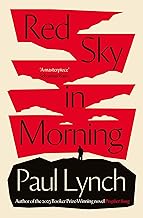
Set in C19 rural Ireland and America, this is the tale of Coyle, a poor, uneducated man who does not baulk at acts of violence when faced with injustice, or the need to survive, but is also gentle in his love for his wife and his little daughter. After accidentally causing the death of the landowner’s malicious son Hamilton, responsible for serving him notice to quit for no apparent reason, Coyle is forced to go on the run, with the foreman Faller and a couple of henchman in hot pursuit. It is unclear why Faller has such an implacable desire to avenge the death of such an unworthy character, nor what may have moulded the wily, vindictive +Faller into a personification of evil. So as Coyle endures the rigour of an Atlantic crossing, and the hardships of life in a gang of exploited Irish immigrants constructing an American railroad, based on real events at “Duffy’s Cut” in 1832, we know that the two men’s paths will ultimately cross again.

What may sound like a familiar, even hackneyed plot, is transformed by the power of Paul Lynch’s prose, remarkable in its original and lyrical stream of consciousness. Like poetry, almost every paragraph repays reading twice or more to absorb and reflect upon it. This often runs counter to the urge to turn the page not only to discover how events will turn out, but perhaps also to escape exposure to their too frequent gratuitous violence and bleakness. The latter are sometimes eased by gentle moments, when Coyle recalls his wife, or fingers the ribbon which is his only keepsake of his daughter. Yet overall, the acute observations and insights tend to be overwhelmed by scenes of brutality or acute suffering.
Quotations out of context are unlikely to do justice the writing, but here are brief descriptions of a storm and its aftermath.
“The world that was all sky was leaded and sinking fast and the sun was nowhere to be seen. Around noon came the sound that many dreaded, the snapping shut of the hatches and the ventilators to keep watertight the boat, the scuffle of tarpaulin on the deck and the dull thud of the pitched weights. Nothing to suck on now but the air tombed beneath.
The master watched the sky swirl and he bellowed commands in a broad voice that was torn up and scattered by the wind. The ship scudded headlong into the squall. Mountains rose out of the sea, reached up towards the sky as if it wanted to take the smudged remnants of the heavens into its quickening mouth, a sea of jagged teeth.”…………………………………….
……………………………………. “They emerged red-eyed and silent into the rinsed air, their clothes ragged and their bodies bent and their faces creased with dirt. They stared in disbelief at the great waters silent, smoothed with a benevolent repose, and they looked with distrust toward the sun that glittered warmly in the pale blue sky, moved awkward through its gift of pure air.”
These words evoke vivid images and authentic emotions, drawing on the author’s experience as a film critic.
Although I have yet to read “Prophet Song”, Paul Lynch seems to be a worthy winner of the Booker Prize for a quality of writing fed by his copious reading since early childhood, and very much in the vein of Cormac McCarthy, but with his own twist, the articulacy and skilful way with words found in so many Irish writers. “Red Sky at Morning” contains these ingredients, although being his first published novel, it may not be the best. Perhaps at times, the verbal pyrotechnics are a little too contrived, but this may be inevitable if a writer is prepared to take risks, pushing the limits of what words can convey.
It’s interesting to compare his style with that of Graham Greene, who aimed to achieve in his writing “a kind of verbal transparency which refuses to allow language to become a character in its own right” – hence the sentences which have been described as “lean and lucid”. In “Red Sky at Morning”, the words seem almost an end in themselves. The conclusion to be drawn seems to be simply, as Coyle’s wife reluctantly observes, that “all you can do in this life is to learn to accept loss”. Combined with the ambiguous, incongruously upbeat “Epilogue”, this left me dissatisfied. In view of the current state of the world, perhaps the author is justified in what he himself has called his “tragic world view”, but while having huge admiration for his talent, this is hard to take in large doses.
 Antenna Reviews