In mid C17 Holland, Catrin, a young widow, sells the possessions inherited from her husband Govert, to fund her decision to leave her remote village on the edge of the Dutch polders. This is not only to escape the gossip of neighbours, suspicious about the cause of Govert’s sudden death, but also to see more of the world. Her natural skill as an artist, so far limited to painting flowers on the family’s wooden furniture, soon enables her to gain employment with a potter in Delft.
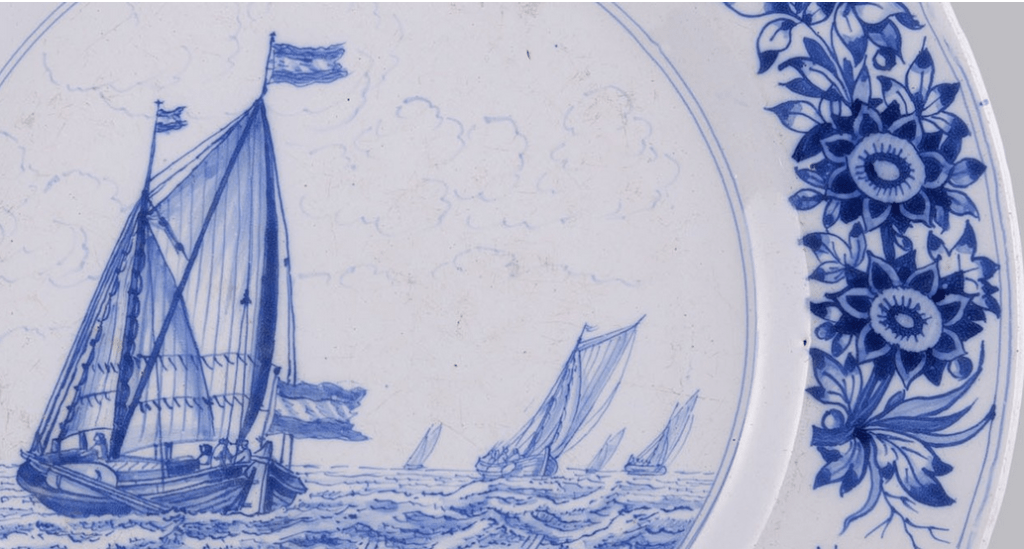
This is the cue for the fascinating history of the Dutch “Golden Age”, initially based on the import of fine white porcelain from China by the East India Company until distant civil wars disrupted the trade. These events encouraged the development of a domestic product, Delft faience with its striking blue images, which replaced the copied or imagined Chinese scenes with the sailing ships, windmills and rural scenes of Holland. All this forms the background to one of the “thrillers” for which the Dutch author is apparently best known.
Meetings with artists already or soon to be famous are shoehorned in: Catlin encounters Rembrandt who notes her true appreciation of art, and Vermeer, who runs an inn with his wife, becomes a friend. Catlin even come across Carel Fabritius the painter of “The Goldfinch”, shortly before he is a victim of the explosion of the gunpowder store which destroyed a quarter of Delft in 1654. Catlin has to endure not only this, but also the plague which devastated cities like Delft the following year, but we know she will survive, being the narrator of this tale of an action-packed eighteen-month period.
Despite being a potentially “good yarn”, this novel seems likely to disappoint readers looking for depth of character, and a certain degree of plausibility in a plot, which swings too often between sentimentality and violent melodrama. It is impossible to judge how much this novel has “lost” in translation from the Dutch, but the frequent clichés and tin-eared use of modern turns of phrase in the dialogues are continually jarring.
“You’re young, beautiful and you obviously have talent”.
“I hope it was the last one that swung it for me”.
Catlin lives in a society in which a woman cannot pursue an apprenticeship to become a master potter, nor sign contracts herself when running a business. People believe that the plague is a punishment from God, which can be kept a bay with certain potions. Yet some of the exchanges would not sound out of place in a modern soap opera.
Despite the obvious flaws, at least Simone van der Vlugt’s historical research seems to be essentially accurate. By coincidence, the art historian Laura Cumming has produced in 2023 “Thunderclap: A Memoir of Art and Life & Sudden Death “ a study of Dutch art featuring Carel Fabritius, which could be of interest who have found this aspect the most rewarding part of “Midnight Blue”.
 Antenna Reviews