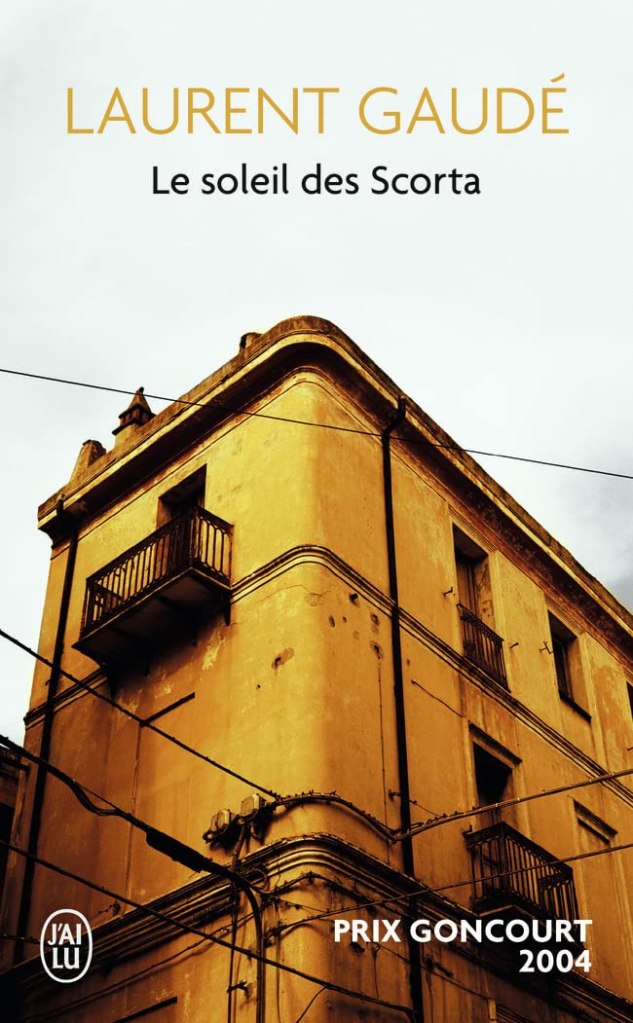
It’s the 1870s in “Les Pouilles”, the arid, sun-scorched heel of Italy’s boot. A weary donkey carries former bandit Luciano Mascalzone, prematurely aged by years in jail, back to his home town of Montepuccio, where he plans to fulfil his dream of “possessing by force” the beautiful Filomena Biscotti, a final crime for which the local men will surely kill him. The opening scenes, with their vivid sense of place and of a simple, sentimental, inward-looking community, quick to deliver rough justice, calls to mind a spaghetti western.
The succeeding chapters which trace Mascalzone’s descendants, the “Scorta” line, through four generations, starting with his bastard son Rocco, resemble a darker version of Daudet’s “Lettres de mon moulin”. They present a series of incidents which reveal the gradual change of a community over a century, focusing on the relations within a family in which each generation feels tied to a land it seems impossible to leave, but where making a living means a struggle to survive. Whether this takes the form of Rocco’s acts of violence and theft by which he enriches himself, or the sheer hard work rebuilding a business selling cigarettes like his grandson Elia, it gives a sense of pride. Those with less drive may be satisfied to labour growing olives, or fishing. Life evolves gradually, but not always for the better: the fishermen’s tradition of supplementing their income with smuggling switches from cigarettes to Albanians or refugees from further afield; the streets of Montepuccio may be lit with electricity, but they are thronged with tourists, and bright young people, including Elia’s daughter Anna, leave to study in the cities of the north.
Striking descriptions of the landscape ring true, since based on Laurent Gaudés own experience of frequent visits there, where his wife’s family and neighbours must have provided the models for his characters. Since he has also made a name as a playwright, it is not surprising that this novel has a distinctly theatrical flavour. One can imagine many of the scenes as stage sets: at one extreme Rocco’s defiant, remarkably vigorous death-bed speech to his startled audience; at the other the family celebration with a huge banquet held on a fishing platform in a rocky cliff, which remains “engraved” ad the high point of the family’s memories.

The story is related in old age by Rocco’s daughter Carmela to Don Salvatore, the once fiery priest and outsider, nicknamed “le Calabrais”, who has softened his jaundiced view of the locals. Sensing the onset of senility, Carmela is anxious to ensure that, after her death, details of the family’s history should be passed on to Anna, including one closely-guarded secret which seems ironical more than shameful, but might indeed dent the reputation of “les Scorta”, if widely known.
Despite its insights into human nature and evocation of a distinctive community, the frequent sentimentality, exaggeration and sheer implausibility of some events may captivate the reader, but make it more like a series of fables or flights of fancy than seriously moving. On the other hand, it makes one reflect on a disappearing way of life which has perhaps been dismissed too readily for its superstition, prejudices and poverty, so undervalued for its strength of ties to family, land and traditional ways of living.
In the English translation, the title is “The House of Scorta”.
 Antenna Reviews