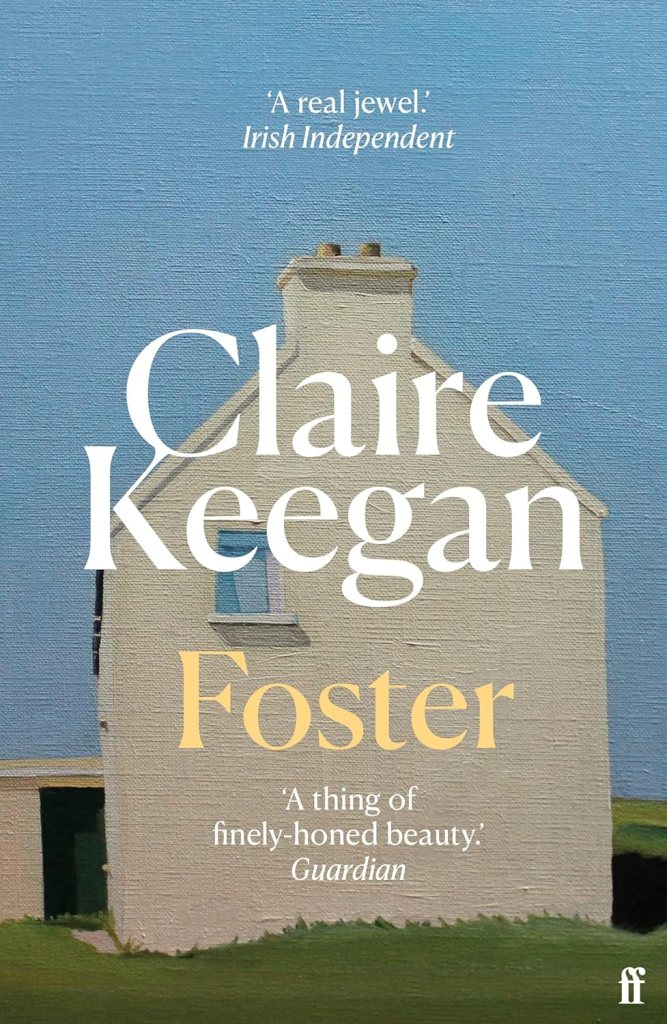
“The wind is high and hoarse in the trees, tearing fretfully though the high boughs…..A big loose hound whose coat is littered with the shadows of the trees lets out a few rough, half-hearted barks…..The presence of a black and white cat moves on the window ledge.” This spare, poetical prose sometimes sounds incongruous, too mature in the thoughts of the young girl narrating this story, unusually observant as she is. But does this really matter? Recounted in the present tense to give a sense of immediacy, this is one of those simple tales which hang on the subtle way in which the facts are revealed.
In the rural Wexford of southeast Ireland during the early 1980s (as we glean from references to the IRA hunger strike in the Maze Prison), a girl – whose name we are never told – is fostered with a farming couple, the Kinsellas, to ease the burden on her heavily pregnant mother. Home life sounds chaotic, since her mother already has to care for at least four children, and do more than her fair share of running the farm, with a husband who clearly drinks away what money there is, leaving too little to pay for the hay to be cut, gambles away a red Shorthorn cow, and casually accepts handouts of potatoes, rhubarb and “the odd bob” sent to his wife. His callousness is revealed when he forgets to unload the girl’s luggage as he drives away, but never seems to make any move to remedy his error.
The Kinsellas could not be more different. Working hard in quiet cooperation, they are keeping at bay a suppressed grief which the girl only discovers after some weeks, from a neighbour’s gossip. Yet although the girl’s presence can only enhance their sense of loss, they still give her the care and attention which she has lacked, so that she blossoms and develops in the space of a few weeks. Suddenly, it becomes clear, as it would to a child with little sense of time passing over a long summer holiday, that the school year is about to start, her mother has given birth and she must return to her old life. The sense of belonging and the affection which have grown make the parting all the harder, on both sides. As is the case with Claire Keegan’s novellas, the ending is ambiguous, leaving the reader to reflect on what happens next. Yet it seems that the girl has gained some permanent benefit from the experience, as perhaps the Kinsellas have as well.

Much of the emotion in this book is implied, together with the way in which observations are used to reveal the characters’ lives and the rural setting, laced with the Irish turn of phrase in the dialogues. As John Kinsella observes, “You don’t have to say anything. Always remember that as a thing you need never do. Many’s a man lost much just because he missed a perfect opportunity to say nothing”.
This novella has been made into the film “The Quiet Girl” which has also been highly praised.
 Antenna Reviews